
Sage Potash's Strategic Financing and Path to Production: A Cautious Bull Case
Sage Potash (SAGE.V) has emerged as a compelling player in the U.S. potash sector, leveraging a combination of aggressive financing, federal grants, and favorable geology to advance its Sage Plain Potash Project in Utah. The company's recent capital-raising efforts and preliminary economic assessment (PEA) suggest a high-conviction bet on domestic potash production, but investors must weigh the risks of speculative resource estimates and regulatory hurdles.
Strategic Financing: Fueling the Path to Production
Sage Potash has executed a series of well-timed financing rounds in late 2025, raising $11.487 million in the first tranche of a $14 million private placement by December 23. This upsizing-from an initial $7 million target to $14 million-reflects strong investor demand and underscores the company's ability to secure capital for critical project milestones. Proceeds are earmarked for drilling, core analysis, and engineering reviews, all aligned with recommendations from RESPEC LLC, the firm behind the PEA.
The company's financial flexibility is further bolstered by a $14 million USDA grant under the Fertilizer Product Expansion Program. This federal support is pivotal, as it not only reduces capital outlays but also aligns with the U.S. government's push to classify potash as a critical mineral-a move that could streamline permitting and attract additional subsidies according to NASDAQ.
Project Economics: A High-Grade, High-Return Proposition
The PEA, filed in November 2025, paints an optimistic picture: an after-tax NPV of $502 million and an IRR of 39%. These metrics are underpinned by a 298 million metric tonne inferred resource base with 42.1% KCl and low insolubles, making it one of the highest-grade potash deposits in North America. 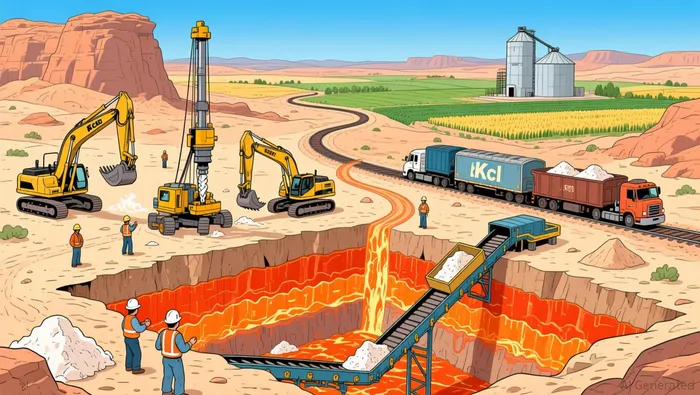 The project's proximity to agricultural markets in the Pacific Northwest also offers a transportation cost advantage, a critical edge in a commodity-driven sector.
However, the PEA's reliance on inferred resources-a category that lacks the confidence of measured or indicated resources-introduces execution risk. As noted in the technical report, these estimates are speculative and require further drilling and metallurgical testing to confirm economic viability.
Permitting and Technical Challenges: Navigating a Complex Landscape
Sage Potash's Utah project is progressing through advanced permitting and engineering phases, but challenges remain. The project spans private, state, and federal lands, necessitating coordination with multiple regulatory bodies. While the PEA highlights no mitigation requirements for environmental or cultural studies, delays in securing permits for additional exploration wells could disrupt timelines.
Technically, the project relies on solution mining-a method that involves injecting brine to dissolve potash and recover it via evaporation. This approach is capital-efficient and environmentally favorable compared to conventional mining, but its success hinges on precise brine chemistry and recovery rates. RESPEC's involvement adds credibility, but unanticipated technical hurdles-such as lower-than-expected dissolution rates-could inflate costs according to RESPEC.
Execution Risks: Balancing Optimism with Caution
While Sage Potash's financial and strategic positioning is robust, investors should remain vigilant. The company's post-December 2025 cash reserves are not explicitly disclosed, though the $14 million in financing and USDA grant suggest adequate liquidity for near-term activities. However, the path to a bankable feasibility study (BFS) and eventual production will require further capital, which may test market confidence if results from drilling or engineering reviews fall short of expectations.
Additionally, the project's success depends on maintaining federal and state support. The recent critical mineral designation for potash is a tailwind, but policy shifts or budget constraints could impact future grant availability.
Conclusion: A High-Risk, High-Reward Play
Sage Potash's Utah project represents a bold attempt to establish a domestic potash supply chain in a sector dominated by imports. The company's strategic financing, federal backing, and high-grade resource base create a compelling narrative. However, the speculative nature of inferred resources, permitting complexities, and technical uncertainties mean this is not a low-risk investment. For investors with a high tolerance for volatility and a long-term horizon, Sage Potash offers a unique opportunity to capitalize on the U.S.'s push for mineral self-sufficiency.






Comentarios
Aún no hay comentarios