
Saga Metals' Radar Project: A Strategic Pathway to Becoming a Major North American Supplier of Critical Minerals
In an era defined by energy transition and geopolitical uncertainty, critical minerals like titanium and vanadium have emerged as linchpins of industrial and national security. SagaSAGA-- Metals' Radar Project in Labrador, Canada, is positioning itself as a pivotal player in this high-stakes arena. By targeting vanadiferous titanomagnetite (VTM) deposits-rich in titanium, vanadium, and iron-the project aligns with surging global demand and North America's urgent need to diversify its supply chains. With recent exploration milestones and a robust financial strategy, the Radar Project is not just a mining venture but a strategic investment in the future of critical minerals.
A Geologically Promising Foundation
The Radar Project spans 24,175 hectares in Labrador, centered on the Dykes River intrusive complex, a 160 km² geological formation with oxide layering extending over 20 km of strike length according to recent reports. Recent drilling at the Trapper Zone has confirmed extensive vanadiferous titanomagnetite mineralization, with semi-massive to massive cumulate oxides intersected in multiple drill holes. 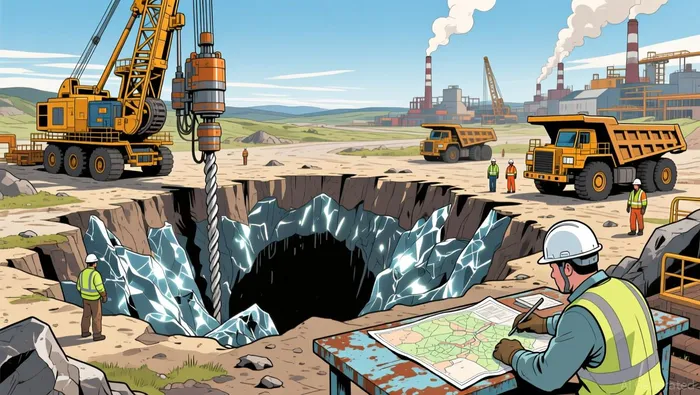 For instance, Phase 2 drilling in Trapper South included four diamond drill holes totaling 977 meters, revealing continuous rhythmic oxide layering. These findings validate a 3+ km magnetic anomaly and underscore the project's potential to host a large, economically viable deposit.
The project's geological analogs-such as China's Panzhihua, South Africa's Bushveld, and Norway's Tellnes-further bolster its strategic appeal. Initial metallurgical testing has also confirmed the feasibility of recovering vanadium alongside titanium, adding value to the project's output. Such dual recovery is rare and positions Saga to capitalize on both the titanium and vanadium markets, which are expanding due to their roles in advanced batteries, aerospace alloys, and steelmaking.
Strategic Significance in a Geopolitical Context
The urgency of securing domestic sources of critical minerals has never been higher. The United States imports 100% of 12 critical minerals and over 50% of 29 others. China's dominance in processing and refining these materials has prompted a global shift toward supply chain diversification. In 2025, the U.S. and Australia signed a $1 billion Critical Minerals Framework Agreement, while the U.S. and Japan pledged joint investments in mineral projects. These initiatives highlight the geopolitical imperative to reduce reliance on single-source suppliers.
Saga's Radar Project is uniquely positioned to address this need. Located in Canada-a stable, resource-rich jurisdiction with strong infrastructure-the project benefits from all-season road access, a nearby deep-water port, and hydroelectric power according to company data. These logistical advantages reduce capital and operational costs, making the Radar Project a compelling candidate for large-scale development. Moreover, its proximity to North American markets aligns with U.S. and Canadian policies aimed at reshoring critical mineral production. The One Big Beautiful Bill Act (OBBBA) and streamlined permitting processes further enhance the project's viability in a regulatory environment increasingly favorable to domestic producers.
Market Dynamics and Financial Momentum
The demand for titanium and vanadium is accelerating. Titanium is essential for aerospace and defense applications, while vanadium's role in redox flow batteries-a key technology for renewable energy storage-is gaining traction. According to the International Energy Agency (IEA), global demand for critical minerals could grow by 500% by 2050. Saga's focus on these metals positions it to benefit from this growth, particularly as governments and industries prioritize decarbonization and energy security.
Saga has demonstrated strong momentum. In late 2025, the company completed a $6 million brokered LIFE Offering, its largest capital raise to date. This funding supports a 15,000-meter drill program in 2026, aimed at establishing a maiden mineral resource estimate. The program will focus on confirming grade continuity over a 3 km strike length, determining oxide layering widths, and integrating structural data from prior drilling according to company reports. Such a resource estimate is critical for attracting further investment and advancing the project toward feasibility studies.
Saga's scalability is another strength. The Trapper Zone's 20 km strike length and the Hawkeye Zone's 300–400 m mineralized sequences suggest significant upside potential. The company's phased approach-combining drilling, metallurgical testing, and infrastructure planning-ensures a disciplined path to development. With preliminary metallurgical insights already confirming favorable processing characteristics, Saga is well-positioned to transition from exploration to production.
A Strategic Investment Thesis
Saga Metals' Radar Project embodies the intersection of geological promise, geopolitical necessity, and market demand. By targeting a deposit comparable to global benchmarks and leveraging Canada's infrastructure and regulatory environment, the company is addressing a critical gap in North America's mineral supply chains. The project's dual recovery of titanium and vanadium, combined with its strategic location and robust funding, strengthens its appeal to investors seeking exposure to the critical minerals boom.
As the world races to decouple from unstable supply chains and accelerate the energy transition, Saga's Radar Project stands out as a rare opportunity to invest in a resource that is not only economically viable but also geopolitically essential. With exploration milestones already achieved and a clear roadmap for 2026, the project is poised to become a cornerstone of North America's critical minerals strategy.







Comentarios
Aún no hay comentarios