
Saab's Strategic Expansion and the Ukraine Gripen Deal: A Catalyst for Long-Term Growth in Defense Manufacturing
Production Scalability: From Incremental Growth to Industrial Transformation
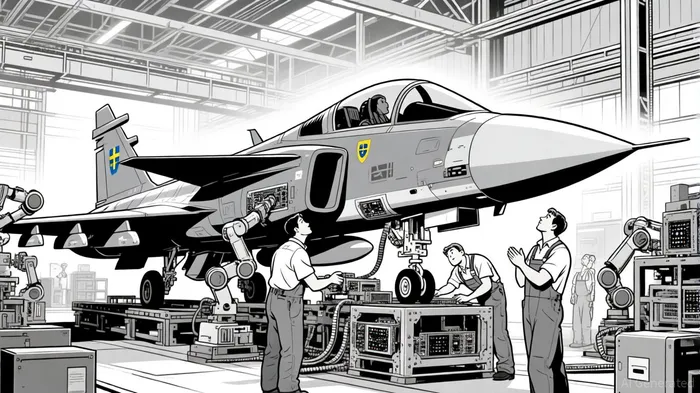
According to a Breaking Defense report, Saab's Gripen E/F program is currently ramping up to an annual production rate of 20–30 units, a significant increase from earlier output levels. However, the proposed Ukraine deal-potentially involving 100–150 aircraft-demands a sustained production capacity that could strain current capabilities. The first deliveries to Ukraine are expected in about three years, with a gradual rollout over a 10–15 year timeline, the report adds. This phased approach underscores the need for Saab to expand its manufacturing infrastructure in Linköping, including investments in automation, workforce training, and supplier coordination.
The company's ability to scale will hinge on its supply chain. While Saab has historically leveraged a distributed network of European suppliers, the Ukraine deal necessitates a more robust and localized industrial base. For instance, Ukraine's participation in pilot training and maintenance programs could reduce dependency on external logistics, creating a hybrid production model that blends Swedish engineering with Ukrainian operational expertise, as the Breaking Defense piece suggests.
Geopolitical Positioning: A Strategic Counterbalance to Russian Aggression
The Ukraine deal is not merely a commercial transaction but a geopolitical statement. By aligning with Kyiv, Saab is embedding itself in a broader European security architecture aimed at countering Russian influence. As stated by Swedish Prime Minister Ulf Kristersson, the agreement emphasizes "long-term collaboration" that extends beyond aircraft procurement to include technology transfer, joint R&D, and industrial co-development. This partnership mirrors Saab's growing influence in Germany, where it is set to secure a €1.2 billion Eurofighter upgrade contract in collaboration with Northrop Grumman, according to a Seeking Alpha report.
The strategic value of the Gripen E-equipped with a General Electric F414G engine, advanced electronic warfare systems, and short-runway operability-aligns with Ukraine's wartime needs and European allies' modernization goals, as noted in an AirDataNews report. By positioning the Gripen E as a versatile, cost-effective alternative to Western fourth-generation fighters, Saab is carving out a niche in a market increasingly prioritizing agility and affordability.
Financial and R&D Commitments: A Mixed Picture
While specific 2025 R&D figures for the Gripen E/F program remain undisclosed, Saab's recent Thai contract-valued at $550 million for four aircraft-demonstrates its financial commitment to platform development, as reported in a Breaking Defense article. This deal, which includes technology transfers and industrial offsets, provides critical funding for incremental upgrades, such as enhanced sensor integration and AI-driven mission systems. However, the absence of detailed R&D budgets raises questions about how Saab will balance innovation with the demands of large-scale production.
Production bottlenecks, particularly in engine and avionics supply chains, remain a concern. The F414G engine, sourced from General Electric, is a known constraint in global fighter production, and Saab's reliance on this component could delay timelines if demand outpaces supply, the earlier report notes. To mitigate this, the company may need to diversify its engine supplier base or invest in in-house manufacturing capabilities-a costly but necessary step for long-term scalability.
Conclusion: A High-Stakes Bet on Geopolitical Stability
Saab's Ukraine deal is a high-stakes bet on the durability of European security alliances and its own industrial adaptability. While the company's production capacity and supply chain are being tested, the strategic benefits-ranging from geopolitical influence to long-term revenue streams-position it as a key beneficiary of the post-2024 defense landscape. For investors, the critical question is whether Saab can maintain its technological edge while scaling production without compromising quality. If successful, the Gripen E program could become a cornerstone of Saab's growth, transforming it from a niche defense manufacturer into a global aerospace leader.







Comentarios
Aún no hay comentarios