
Ryvyl's Q1 Earnings Snapshot: A Catalyst for Long-Term Growth or a Temporary Blip?
The cruise industry’s post-pandemic rebound has been nothing short of remarkable, but few companies have captured the momentum like VikingVIK-- Holdings Ltd (formerly Ryvyl). Its Q1 2025 earnings report—a mix of record passenger demand, margin expansion, and strategic fleet investments—has investors asking: Is this a sign of sustained growth, or merely a fleeting tailwind? Let’s dissect the numbers, the industry landscape, and what it means for investors.
The Earnings Surge: A Foundation of Strength or a One-Time Boost?
Viking’s Q1 results were unequivocally strong. Revenue soared to $897.1 million, a 24.9% year-over-year jump, driven by a 14.9% increase in Capacity Passenger Cruise Days (PCDs) and a 7.1% rise in Net Yield. Occupancy hit 94.5%, and 92% of 2025 Core Product capacity was sold by early May—a staggering figure signaling demand resilience. Even the net loss narrowed sharply to $105.5 million, thanks to operational improvements and the absence of a $330 million one-time charge from 2024.
But here’s the catch: While revenue growth and margin improvements are encouraging, the stock dipped post-earnings after passenger counts fell short of some analyst expectations. This underscores a critical question: Can Viking sustain its growth trajectory amid macroeconomic headwinds, or is the cruise industry’s recovery vulnerable to economic volatility?
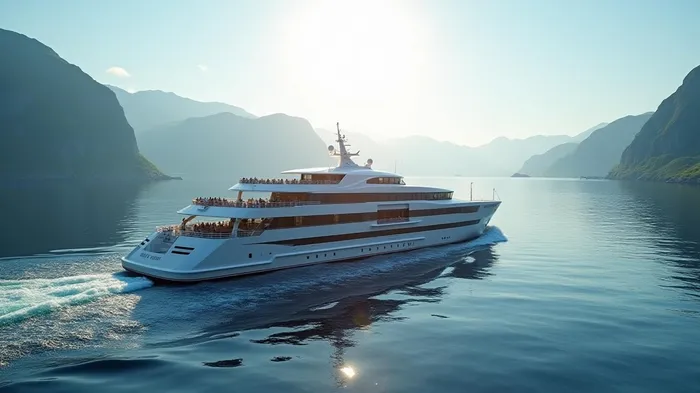
Sector Tailwinds: A Market in Overdrive
The cruise industry’s Q1 performance offers context. Global passenger numbers are projected to hit 37.7 million in 2025, surpassing pre-pandemic levels, while revenue is on track for a 12.9% CAGR through 2030. Key trends favor Viking:
- Demand Resilience: Even as consumer confidence wavers, cancellation rates remain stable, and 76% of travelers now prioritize transparent pricing—a model Viking has embraced.
- Strategic Pricing Power: Competitors like Royal Caribbean and Carnival are raising fares, but Viking’s focus on long booking windows (92% of 2025 capacity sold by May) and differentiated itineraries gives it pricing leverage.
- Fleet Innovation: Viking’s hydrogen-powered Libra (2026) and expanded fleet (including two new ocean ships by 2033) position it to capitalize on the industry’s shift toward sustainability and premium experiences.
Competitive Edge: Where Viking Stands
Viking isn’t just keeping pace—it’s redefining the market. Unlike mass-market competitors, it targets affluent travelers seeking cultural immersion and small-ship intimacy. This niche strategy has paid off:
- Premium Pricing: Its Net Yield of $544 outpaces peer averages, reflecting higher spending per passenger.
- Loyalty-Driven Sales: 86% of bookings come from repeat customers, a testament to brand stickiness.
- Balance Sheet Fortitude: With $2.8 billion in cash and a net leverage ratio dropping to 2.0x, Viking has the financial flexibility to invest in new ships and sustainability initiatives without overleveraging.
Valuation: Is the Market Pricing in Success?
Critics argue Viking’s valuation is stretched given its net loss. But earnings aren’t the only metric here. Consider:
- Advance Bookings: $5.5 billion booked for 2025 (up 21% year-on-year) and $2.7 billion for 2026 (up 11%) provide a visibility wall of cash.
- Capacity Growth: 2025 capacity is up 12%, with 2026 expected to rise another 8%. This disciplined expansion aligns with demand without overextending.
- Margin Trajectory: Adjusted EBITDA surged $77.3 million compared to Q1 2024, signaling scalability.
While Viking’s P/S ratio of ~3x may seem high, it’s justified if revenue growth persists. For context, industry peers like Royal Caribbean trade at ~3.5x forward P/S, and Viking’s niche positioning could warrant a premium.
The Risks: Can Viking Navigate the Storm?
No investment is risk-free. Key concerns include:
1. Economic Sensitivity: Cruise demand is cyclical. A recession could crimp discretionary spending.
2. Cost Pressures: Fuel prices and tariffs remain volatile, though Viking’s fleet expansion (reducing fixed-cost per PCD) mitigates this.
3. Execution Risk: Delivering the hydrogen-powered Libra and new ships on time is critical to maintaining momentum.
The Bottom Line: Invest Now, or Wait for a Pullback?
The data paints a compelling picture. Viking’s Q1 results are no blip—they’re a sign of structural growth fueled by:
- A premium brand in a booming industry.
- A fortress balance sheet enabling strategic bets.
- Unmatched advance bookings that reduce earnings uncertainty.
While short-term volatility is inevitable, the long-term story is clear: Viking is positioned to capitalize on cruise travel’s renaissance. For investors with a 3–5 year horizon, this is a buy—especially if the stock dips further on near-term noise.
The question isn’t whether Viking’s Q1 was a fluke—it’s whether investors will recognize this as a turning point. For now, the answer lies on the open seas.





Comentarios
Aún no hay comentarios