
Ryanair's Ticket Price Recovery: Strategic Implications for the Low-Cost Airline Sector
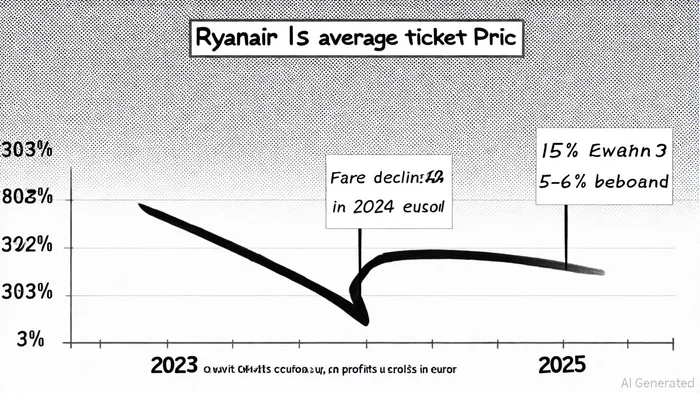
Ryanair's recent financial performance and strategic recalibration offer a compelling case study for investors assessing the resilience of low-cost carriers in a post-pandemic aviation landscape. The airline's 2024 results—marked by a 15% decline in average fares and a 16% drop in annual profits—underscore the fragility of its cost-driven model amid rising operational pressures[1]. Yet, its Q3 2025 profit surge to €149 million, driven by a 9% traffic increase and strong holiday bookings, signals a tentative stabilization[2]. This duality—of setbacks and partial recovery—raises critical questions about the broader sector's ability to adapt to shifting demand, inflationary pressures, and regulatory headwinds.
Strategic Shifts and Cost Leadership
Ryanair's response to 2024's challenges has been a recalibration of its growth strategy. While the airline historically prioritized route expansion and ultra-low fares, it now emphasizes profitability and operational efficiency. CEO Michael O'Leary's acknowledgment that the 2025 fare increase of 4–6% will only partially offset the 2024 decline—leaving prices 2% below 2023 levels—reflects a pragmatic acceptance of constrained pricing power[3]. This shift is not merely reactive but strategic: the airline is now targeting markets with favorable regulatory environments, such as Sweden and Poland, while scaling back in high-tax regions like the UK and Germany[4].
The airline's cost leadership remains its core competitive advantage. By operating a single aircraft type (Boeing 737 MAX), leveraging secondary airports, and maximizing ancillary revenue, RyanairRYAAY-- maintains unit costs roughly half those of its peers[1]. This model, honed during the pandemic, has allowed it to outperform rivals like easyJet in both cost efficiency and route flexibility. However, recent Boeing delivery delays have constrained capacity expansion, limiting its ability to capitalize on summer 2025 demand surges[3].
Sector-Wide Implications
Ryanair's trajectory highlights systemic challenges for low-cost carriers. The 2024 fare declines were driven by a combination of soft demand and aggressive competition, particularly in short-haul routes. While the airline's summer 2025 fare hike—projected at 5–6%—is a response to constrained supply, it also signals a sector-wide recalibration. Competitors must now balance fare competitiveness with margin preservation, a tightrope walk exacerbated by rising fuel costs (despite Ryanair's 85% hedged fuel needs at $79/barrel) and labor expenses[4].
For investors, Ryanair's strategic pivot offers a blueprint for navigating these pressures. Its focus on profitability over growth, coupled with a robust balance sheet (€600 million in net cash), positions it to weather near-term volatility. Yet, the broader sector's ability to replicate this model remains uncertain. Rivals lacking Ryanair's cost discipline or regulatory agility may struggle to offset fare erosion, particularly in markets with less favorable tax regimes.
Conclusion
Ryanair's 2025 fare recovery, though modest, underscores its enduring influence as a bellwether for the low-cost airline sector. Its strategic emphasis on cost optimization, route rationalization, and regulatory arbitrage provides a template for navigating a high-cost environment. However, the airline's challenges—delivery delays, fare pressure, and demand volatility—also highlight the sector's vulnerabilities. For investors, the key takeaway is clear: in an era of constrained pricing power, operational discipline and financial flexibility will separate survivors from casualties. Ryanair's path forward, while not without risks, reaffirms its role as a leader in redefining the economics of low-cost aviation.





Comentarios
Aún no hay comentarios