
RWE's Resilient Outlook Amid Q1 Headwinds: A Buy Signal for Renewable Growth?
Is RWE’s recent stumble a buying opportunity? The German energy giant’s Q1 2025 results revealed a 59% drop in net profit to €498 million, driven by unfavorable wind conditions and a sharp decline in trading performance. Yet, management reaffirmed its full-year guidance and proposed a dividend hike, signaling unwavering confidence in its long-term renewable growth story. For investors weighing near-term turbulence against the energy transition’s irreversible momentum, RWE presents a compelling contrarian opportunity.
Q1 Stumbles: Weather and Trading Headwinds
RWE’s Q1 2025 results were a mixed bag, with adjusted EBITDA falling 24% year-on-year to €1.3 billion. The underperformance stemmed from two key factors:
1. Weather-Related Volatility: Offshore wind EBITDA plummeted 30% to €380 million due to weaker-than-expected wind speeds and lower hedged prices.
2. Trading Slump: The Supply & Trading division’s EBITDA collapsed 84% to €40 million, reflecting a challenging market environment and reduced risk-taking.
These headwinds, however, were partially offset by strong performance in onshore wind and solar, where EBITDA surged 45% to €496 million, fueled by U.S. market expansion and hedged price advantages.
The Silver Lining: Renewable Projects on Track
While short-term profits took a hit, RWE’s pipeline of large-scale renewable projects remains its crown jewel. Key developments include:
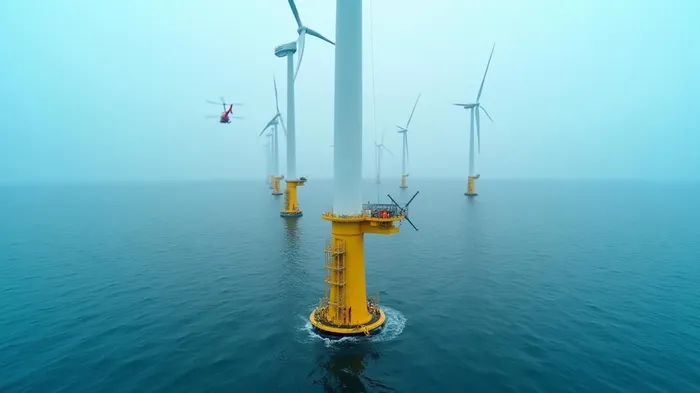
- Offshore Wind:
- Sofia (UK): 79 of 100 foundations installed, with first power expected in H2 2025.
- Thor (Denmark): Construction began, with 5 of 72 monopiles installed.
- Battery Storage: A 220 MW system commissioned in Germany, with 1.4 GW under construction across Europe.
- Pipeline Momentum: 10.6 GW of capacity under construction, including equity sell-downs in Nordseecluster (Germany) and Thor (Denmark), which could reduce net debt while retaining long-term cash flows.
By 2027, these projects are expected to generate €1.3–1.7 billion in annual offshore wind EBITDA, a critical lever to offset current volatility.
Dividend Hike and Buyback: Confidence in Cash Flow
Despite Q1’s profit slump, RWE’s Board reaffirmed its 2025 dividend target of €1.20 per share, a 10% increase from 2024’s €1.10. This decision, subject to shareholder approval in April 2025, underscores management’s belief that renewable growth will stabilize margins over time.
The company also remains on track with its €1.5 billion share buyback, with the first tranche of €500 million to conclude by May 2025. These moves signal:
- Financial discipline: RWE has tightened its investment criteria, reducing its 2025–2030 capex plan to €35 billion (from €45 billion) and raising its hurdle rate for new projects.
- Shareholder focus: Returning cash to investors amid near-term uncertainty.
Debt Dynamics: A Manageable Trade-Off
RWE’s net debt surged to €15.9 billion as of March 2025, up from €11.2 billion in December 2024, primarily due to renewable investments and hedging timing. However, its leverage ratio (net debt/adjusted EBITDA) remains within a 2.5–3.0x target range, a deliberate choice to fund growth.
The debt load is offset by:
1. Long-term contracts: Over 95% of onshore/solar projects are backed by offtake agreements.
2. Equity partnerships: Selling 49% stakes in offshore projects reduces upfront capital needs while retaining operational control.
Contrarian Case: Short-Term Pain vs. Long-Term Upside
For investors, RWE’s Q1 stumble presents a strategic entry point into one of Europe’s leading renewable energy players. Key arguments for a long position:
1. Renewable Transition is Irreversible
The global shift to net-zero energy systems remains unstoppable. RWE’s 10.6 GW under construction and 2030 target of €4 per share in adjusted net income align with this secular trend.
2. Project Execution Excellence
RWE’s track record of delivering large-scale projects—evident in Sofia’s progress—minimizes execution risk. Partnerships like its green hydrogen agreement with TotalEnergies further diversify revenue streams.
3. Valuation Attraction
At €32.28 per share (May 14, 2025), RWE trades at a 12.5x EV/2025E EBITDA multiple, below its five-year average of 15x. The dividend yield of 3.7% (based on €1.20 payout) adds further safety.
4. Dividend as a Safety Net
The proposed dividend hike—despite Q1’s profit drop—sends a strong signal about management’s confidence in future cash flows.
Risks to Consider
- Regulatory Delays: Permitting hurdles in the U.S. (e.g., offshore wind) could delay project timelines.
- Commodity Volatility: Natural gas prices and trading performance remain unpredictable.
Conclusion: Buy the Dip in a Renewable Giant
RWE’s Q1 stumble is a temporary setback in a decade-long journey to dominate renewable energy infrastructure. With a robust project pipeline, disciplined capital allocation, and a dividend policy that rewards shareholders through thick and thin, this is a buy signal for investors with a 3–5 year horizon.
The energy transition is not a sprint—it’s a marathon. RWE is positioned to win the race.







Comentarios
Aún no hay comentarios