
RWAs Enter Solana DeFi: Institutional-Grade Tokenization and the S-Token Revolution
The tokenization of real-world assets (RWAs) is reshaping the financial landscape, and SolanaSOL-- is emerging as a pivotal player in this transformation. By mid-2025, Solana's RWA ecosystem had surpassed $656 million in tokenized assets, growing at a blistering 260% year-to-date[1]. This surge is driven by a confluence of technical advantages, institutional partnerships, and innovative frameworks like Splyce and Chintai's S-Tokens, which are democratizing access to institutional-grade yields while navigating regulatory complexities.
The S-Token Breakthrough: Bridging Institutional and Retail Markets
S-Tokens, introduced by Splyce and Chintai, represent a novel approach to RWA tokenization. These tokens act as indirect exposure vehicles to institutional-grade assets, such as Chintai's tokenized real estate funds, without requiring retail investors to hold the underlying securities[2]. Instead, S-Tokens operate via a compliant loan structure, where the token's value mirrors the performance of the asset while embedding anti-money laundering (AML) and know-your-customer (KYC) checks at the deposit stage[3]. This model eliminates traditional barriers—such as high minimum investments and cumbersome onboarding—enabling retail users to access institutional opportunities through familiar Web3 wallets[4].
The first S-Token iteration, the Kin Fund, tokenizes real estate investments managed by Kin Capital, offering a tangible example of how Solana's ecosystem is expanding beyond speculative crypto assets into tangible, yield-generating RWAs[5]. By leveraging Solana's high throughput (50,000+ transactions per second) and near-zero fees, S-Tokens also support DeFi strategies like liquidity provision and lending, blending the efficiency of blockchain with the stability of traditional assets[6].
Solana's Institutional-Grade Infrastructure
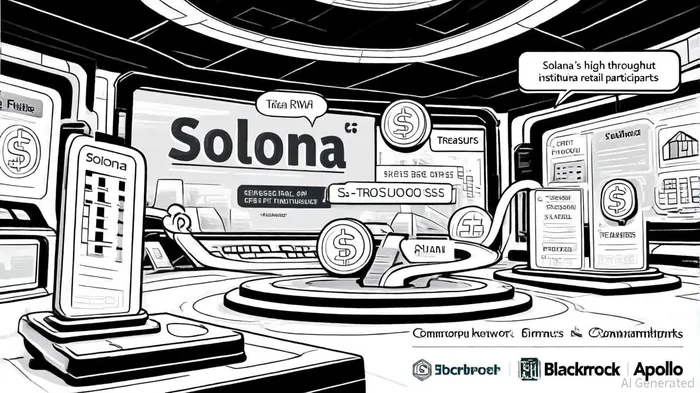
Solana's rise as an RWA hub is underpinned by its technical architecture and strategic partnerships. The network's performance metrics—sub-400ms finality, low fees, and scalability—make it ideal for processing high-volume tokenized assets, from U.S. Treasuries to private credit funds[7]. For instance, BlackRock's BUIDL fund, a tokenized Treasury product, and Apollo's $ACRED credit fund, distributed via WormholeW--, highlight how major institutions are leveraging Solana's infrastructure for institutional-grade tokenization[8].
Compliance is another cornerstone. RedStone's RWA Oracle, now live on Solana, provides institutional-grade price feeds for tokenized assets, ensuring seamless integration with DeFi protocols while adhering to regulatory standards[9]. This infrastructure is critical for attracting traditional players, as it addresses the SEC's emphasis on compliance with federal securities laws[10].
The Broader RWA Ecosystem: Growth and Diversification
Solana's RWA ecosystem is notNOT-- limited to financial instruments. Platforms like Parcl Protocol and Homebase are tokenizing real estate and commodities, enabling fractional ownership and geographic market exposure[11]. Meanwhile, yield-bearing stablecoins and credit products are expanding the network's utility, with Ondo Finance's USDY and OUSG tokens accounting for ~60% of Solana's non-stablecoin RWA market[12].
Institutional confidence is further reinforced by coordinated ETF filings from firms like Franklin Templeton and Grayscale, signaling potential regulatory clarity by late 2025[13]. As of July 2025, Solana's RWA TVL ($418 million) had grown 140.6% year-to-date, outpacing Ethereum's 81% expansion[14]. This growth is not just quantitative but qualitative, with tokenized public equities surging from $0 to $48.5 million in value since June 2025[15].
Challenges and the Road Ahead
Despite its momentum, Solana's RWA journey is not without hurdles. U.S. regulatory uncertainty, particularly under the SEC's securities framework, remains a risk, as tokenized assets often require compliance with existing laws that favor accredited investors[16]. However, innovations like S-Tokens—designed to maintain compliance while enabling retail access—demonstrate the ecosystem's adaptability.
Looking ahead, Solana's technical upgrades, such as the Alpenglow and Firedancer updates, aim to enhance network performance and solidify its role as a settlement layer for institutional flows[17]. With over $24 billion in tokenized assets across public blockchains by mid-2025[18], Solana's position as a bridge between traditional finance and DeFi is increasingly hard to ignore.
Conclusion: A New Era for Institutional-Grade Access
The convergence of Solana's technical prowess, institutional partnerships, and innovative frameworks like S-Tokens is redefining RWA tokenization. By democratizing access to institutional-grade yields while maintaining regulatory compliance, Solana is not just expanding DeFi's reach—it's building a financial system where traditional and decentralized markets coexist. For investors, this represents a unique opportunity to participate in a rapidly evolving ecosystem where the lines between Web2 and Web3 are blurring.





Comentarios
Aún no hay comentarios