
Russia's Strategic Shift in Energy Exports: Implications for Global Gas Markets and Energy Transition Plays
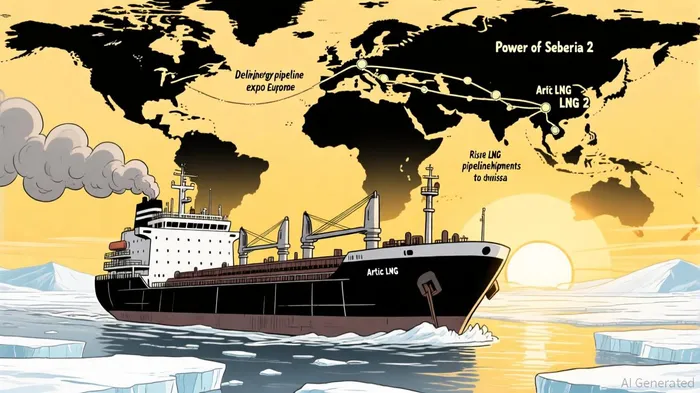
Russia's energy strategy has undergone a seismic shift in 2025, driven by Western sanctions, the war in Ukraine, and the collapse of European demand for its fossil fuels. As pipeline gas exports to Europe plummeted from 140 bcm in 2021 to 27 bcm in 2023, Moscow has pivoted to Asian markets, particularly China and India, to sustain its energy revenues. However, this realignment has exposed structural vulnerabilities in Russia's export infrastructure and raised critical questions for investors assessing long-term risks and opportunities in energy equities and commodities.
Production and Export Trends: A Tale of Two Markets
According to a report by the International Energy Agency (IEA), Russia's gas production in 2025 is projected to reach 690 bcm, a marginal decline from earlier forecasts, but still 13–38% below 2020 levels due to infrastructure constraints and geopolitical pressures [1]. While the Power of Siberia pipeline operates near its design capacity of 38 bcm/year, the delayed Power of Siberia 2 project—expected to add 50 bcm/year—remains mired in negotiations with China, which prioritizes energy diversification over full reliance on Russian gas [2]. Meanwhile, LNG exports to Europe have stabilized at 50% of Russia's LNG shipments in August 2025, but revenues face downward pressure due to discounted pricing and competition from U.S. and Qatari suppliers [3].
The shift to Asia has not fully offset Europe's withdrawal. Infrastructure bottlenecks, including underdeveloped rail and pipeline networks, limit Russia's ability to redirect gas and coal exports eastward. For example, while coal exports to China and India surged in 2024–2025, these markets absorbed only half of the lost European volumes [4]. This imbalance has forced Russia to rely on a “shadow fleet” of sanctioned tankers for oil shipments, a costly and legally precarious workaround that underscores the fragility of its export model [5].
Global Market Responses: Geopolitical Realignment and Energy Transition
The global energy landscape is reshaping in response to Russia's pivot. China, now Russia's largest energy partner, has adopted a cautious approach, balancing Russian imports with investments in domestic shale and LNG from the U.S. and Middle East. This diversification limits Russia's ability to dominate Asian markets, even as Moscow seeks to lock in long-term contracts [6]. Meanwhile, India's oil imports from Russia rose to 1.92 million barrels per day by April 2025, but these purchases are often priced below the $60-per-barrel cap imposed by Western nations, eroding profit margins [7].
The energy transition further complicates the outlook. Global clean energy investment hit $3.3 trillion in 2025, outpacing fossil fuel spending, as the EU's REPowerEU strategy accelerates renewable adoption [8]. LNG is increasingly viewed as a destination fuel, supported by carbon capture technologies and AI-driven grid optimization. For investors, this shift creates opportunities in renewables and nuclear energy—sectors where Russia's role remains limited but could expand through regional partnerships in Central Asia [9].
Investment Risks and Opportunities
For energy equities, the Russian pivot presents a mixed bag. Oil majors like Rosneft and Lukoil have maintained market relevance by securing Asian buyers, but discounted pricing and sanctions-related operational costs have squeezed margins. In contrast, LNG producers face volatility due to infrastructure delays and geopolitical competition. The Arctic LNG 2 project, for instance, has seen production delays attributed to sanctions and a shortage of gas carriers, raising concerns about Russia's ability to meet export targets [10].
On the other hand, the energy transition offers alternative avenues. Small modular reactors (SMRs) and hydrogen technologies are gaining traction, with Russia's state-owned nuclear agency, Rosatom, exploring partnerships in Asia. While these ventures are nascent, they could position Russian firms as facilitators of regional energy security, particularly in markets where fossil fuels still dominate [11].
Equity Market Dynamics and Geopolitical Uncertainties
The Russian equity market, as reflected in the MOEX Russia Index, has shown cautious resilience in Q3 2025 despite geopolitical headwinds. Energy stocks like Gazprom and Rosneft remain key drivers, but their performance is closely tied to commodity prices and sanctions relief. In September 2025, oil and gas revenues fell 23% year-on-year to $7.11 billion, highlighting the sector's vulnerability to global price swings and ruble fluctuations [12].
Investors must also contend with the U.S. LNG industry's looming oversupply, which could drive down global prices and further erode Russian export competitiveness. By 2030, U.S. LNG capacity is projected to account for half of the global supply increase, creating a “glut” that may displace renewables and prolong fossil fuel dependence [13].
Conclusion: Navigating a Fractured Energy Order
Russia's energy strategy in 2025 reflects a desperate but constrained effort to sustain its geopolitical influence amid a fractured global energy order. While Asian markets provide a lifeline, infrastructure limitations, discounted pricing, and the energy transition's momentum pose long-term risks. For investors, the key lies in diversification: hedging against fossil fuel volatility by allocating capital to renewables, nuclear innovation, and AI-driven energy efficiency. As the IEA notes, Russia's gas exports are unlikely to recover pre-2020 levels by 2040, underscoring the need for adaptive, forward-looking investment strategies [14].







Comentarios
Aún no hay comentarios