
Russia's Strategic Use of Crypto in Geopolitical Sabotage: Reshaping Global Investment Risk Profiles Through Regulation and Cybersecurity Threats
In the shadow of Western sanctions and the collapse of traditional financial channels, Russia has weaponized cryptocurrency to sustain its global economic influence and fund geopolitical sabotage. From 2023 to 2025, Moscow's strategic pivot to digital assets has not only circumvented economic pressure but also introduced new layers of risk for global investors. The interplay of regulatory shifts, cybercrime proliferation, and state-backed crypto operations is redefining how markets assess geopolitical instability and financial exposure.
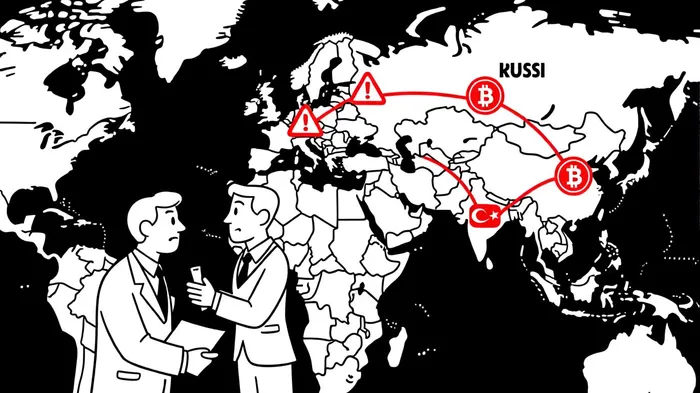
Regulatory Shifts: From Sanctions Evasion to Strategic Adoption
Russia's transformation from crypto skepticism to strategic adoption is a masterclass in regulatory agility. By 2024, the government legalized cryptocurrency for international trade, enabling businesses to settle cross-border transactions in digital assets, according to a RAND analysis. This move was pivotal in sustaining energy exports to China, India, and Turkey, with Russian oil firms reportedly using BitcoinBTC-- and TetherUSDT-- to bypass SWIFT and USD-based systems, as described in an Invezz report. The Central Bank of Russia (CBR) further cemented this shift by launching a national miner registry and legalizing crypto mining in August 2024.
However, this regulatory flexibility is a double-edged sword. While it allows Russia to maintain economic autonomy, it also creates a gray zone where illicit activities thrive. For instance, no-KYC exchanges and sanctions-evasion schemes-such as Garantex's 82% share of global sanctioned crypto volume in 2023-highlight how regulatory loopholes enable dual-use scenarios, according to an NSA press release. Investors must now weigh the risks of funding state-backed operations against the potential for Russia to emerge as a crypto-driven economic power.
Cybersecurity Threats: A New Frontier of Geopolitical Risk
The rise of Russian cybercrime has amplified global investment risks. According to a Kroll report, nearly $1.93 billion was stolen in crypto-related crimes in the first half of the year alone, with ransomware groups like Lockbit and ALPHV/Black Cat dominating the landscape. These groups, often linked to Russian-speaking threat actors, exploit vulnerabilities in critical infrastructure, from energy grids to financial systems. For example, GRU Unit 29155 has deployed destructive malware like WhisperGate, targeting NATO members and global supply chains, as noted by RAND.
The stakes are further elevated by state-tolerated cyber operations. A Polish official revealed in 2025 that GRU agents uncovered in 2023 were "to a high extent" funded via cryptocurrency, as the NSA press release indicates. This blurring of lines between state and criminal actors complicates risk assessments for investors. Sectors like energy, healthcare, and finance-already vulnerable to cyberattacks-now face heightened exposure to geopolitical sabotage, with cascading effects on market stability.
Investment Implications: Navigating a Fractured Financial Landscape
The convergence of crypto regulation and cybersecurity threats is reshaping global investment risk profiles in three key ways:
Currency Diversification and BRICS Integration: Russia's push for a digital ruble and blockchain-based trade networks with BRICS nations challenges the U.S. dollar's dominance, a trend described in the Invezz report. While this could reduce reliance on Western systems, it also fragments global financial infrastructure, creating new corridors for volatility. Investors in emerging markets must monitor how BRICS nations adopt similar strategies, potentially accelerating a shift away from dollar-centric trade.
Supply Chain Vulnerabilities: The 2025 ODNI Threat Assessment underscores Russia's cyber capabilities in disrupting critical infrastructure, as detailed in the Kroll Threat Landscape report. For instance, the exploitation of CVE-2023-42793 in JetBrains TeamCity by SVR actors highlights risks to software supply chains, an issue the NSA has publicly described. Investors in tech and logistics sectors face elevated exposure to operational disruptions, reputational damage, and regulatory scrutiny.
Regulatory Uncertainty and Liquidity Risks: Despite Russia's formalization of crypto mining and trade, regulatory hurdles persist. The blocking of exchanges like BestChange in February 2025 illustrates the government's erratic enforcement of AML/KYC rules, which Kroll also documents. Such instability deters institutional adoption and raises questions about the liquidity of large-scale crypto transactions, particularly in volatile markets.
Conclusion: A Call for Vigilance in a Decentralized World
Russia's strategic use of cryptocurrency is a harbinger of a new era in geopolitical finance. While digital assets offer a lifeline for sanctioned economies, they also amplify risks through cyber-enabled sabotage and regulatory arbitrage. For investors, the lesson is clear: diversification must now account for both macroeconomic trends and micro-level cyber threats. The days of viewing crypto as a purely speculative asset are over; it is now a geopolitical tool with real-world consequences.
As the lines between statecraft and financial innovation blur, the ability to navigate this landscape will separate resilient portfolios from those left vulnerable to the next wave of digital disruption.






Comentarios
Aún no hay comentarios