
Russia's Revised LNG Export Outlook and Market Implications: Strategic Risk Reassessment and Alternative Energy Opportunities
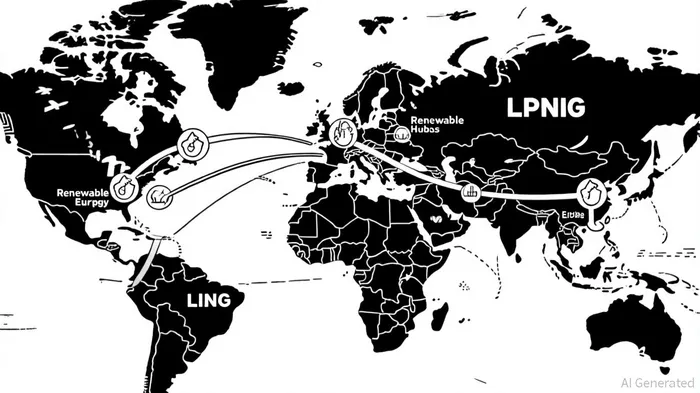
Russia's liquefied natural gas (LNG) export strategy has undergone a dramatic realignment since 2022, driven by geopolitical tensions, Western sanctions, and shifting global demand. With European imports of Russian LNG declining from 22% of EU imports in Q1 2021 to 14% in Q2 2025[1], Moscow has pivoted decisively toward Asian markets. By January–August 2025, 9.5 million metric tons of Russian LNG were shipped to Asia, compared to 9.2 million tons to Europe[1]. This shift, however, is not without challenges. U.S. sanctions targeting medium-tonnage LNG plants like KSNG Portovaya and Cryogas-Vysotsk are projected to reduce Russia's LNG output by 5% in 2025[4], while infrastructure bottlenecks in Arctic projects like Arctic LNG 2 delay capacity expansions[5].
Geopolitical Reorientation and Market Dynamics
Russia's strategic pivot to Asia is anchored in long-term partnerships, particularly with China. The Power of Siberia 2 pipeline, a 2,600-kilometer project to deliver 50 billion cubic meters of gas annually to northern China, underscores this realignment[2]. While China's domestic gas production has risen to 245 billion cubic meters in 2024 (up from 190 bcm in 2020), its reliance on Russian pipeline gas remains critical for industrial and residential demand[5]. However, China's cautious diversification strategy—balancing domestic shale, LNG imports, and Russian pipeline gas—limits Russia's ability to fully offset lost European revenues[1].
Meanwhile, the U.S. and Qatar are capitalizing on the vacuum left by reduced Russian exports to Europe. U.S. LNG now accounts for 48% of EU imports in 2023[4], while Qatar's expanded capacity positions it as a key supplier to both Europe and Asia. This competition has tightened global LNG markets, with prices stabilizing around $8/MMBtu in 2025[6]. For Russia, the challenge lies in maintaining market share in Asia while navigating infrastructure constraints and geopolitical risks, such as U.S. tariffs on Indian goods aimed at curbing Russian oil imports[3].
Strategic Risk Reassessment in Global Gas Markets
The realignment of Russian LNG exports has triggered a strategic reassessment of risks in global gas markets. Europe's shift from Russian gas has accelerated investments in energy security, with the EU's REPowerEU initiative prioritizing renewables and hydrogen[2]. By 2024, renewables accounted for 46.9% of EU electricity production, up from 38% in 2021[2]. However, the transition is not without hurdles. Green hydrogen projects, for instance, face delays due to high costs and policy uncertainty. Germany and France, once bullish on hydrogen, have scaled back ambitions, with E.On deprioritizing large-scale infrastructure[3].
In Asia, the surge in Russian LNG exports has intensified competition, particularly in China and India. India's imports of Russian oil surged to 1.92 million barrels per day by April 2025, saving an estimated $17 billion since 2022[3]. Yet, this dynamic has introduced volatility into global LNG pricing, complicating Europe's energy transition goals. The EU now faces a dual challenge: securing short-term gas supplies while investing in long-term decarbonization.
Alternative Energy Investment Opportunities
The geopolitical shifts in gas markets have catalyzed alternative energy investments, particularly in Europe. The EU's hydrogen strategy, which aims to produce 10 million tons of renewable hydrogen annually by 2030, is gaining traction. Projects like the Netherlands' large-scale green hydrogen plant, designed to replace Russian gas imports, highlight this pivot[3]. However, progress remains uneven. As of 2025, only 0.92 GW of the 7.1 GW of initially announced electrolysis capacity was realized in 2023[6], underscoring the gap between ambition and execution.
Renewable energy funding has also surged, with 72% of surveyed executives reporting rapid increases in investments in 2024[6]. The EU's Innovation Fund and IPCEI grants are critical in de-risking projects, but challenges persist. For example, Spain and Portugal's 2024 blackout highlighted the need for grid resilience and energy storage solutions[2]. Meanwhile, Russia's domestic renewable energy sector, though nascent, is exploring localized projects like the 10 MW solar plant in Orenburg[7], supported by long-term tariffs and subsidies[7].
Market Implications and Future Outlook
For investors, the revised Russian LNG outlook presents both risks and opportunities. In the short term, volatility in global LNG markets and geopolitical tensions will likely persist, with U.S. and Qatari LNG vying for market share. However, the long-term trajectory points to a decarbonized energy landscape. By 2030, renewables are projected to meet nearly half of global electricity demand[6], while green hydrogen could dominate hard-to-abate sectors like steel and shipping[3].
Russia's ability to sustain its LNG exports to Asia will depend on overcoming infrastructure bottlenecks and geopolitical pressures. For Europe, the transition to renewables and hydrogen remains a work in progress, with policy clarity and cost reductions critical to success. Investors must weigh these dynamics carefully, balancing exposure to traditional energy markets with the growing potential of alternative energy.







Comentarios
Aún no hay comentarios