
Russia's Resilient Inflation Trends and Their Implications for Commodity and EM Equity Investors
Russia's inflation dynamics in September 2025 have confounded expectations, with conflicting data underscoring the complexity of its economic landscape. While the Bank of Russia reported an annual CPI rate of 8.2% as of September 8, according to an AP report, other surveys, including the central bank's macroeconomic survey, projected a lower 6.4% year-on-year rate for the month. This divergence reflects the interplay of short-term price fluctuations-such as seasonal drops in food prices-and persistent structural inflationary pressures. For investors, the September CPI acceleration signals a critical inflection point in Russia's inflation trajectory, with profound implications for commodities and emerging market (EM) equities.
Drivers of Inflation Acceleration: A Multi-Faceted Challenge
The Bank of Russia's September rate cut to 17%-its third in 2025-was a response to easing inflation from 8.79% in July, as reported by AP. Yet, core inflation remains stubbornly high, driven by robust domestic demand and supply-side constraints. Services inflation, at 11.9% year-on-year, was cited by Reuters as a key driver, fueled by rising wages and government spending. Food inflation, though moderated by seasonal declines in vegetable prices (e.g., potatoes down 30% in August, Reuters noted), remains elevated at 10.8%, reflecting global agricultural commodity prices and ruble depreciation. Energy prices, while not explicitly detailed in recent reports, are indirectly influenced by geopolitical tensions and export restrictions, according to a Bank of Russia press release.
The central bank's dilemma is clear: while monetary easing aims to support a slowing wartime economy, fiscal stimulus-such as the 9% budget spending increase to 41.5 trillion roubles-risks prolonging inflation, Reuters warned. Analysts estimate this fiscal expansion could add 0.7–0.8% to 2025 inflation, complicating the Bank of Russia's path to its 4% target by 2026.
Commodity Market Implications: Volatility as the New Normal
Russia's inflationary environment has significant spillovers for global commodities. Energy prices, a cornerstone of the Russian economy, remain volatile despite a World Bank projection of a 17% decline in 2025. Geopolitical risks-such as sanctions and Ukraine war spillovers-threaten to disrupt supply chains, creating upward pressure on oil and gas prices. For investors, this duality presents opportunities in hedging assets like gold, which the World Bank suggested could outperform due to inflationary and policy uncertainties.
Agricultural commodities also face upward risks. Russia's role as a major exporter of wheat and other staples means its domestic food inflation could translate into higher global prices, particularly if ruble weakness persists. Meanwhile, energy-linked metals (e.g., copper) may see mixed signals, as demand from China's post-pandemic recovery clashes with export curbs, according to the Bank of Russia survey.
EM Equity Markets: Divergence and Selectivity
For emerging market equities, Russia's inflation trajectory highlights the growing divergence in global monetary policy. While the Federal Reserve's anticipated rate cuts in 2025 could ease capital flows to EMs, Russia's high real interest rates (17% as of September) create a fragmented landscape. Investors must navigate this divergence carefully: sectors tied to Russia's energy and agricultural exports may benefit from inflation-linked pricing power, while those exposed to ruble depreciation or fiscal drag could underperform.
Moreover, the Bank of Russia's cautious approach to rate cuts-balancing inflation control with economic support-signals a prolonged period of policy uncertainty. This could dampen equity valuations in EMs reliant on Russian capital flows, particularly in Central and Eastern Europe, the World Bank noted. Conversely, EMs with stronger fiscal positions and diversified commodity exports may attract inflows, creating a "winners and losers" scenario.
Conclusion: Navigating Uncertainty with Strategic Positioning
Russia's September 2025 CPI data, though conflicting, underscores a broader narrative: inflation is no longer a transient post-pandemic phenomenon but a structural challenge shaped by geopolitical and monetary forces. For investors, this means prioritizing flexibility and hedging. In commodities, allocations to gold and energy should account for geopolitical volatility. In EM equities, sectoral selectivity-favoring energy and agriculture over cyclical sectors-will be key. As the Bank of Russia's policy path remains uncertain, the ability to adapt to shifting inflation dynamics will define investment success in 2025 and beyond.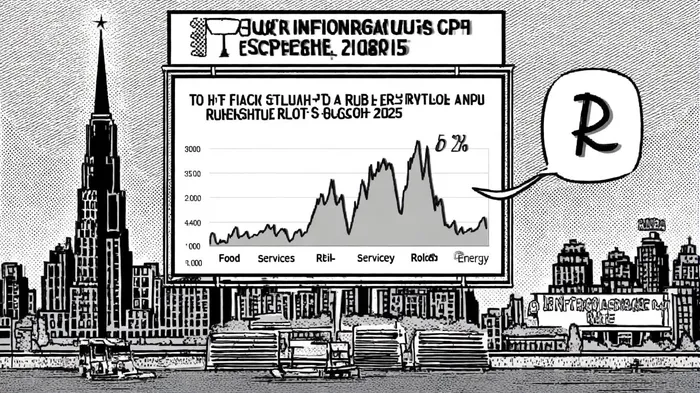







Comentarios
Aún no hay comentarios