
U.S.-Russia Geopolitical Dynamics: Navigating Risks and Opportunities in Commodities and Defense Sectors
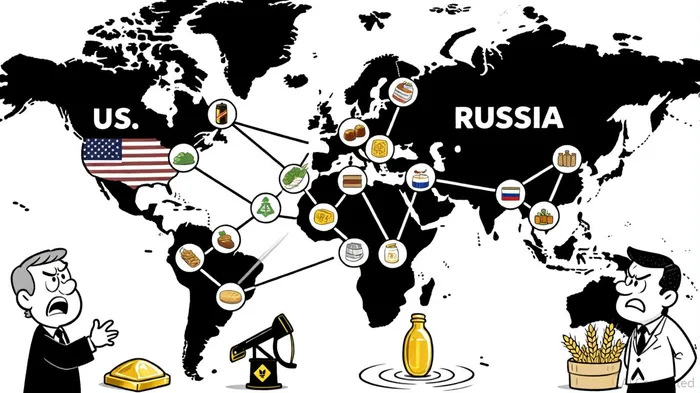
The U.S.-Russia geopolitical landscape in 2025 remains a critical driver of volatility in global markets, with profound implications for commodities and defense sectors. As tensions persist over the Russia-Ukraine conflict and diplomatic summits yield mixed outcomes, investors must assess both risks and opportunities across these asset classes.
Defense Sector: A Geopolitical Tailwind
The defense industry has emerged as a clear beneficiary of heightened geopolitical tensions. The August 15, 2025, summit between former U.S. President Donald Trump and Russian President Vladimir Putin, while failing to resolve the Ukraine conflict, catalyzed discussions on security guarantees, prompting NATO allies to accelerate defense spending, according to a FinancialContent analysis. This surge in demand has directly boosted defense contractors. For instance, Lockheed MartinLMT-- (NYSE: LMT) and Raytheon (NYSE: RTX) reported robust order backlogs, with LMT's stock rising 21.1% in early 2025 following renewed military contracts, as detailed in a MarketClutch analysis. European firms like BAE Systems (LSE: BAESF) and Rheinmetall (ETR: RHMGF) have similarly seen increased revenues, reflecting a global arms race, the FinancialContent analysis observed.
The financial infrastructure supporting the sector has also evolved. The SPADE Defense Index surged 90% since the start of the Russia-Ukraine conflict, outpacing the S&P 500's 40% growth, according to a Defense News report. Defense-focused ETFs have proliferated, with assets under management rising nine-fold to $35 billion as of 2025, underscoring institutional confidence, Defense News reported. Analysts attribute this trend to Russia's 38% defense budget increase in 2024 and broader global militarization, the same Defense News report noted.
Commodities: Volatility as the New Normal
Geopolitical tensions have introduced asymmetric risks and opportunities in commodity markets, particularly for oil, gold, and wheat.
Oil: A Fragile Balance
Crude oil prices in 2025 reflect the interplay of OPEC+ policies, U.S. foreign policy, and supply disruptions. While the Trump administration's delayed tariffs on Chinese and Indian purchases of Russian oil temporarily stabilized prices, the ongoing conflict and potential sanctions on Iran could reignite volatility, according to a TradingNews analysis. The International Energy Agency (IEA) projects an oversupplied market in 2025 due to rising U.S. and Nigerian production, yet geopolitical risks-such as a potential Israel-Iran war-could push prices into the mid-$70s per barrel, TradingNews also noted. Investors must monitor OPEC+ output decisions and regional conflicts as key price drivers.
Gold: The Ultimate Safe Haven
Gold prices have surged to $2,627.60 per ounce in late 2024, driven by central bank purchases and inflationary pressures, according to an Economies article. Emerging markets, including China and India, have increased gold reserves to hedge against U.S. dollar devaluation, with Q1 2025 central bank purchases reaching 243.7 tonnes-24% above the five-year average, per a Kitco report. The Economies article forecasts prices to reach $3,675–$4,000 per ounce by late 2025, fueled by geopolitical uncertainty and dollar weakness.
Wheat: A Mixed Bag
The Russia-Ukraine war has depressed Ukraine's wheat production to a 22-year low for the 2025-26 season, yet both nations have maintained stable exports, according to a GCCoop report. Global wheat prices initially spiked post-2022 invasion but stabilized with the Black Sea Grain Initiative. However, economic factors now dominate demand dynamics, with peace talks potentially reducing shipping costs and easing trade flows, GCCoop observed.
Strategic Implications for Investors
The interplay of geopolitical risks and market fundamentals demands a nuanced approach. In defense, long-term growth appears secure, supported by sustained spending and technological innovation (e.g., drone production in Ukraine, the FinancialContent analysis highlighted). For commodities, diversification is key: while gold offers inflation and geopolitical hedges, oil and wheat require careful timing amid supply-demand imbalances.
Conclusion
U.S.-Russia tensions in 2025 underscore the interconnectedness of geopolitics and markets. Defense stocks and gold present compelling opportunities amid uncertainty, while commodities like oil and wheat require vigilant risk management. As diplomatic outcomes remain unpredictable, investors must prioritize adaptability and leverage data-driven insights to navigate this volatile landscape.





Comentarios
Aún no hay comentarios