
Russia's Exit from the Aircraft Carrier Era: Strategic Shifts and Investment Opportunities in Global Naval Innovation
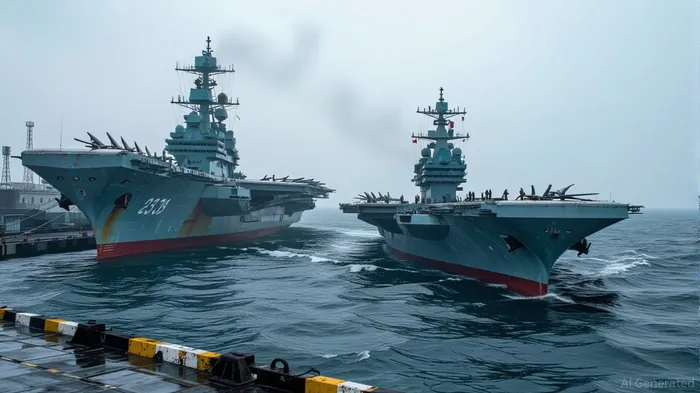
Russia's decision to scrap its sole aircraft carrier, the Admiral Kuznetsov, marks a pivotal moment in global naval strategy. After decades of technical failures, exorbitant maintenance costs, and a strategic pivot toward smaller, unmanned platforms, Moscow is effectively exiting the aircraft carrier era. This shift not only reshapes Russia's maritime capabilities but also creates a vacuum in the global defense and shipbuilding markets, opening doors for China and Western nations to capitalize on emerging opportunities.
The Kuznetsov's Demise: A Strategic and Financial Dead End
The Admiral Kuznetsov, launched in 1985, has been a symbol of Soviet and Russian naval ambition. However, its modernization efforts since 2017 have been plagued by delays, fires, and a $1.3 billion price tag—far exceeding initial estimates. Retired Russian Admiral Sergei Avakyants has openly declared that “aircraft carriers in their classic form are a thing of the past,” citing their vulnerability to modern precision weapons and the high costs of maintenance. With its crew reassigned and no replacement on the horizon, the Kuznetsov's scrapping signals a pragmatic shift in Russian naval priorities.
This exit is not merely a technical failure but a strategic recalibration. Russia is now focusing on smaller amphibious assault ships, such as the Ivan Rogov-class, and investing heavily in hypersonic missiles, drones, and autonomous systems. The move reflects a broader trend: the diminishing role of large, capital-intensive platforms in favor of cost-effective, flexible assets.
China's Rise in Carrier and Shipbuilding Markets
With Russia's withdrawal from carrier development, China has emerged as the dominant force in global carrier production. The People's Liberation Army Navy (PLAN) now operates three carriers—the Liaoning, Shandong, and Fujian—with the latter featuring advanced electromagnetic aircraft launch systems (EMALS). By 2025, China is expected to complete a fourth carrier, solidifying its blue-water navy ambitions.
State-owned shipbuilders China State Shipbuilding Corporation (CSSC) and China Shipbuilding Industry Corporation (CSIC) are at the forefront of this expansion. CSSC, for instance, controls 50% of global commercial ship production, outpacing the U.S. by a staggering margin. The company's ability to scale production at lower costs gives it a significant edge in both commercial and defense markets. Investors should monitor CSSC's stock performance, which has seen a 12% surge in 2025 amid increased defense contracts.
Beyond carriers, China is also capitalizing on the Kuznetsov's exit by expanding its export of naval technology to countries seeking affordable alternatives. This includes selling containerized missile systems, drones, and advanced radar technology to smaller navies, further entrenching its influence in the global maritime order.
The West's Hybrid Approach: Carriers Plus Unmanned Systems
While the U.S. Navy remains committed to aircraft carriers, it is rapidly integrating unmanned systems to enhance their relevance. The MQ-25 Stingray UAV, for example, extends the operational range of carrier-based aircraft by 500 nautical miles, while the Mojave UAV is being tested for short-takeoff and landing operations. The 2024 Navigation Plan, authored by Admiral Lisa Franchetti, emphasizes the need for a “kill web” of manned and unmanned platforms, leveraging AI and machine learning to outpace adversaries.
The U.S. is also exploring the concept of “missile merchants”—commercial ships retrofitted with containerized weapons and drones. A 40,000-deadweight-ton container ship can be converted for $145 million, a fraction of the cost of a new carrier. This approach aligns with the Navy's Distributed Maritime Operations strategy, which prioritizes dispersed, survivable platforms.
Investors should pay attention to General Atomics, which produces the MQ-25 and other UAVs, and Lockheed Martin, developing advanced carrier-based systems like the F-35C. Both companies are benefiting from the Navy's $28 billion annual budget for unmanned systems.
Investment Opportunities in Unmanned and Hybrid Naval Platforms
The shift away from traditional carriers is creating fertile ground for innovation in unmanned and hybrid naval platforms. Key sectors to watch include:
- Unmanned Surface and Subsurface Vehicles: Companies like Blue Water Autonomy and Saildrone are developing autonomous ships for surveillance, logistics, and strike roles. Blue Water's recent $50 million Series C funding round underscores growing investor confidence.
- AI and Command-and-Control Systems: The Navy's Maritime Targeting Cell Afloat (MTC-A) initiative requires advanced data fusion and AI tools. Startups like Havoc.ai and Saronic are positioning themselves as key suppliers.
- Advanced Shipbuilding and Repair: With global carrier modernization programs ramping up, firms like Babcock International (UK) and Lloyd's Register (U.S.) are securing contracts for retrofitting and maintaining hybrid platforms.
Strategic Implications for Defense Investors
The Kuznetsov's scrapping is more than a symbolic event—it is a catalyst for a new era in naval warfare. For investors, this means:
- Long-term bets on Chinese shipbuilders (CSSC, CSIC) as they dominate the carrier export market.
- Short-to-medium term gains in U.S. defense tech firms (General Atomics, Northrop Grumman) driving unmanned integration.
- Speculative plays on emerging startups (Blue Water Autonomy, Havoc.ai) developing next-gen autonomous systems.
As the global balance of naval power shifts, the winners will be those who adapt to the hybrid, unmanned future. For now, the seas are wide open—and the market is ready to capitalize.





Comentarios
Aún no hay comentarios