
Russia's Evolving Crypto Regulatory Landscape and VTB's Strategic Move to Capture the Market
The geopolitical and economic pressures facing Russia in 2025 have catalyzed a dramatic shift in its approach to cryptocurrency. Once a nation with stringent crypto restrictions, Russia is now recalibrating its regulatory framework to leverage digital assets as a tool for economic resilience amid Western sanctions. This transformation, coupled with the strategic initiatives of institutions like VTB Bank, is reshaping the investment landscape for institutional players navigating a sanctions-driven crypto ecosystem.
Regulatory Reforms: A Strategic Pivot
Russia's 2025 regulatory updates reflect a calculated response to the constraints imposed by Western sanctions, which have severely limited its access to traditional international payment systems. The Bank of Russia, under the leadership of First Deputy Governor Vladimir Chistyukhin, has signaled openness to easing prior rules that restricted crypto transactions to "super-qualified investors". This shift aligns with broader efforts to position cryptocurrencies as a viable alternative for international trade, particularly in oil and gas exports to non-sanctioned markets like China and India according to reports.
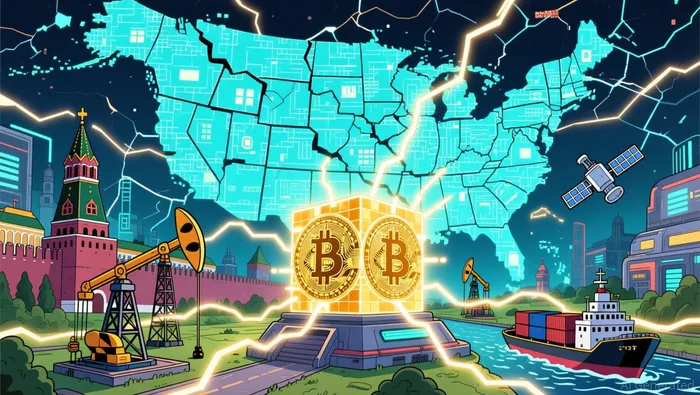
The Duma's recent legislation permitting crypto use in international settlements further underscores this pivot according to analysis. By legalizing crypto mining as an export sector and lowering investment barriers for middle-income groups, the Russian government aims to formalize a market that has long operated in the shadows according to reports. These reforms are not merely about economic survival but also about creating a regulated environment that could attract institutional participation while reducing reliance on unregulated channels according to analysis.
VTB Bank: A Pioneer in Institutional Adoption
VTB Bank, Russia's second-largest lender by assets, is at the forefront of this institutional adoption. The bank plans to launch a spot trading platform for cryptocurrencies like BitcoinBTC-- and EthereumETH--, targeting high-net-worth individuals with portfolios exceeding $1.3 million or annual incomes over $650,000. This move positions VTB as the first major Russian bank to offer direct crypto trading, a strategic step to capture a growing market while aligning with national objectives to circumvent sanctions according to reports.
VTB's initiative is part of a broader trend where Russian financial institutions are reorienting their strategies to accommodate digital assets. The bank's phased approach-testing the platform with "superqualified" investors before potential expansion-reflects both caution and ambition according to analysis. By operating within a regulatory framework that now permits crypto trading, VTB is signaling to global investors that Russia is serious about integrating digital assets into its financial infrastructure according to reports.
Investment Implications: Opportunities and Risks
The evolving Russian crypto market presents a dual-edged sword for institutional investors. On one hand, the surge in transaction volumes-$376.3 billion in crypto activity between July 2024 and June 2025-positions Russia as Europe's leading crypto market. This growth is driven by both retail and institutional demand, with over $27 million invested in Bitcoin and Ethereum-based funds through the Moscow Exchange since June 2025 according to reports. For investors, this represents an opportunity to tap into a market that is rapidly maturing under regulatory oversight.
However, the risks are equally pronounced. The use of crypto to evade sanctions has drawn scrutiny from Western regulators. The U.S. Treasury's $4.6 million penalty for Russia-related sanctions violations and the EU's 19th sanctions package, which targets crypto asset service providers (CASPs), highlight the geopolitical tensions inherent in this space according to analysis. Institutions investing in Russian crypto initiatives must navigate a complex compliance landscape, where the line between innovation and sanctions evasion is increasingly blurred.
Moreover, the Bank of Russia's cautious stance-despite its strategic openness-introduces regulatory uncertainty. While Vladimir Chistyukhin has framed crypto as a "strategic response to sanctions regimes," the central bank's emphasis on risk management and investor education suggests a measured approach to scaling adoption according to reports. This duality-between rapid market growth and regulatory caution-requires investors to balance optimism with vigilance.
Conclusion: A Calculated Bet in a Sanctions-Driven Ecosystem
Russia's crypto market in 2025 is a testament to the adaptability of financial systems under geopolitical stress. The regulatory reforms and institutional initiatives like VTB's trading platform reflect a nation leveraging digital assets to sustain economic activity and challenge traditional financial constraints. For institutional investors, the opportunity lies in participating in a market that is both strategically significant and rapidly evolving.
Yet, the risks of sanctions-related scrutiny and compliance challenges cannot be ignored. Success in this ecosystem will depend on the ability of investors to align with Russia's regulatory trajectory while adhering to international compliance standards. As the Global Crypto Policy Review & Outlook 2025/26 notes, the coming year will likely see further divergence in regulatory approaches, with markets like Russia testing the boundaries of innovation under sanctions according to analysis. For now, the Russian crypto landscape remains a high-stakes arena where strategic foresight and regulatory agility will define outcomes.







Comentarios
Aún no hay comentarios