
Russia's Evolving Crypto Policy and Its Impact on Global Digital Asset Markets
Russia's 2025 cryptocurrency regulatory framework marks a pivotal shift in its approach to digital assets, blending strategic economic resilience with stringent control. As Western sanctions intensify, Moscow has weaponized crypto as a tool to bypass financial restrictions and reorient trade toward emerging markets. This dual strategy-legalizing cross-border transactions while cracking down on domestic operations-has profound implications for global digital asset markets and investor portfolios.
A Dual Regulatory Approach: Control and Strategic Leverage
Russia's 2024 law permitting cryptocurrency use in international trade reflects a calculated move to circumvent Western sanctions. By allowing crypto transactions with partners in the Middle East, Southeast Asia, and Central Asia, the government has created a parallel financial channel to sustain economic activity. Simultaneously, it has imposed a domestic ban on crypto payments, reserving digital assets for "ultra-wealthy investors" through licensed firms and cross-border trade under an "experimental legal regime."
The Central Bank of Russia (CBR) has further tightened the screws, targeting illegal mining operations with severe penalties and smaller fines for minor violations. While these measures aim to bring order to the sector, they risk driving unregulated mining underground, potentially fueling a black market. The Finance Ministry, however, advocates for a more measured approach to avoid stifling innovation. This balancing act underscores Russia's broader tension between leveraging crypto for geopolitical leverage and mitigating domestic instability.
Global Market Implications: A New Geopolitical Order
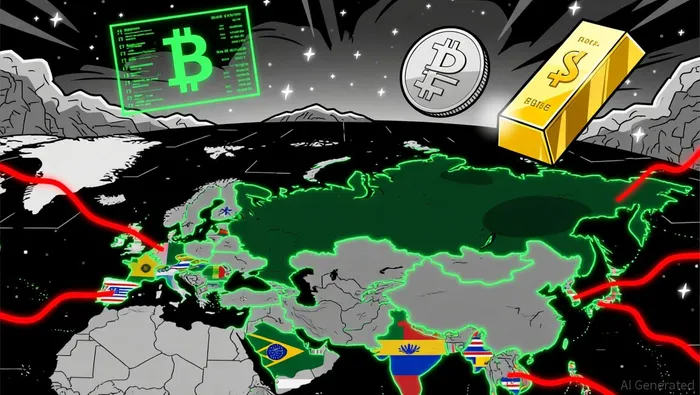
Russia's crypto policies are reshaping global trade dynamics. By legalizing cross-border transactions, the country is accelerating its pivot away from Western financial systems, aligning with BRICS Plus nations to de-dollarize trade. For instance, the BRICS Plus bloc is exploring a shared digital currency to facilitate local-currency transactions, reducing reliance on the U.S. dollar. Russia's digital ruble, already in use, serves as a prototype for this vision.
However, the crackdown on domestic crypto activity has unintended consequences. Stricter mining regulations may displace operations to less regulated jurisdictions, increasing global energy consumption and environmental risks. Meanwhile, Russia's use of crypto derivatives-allowing mutual funds to allocate up to 10% of portfolios to crypto-related instruments-signals a cautious embrace of digital assets for institutional investors. This mirrors broader trends in the BRICS Plus coalition, where gold and clean cryptocurrencies are gaining traction as hedging tools.
Strategic Diversification: Investor Tactics in a Fragmented Landscape
For investors navigating this fragmented landscape, diversification is key. Russia's 2025 policies have created opportunities for accredited investors to hedge geopolitical risks through crypto derivatives, albeit with caveats. The CBR's framework permits indirect exposure to BitcoinBTC-- and EthereumETH-- via futures and options, offering a way to speculate on price movements without direct custody challenges. However, the volatility of these instruments-exacerbated by past crashes like the 2022 LUNA collapse-demands rigorous risk management.
A comparative analysis reveals divergent strategies across regions. In the BRICS Plus bloc, investors are increasingly allocating to gold and "clean" cryptocurrencies (energy-efficient protocols) to balance returns and sustainability. For example, portfolios combining gold and clean crypto have shown improved risk-adjusted returns during crises like the Russia-Ukraine war. In contrast, Western investors remain cautious, prioritizing traditional safe-haven assets like U.S. Treasuries and gold, while maintaining smaller crypto allocations for speculative gains.
Russia's own investors are adopting a hybrid approach. By integrating clean cryptocurrencies into their portfolios, they mitigate the environmental and reputational risks associated with energy-intensive mining. This strategy aligns with global trends toward ESG (Environmental, Social, and Governance) investing, even as geopolitical tensions complicate asset allocation.
Navigating the Risks: Lessons from the Frontlines
The 2025 crypto landscape is fraught with challenges. Russia's crackdown on illegal mining highlights the need for regulatory compliance, while the DPRK's $1.5 billion hack of ByBit underscores the importance of robust security protocols. Investors must also contend with policy reversals, as geopolitical shifts could trigger sudden regulatory changes.
For those seeking to hedge against these risks, a multi-asset approach is essential. Combining crypto derivatives, gold, and BRICS Plus digital currencies can provide both diversification and liquidity. For instance, during the Russia-Ukraine war, Bitcoin's correlation with the S&P 500 reduced its diversification benefits, whereas gold maintained its safe-haven status. This suggests that investors should treat crypto as a complementary, rather than core, asset in their portfolios.
Conclusion: A New Era of Geopolitical Investing
Russia's 2025 crypto policies exemplify the intersection of technology, finance, and geopolitics. By legalizing cross-border transactions and tightening domestic controls, Moscow is redefining its role in the global economy. For investors, this creates both opportunities and challenges. Strategic diversification-leveraging crypto derivatives, clean assets, and BRICS Plus initiatives-offers a pathway to navigate this volatile landscape.
As the world moves toward a multipolar financial order, the ability to adapt to shifting regulatory environments will separate successful investors from the rest. The key lies in balancing innovation with caution, ensuring that portfolios remain resilient in the face of geopolitical uncertainty.






Comentarios
Aún no hay comentarios