
Russia's Energy Infrastructure Resilience: Operational Continuity and Implications for Energy Equity Valuations
In 2025, Russia's energy infrastructure faces unprecedented challenges and adaptations as it navigates the dual pressures of Western sanctions and geopolitical realignments. The country's ability to maintain operational continuity in its energy sector has become a critical factor influencing global energy equity valuations, investor sentiment, and the broader dynamics of energy markets. This analysis examines how Russia's resilience—despite infrastructure vulnerabilities and strategic pivots—shapes the investment landscape in energy equities.
Operational Challenges: A Fractured Infrastructure
Russia's energy infrastructure has been severely tested by sustained attacks on its oil refineries, with over 20% of fuel production capacity offline as of September 2025[1]. Key refineries in Krasnodar, Samara, and Omsk have faced repeated strikes, creating bottlenecks for military logistics and domestic supply chains[2]. Domestically, fuel shortages have driven up transportation and food costs, exacerbating inflation and public discontent[1]. Meanwhile, the U.S. Treasury's 2025 sanctions on “petroleum services” and the designation of major Russian oil firms have compounded operational difficulties[2].
The military implications are stark: disruptions in jet fuel and diesel supply threaten the Russian Armed Forces' operational tempo in Ukraine and beyond[1]. This fragility underscores a broader vulnerability in Russia's infrastructure protection systems, which have struggled to adapt to hybrid warfare tactics targeting energy assets[2].
Strategic Adaptations: Pivoting to Asia and BRICS
To mitigate these challenges, Russia has aggressively reoriented its energy exports toward Asia, with 82% of crude oil shipments now directed to the Asia-Pacific region in 2023[3]. China and India have emerged as critical markets, absorbing over half of Russia's seaborne crude exports[4]. This shift is facilitated by the “shadow fleet” of tankers and non-dollar currency settlements, with 80% of 2024 transactions occurring in yuan or rupees[3].
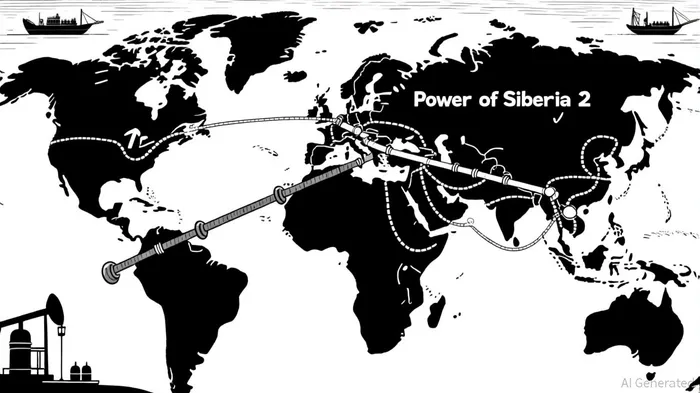
The Power of Siberia 1 pipeline, operating at full capacity since December 2024, has become a lifeline for Russian gas exports to China[3]. However, the proposed Power of Siberia 2 pipeline remains stalled due to unresolved terms between Moscow and Beijing[3]. Meanwhile, Russia's deepening ties with BRICS nations and its push to bypass Western financial systems—through initiatives like the New Development Bank—signal a long-term strategy to sustain energy exports despite sanctions[2].
Implications for Energy Equity Valuations
The resilience of Russian energy infrastructure has had a nuanced impact on global energy equity valuations. While Russia's crude oil production remains stable at 10.84 million barrels per day through 2050[5], its reliance on a narrow set of buyers—China and India—introduces volatility. For instance, U.S. tariffs on India for its continued import of Russian oil could disrupt export volumes[2].
Investor behavior reflects this duality. Energy firms in Asia, particularly those securing discounted Russian crude, have seen valuation boosts[4]. Conversely, Western companies with exposure to Russian assets face reputational and operational risks, leading to capital reallocation toward renewables and LNG infrastructure[6]. The U.S. LNG sector, for example, has capitalized on Europe's pivot away from Russian gas, with 55% of American LNG now exported to the EU[3].
Geopolitical developments further complicate the landscape. The Trump-Putin Alaska Summit in August 2025, for instance, could reshape market perceptions of energy stability. A potential ceasefire agreement might redirect capital toward reconstruction and energy transition projects, while a breakdown in talks could sustain defense sector outperformance[1].
Long-Term Risks and Market Outlook
Despite short-term adaptations, Russia's energy strategy faces structural risks. Declining reserve replacement rates, underinvestment in Arctic and deepwater projects, and global oil demand peaking in the 2030s threaten long-term sustainability[5]. Additionally, the fragility of its infrastructure—exposed by repeated refinery attacks—raises questions about wartime industrial continuity[1].
For investors, the key lies in balancing exposure to Russia's energy resilience with the broader energy transition. While 72% of investors accelerated energy transition asset investments in 2025[7], the geopolitical interdependence between traditional and renewable energy markets remains complex. Energy equity valuations will likely remain sensitive to macroeconomic conditions, with volatility expected in both fossil fuel and green energy sectors[6].
Conclusion
Russia's energy infrastructure resilience is a double-edged sword. While its strategic pivots to Asia and BRICS have mitigated some sanctions' impact, the country's reliance on a narrow export base and vulnerable infrastructure pose significant risks. For global investors, the interplay between Russia's operational continuity and the energy transition will define equity valuations in the coming years. As the world recalibrates to a post-Ukraine war energy landscape, the ability to navigate these dynamics will be critical for portfolio resilience.







Comentarios
Aún no hay comentarios