
Russia's Emerging Crypto Market Liberalization: Assessing the Strategic Opportunity for Early-Stage Investment in Fuel-Backed Digital Assets
Russia's crypto market is undergoing a transformative shift in 2025, driven by a combination of regulatory liberalization, geopolitical imperatives, and the strategic use of fuel-backed digital assets. As Western sanctions tighten and traditional financial systems become increasingly inaccessible, Russia is leveraging cryptocurrencies and stablecoins to maintain economic resilience. This analysis evaluates the investment potential of Russia's fuel-backed digital assets, including ruble-backed stablecoins like A7A5 and the digital ruble (CBDC), while contextualizing their role in the broader liberalization of the Russian crypto market.
Regulatory Framework and Market Liberalization
The Central Bank of Russia has introduced a structured regulatory framework to formalize crypto trading, aiming to balance risk mitigation with market growth. Under the new rules, non-qualified investors can purchase high-liquidity cryptocurrencies up to 300,000 rubles ($3,300) annually after passing a risk-awareness test, while qualified investors face fewer restrictions. This dual-tier system reflects a pragmatic approach to integrating crypto into Russia's financial infrastructure without fully endorsing its use for domestic payments.
The framework also recognizes digital currencies and stablecoins as monetary assets, enabling their trade but prohibiting their use as a medium of exchange within Russia. This distinction aligns with the 2020 law that restricts crypto to investment purposes, a policy designed to prevent destabilizing volatility in everyday transactions. Notably, the Central Bank has permitted Russian residents to purchase crypto abroad and transfer holdings to domestic platforms, provided they comply with tax reporting requirements. These measures signal a shift from outright skepticism to a regulated, risk-managed approach.
Fuel-Backed Digital Assets: A7A5 and the Digital Ruble
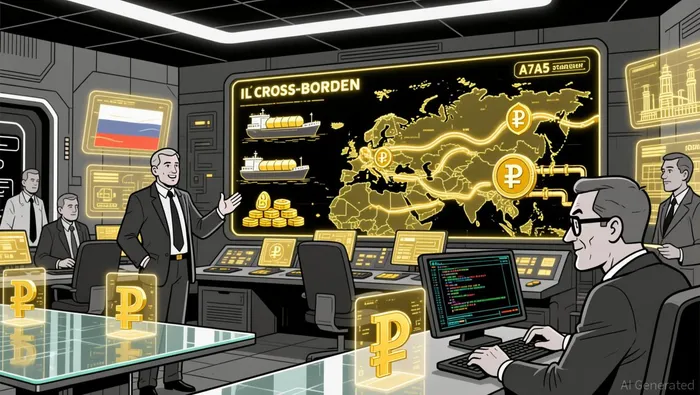
The most prominent fuel-backed digital asset in Russia is A7A5, a ruble-backed stablecoin used for cross-border trade. According to a report by Reuters, A7A5 has facilitated transactions worth $9.3 billion in its first four months, enabling Russia to bypass Western financial systems and conduct oil trade with partners like China and India. The stablecoin is reportedly collateralized by state-affiliated commercial banks, ensuring its peg to the ruble while enabling high-volume, borderless transactions. However, the EU's 19th sanctions package has targeted A7A5's developer, aiming to disrupt its role in sanctions evasion. This regulatory tug-of-war highlights the geopolitical risks inherent in investing in such assets.
In parallel, the digital ruble (CBDC) is advancing as a sovereign alternative to traditional payment systems. The Central Bank of Russia plans to launch the digital ruble in July 2025, with mandatory participation from 13 systemically important banks. The CBDC will initially focus on government transactions, including social security payments and salary disbursements, before expanding to cross-border settlements. By 2026, the digital ruble is expected to integrate with the BRICS Bridge system, a platform for CBDC-based trade settlements independent of SWIFT. While public adoption remains cautious-only 30% of Russians express interest in using the digital ruble-the government's push for universal QR code integration and legislative mandates suggests a long-term commitment to its success.
Strategic Opportunities and Risks
The liberalization of Russia's crypto market presents unique opportunities for early-stage investors. First, the energy-for-compute model pioneered by Gazprom and Gazprom Neft offers a novel use case for fuel-backed assets. By converting flare gas into energy for cryptocurrency mining and AI infrastructure, these projects create a circular economy that monetizes waste while supporting high-growth sectors. A 2025 ministerial proposal to build gas-fired power plants for AI and crypto data centers further underscores this strategic pivot. Investors could benefit from partnerships with Russian energy firms or platforms facilitating these energy-digital asset linkages.
Second, the BRICS Bridge system and Russia's CBDC ambitions position the country as a leader in alternative financial infrastructure. As the 2024 BRICS president, Russia has prioritized cross-border CBDC settlements, with the digital ruble potentially serving as a cornerstone for Eurasian trade. For investors, this represents an opportunity to participate in the development of a parallel financial ecosystem, particularly as China and India also advance their CBDC initiatives.
However, significant risks persist. The EU's sanctions on A7A5 and its ecosystem highlight the vulnerability of fuel-backed assets to geopolitical pressures. Additionally, the volatility of crypto markets and the lack of sovereign guarantees for stablecoins like A7A5 pose liquidity and solvency risks. Regulatory uncertainty remains a wildcard, as the Central Bank's phased rollout of crypto rules (finalized by July 2026) could introduce new compliance burdens.
Conclusion
Russia's crypto liberalization and fuel-backed digital assets represent a high-risk, high-reward investment opportunity. While the regulatory framework provides a foundation for institutional adoption, the geopolitical and market risks cannot be ignored. A7A5 and the digital ruble exemplify Russia's strategic use of digital finance to circumvent sanctions, but their long-term viability depends on navigating EU countermeasures and public trust. For early-stage investors, the key lies in balancing exposure to these assets with hedging strategies and a deep understanding of the evolving regulatory landscape. As Russia continues to integrate energy, AI, and crypto into a cohesive economic model, the potential for innovation-and profit-remains substantial.







Comentarios
Aún no hay comentarios