
U.S.-Russia Diplomacy and Global Geopolitical Risk: Navigating Safe-Haven Assets and Emerging Market Volatility
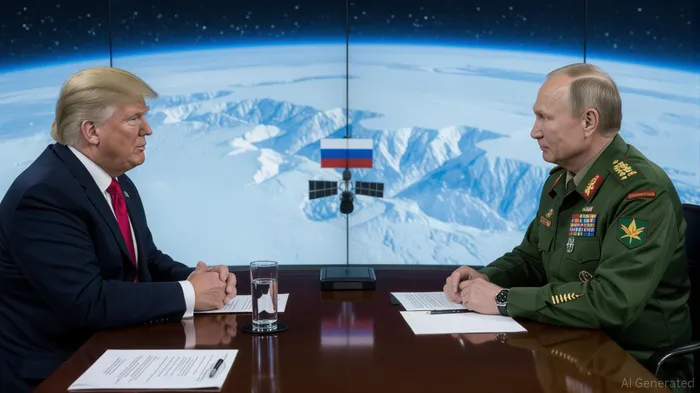
The geopolitical crossroads of 2025 have placed U.S.-Russia diplomacy at the center of global financial uncertainty. With the Trump-Putin summit in Alaska looming and the European Union intensifying its sanctions regime, investors are recalibrating portfolios to hedge against a fragmented world order. The interplay of diplomatic brinkmanship, economic coercion, and strategic realignments is reshaping safe-haven assets and emerging market equities in ways that demand a nuanced, forward-looking approach.
The Gold Conundrum: Safe-Haven Demand Amid Divergent Signals
Gold has long served as a barometer for geopolitical risk, and 2025 is no exception. Central banks in China, India, and Russia have accelerated gold purchases, with the International Monetary Fund reporting a 12% year-on-year increase in global central bank gold reserves. However, the asset's trajectory is now a double-edged sword.
If the Trump-Putin summit yields a diplomatic breakthrough—such as a temporary ceasefire or sanctions relief—gold could face downward pressure as investors rotate into risk-on assets. Conversely, a failure to de-escalate tensions, or a renewed escalation in Ukraine, would likely drive gold prices to record highs. Analysts project prices could surge to $4,500 per ounce by mid-2026, fueled by a loss of confidence in the U.S. dollar and U.S. Treasuries.
Investors should consider a 5–10% allocation to gold or gold mining equities (e.g., Newmont MiningNEM--, KGHM) as a hedge against currency devaluations and geopolitical shocks. However, tactical positioning is key: a short-term dip in gold prices following a diplomatic breakthrough could present a buying opportunity for long-term holders.
Emerging Markets: A Tale of Two Scenarios
Emerging market equities are caught in a tug-of-war between U.S. reshoring initiatives and EU-led sanctions. Countries like Vietnam and Mexico, which stand to benefit from Trump's “America First” trade policies, face a paradox: while reshoring could boost manufacturing demand, secondary tariffs on goods from nations trading with Russia risk penalizing their exports.
Conversely, nations reliant on European trade—such as Brazil, Indonesia, and Turkey—are vulnerable to capital outflows if the Ukraine war persists. The GLOBSEC report's 30% probability of a protracted attrition war underscores this risk. For now, EMs with diversified export baskets and strong fiscal policies—South Korea, Israel, and India—remain relative safe havens.
Investors should prioritize EMs with robust domestic demand and strategic ties to the EU, such as Poland and South Africa, while avoiding overexposure to Russia-dependent economies. Currency hedging via forwards or ETFs (e.g., EMB, EMU) is advisable for markets exposed to European trade shocks.
The EU's Role: Sanctions, Alliances, and Energy Rebalancing
The EU's 18th sanctions package against Russia—targeting oil price caps, shadow fleets, and chemical weapons entities—has reinforced its alignment with U.S. policy while deepening its own strategic autonomy. The bloc's “ReArm Europe” plan, aiming to boost defense spending to 5% of GDP by 2035, has created a $1.2 trillion investment opportunity in air defense, drones, and cybersecurity.
Meanwhile, the EU's energy transition strategy—prioritizing renewables, nuclear, and hydrogen—is reshaping equity valuations. Firms like Ørsted (wind), NextEra Energy (solar), and Framatome (nuclear) are poised to benefit from EU subsidies and the €1.5 billion European Defence Industry Programme.
However, the EU's reliance on U.S. technology and capital for its energy and defense projects introduces risks. Divergent U.S. policies—such as Trump's 100% tariffs on Russian oil buyers—could strain transatlantic cooperation. Investors should monitor EU budget allocations and geopolitical alignment with the U.S.
Positioning for Uncertainty: A Strategic Framework
- Diversify Safe-Haven Exposure: Allocate to gold, U.S. Treasuries, and Swiss francs to hedge against currency volatility.
- Target Resilient EMs: Focus on countries with strong fiscal policies and diversified trade (e.g., Vietnam, South Korea).
- Defensive Sectors: Overweight energy transition and defense equities in the EU and U.S.
- Currency Hedging: Use forwards or ETFs to mitigate risks in EMs exposed to European trade.
- Scenario Planning: Prepare for both a short-term truce and a prolonged conflict by maintaining liquidity and tactical flexibility.
Conclusion
The U.S.-Russia diplomatic landscape in 2025 is a masterclass in geopolitical risk management. While gold and EM equities remain sensitive to diplomatic outcomes, the EU's strategic recalibration and energy transition offer long-term opportunities. Investors must balance caution with conviction, leveraging data-driven insights to navigate a world where stability is fleeting and uncertainty is the new norm.





Comentarios
Aún no hay comentarios