
Russia's Digital Ruble and Its Implications for the Future of Payments and Crypto Markets
Russia's digital ruble, a central bank digital currency (CBDC), is rapidly evolving from a strategic experiment to a cornerstone of the country's financial infrastructure. As the Central Bank of Russia (CBDR) accelerates its rollout, the digital ruble is being integrated into government operations, pensions, and salaries, signaling a shift toward a more controlled and sovereign financial ecosystem. For institutional investors, this represents a unique opportunity to engage with a CBDC-driven market while navigating the geopolitical and technological dynamics reshaping Russia's economic landscape.
Government Integration: A Catalyst for Financial Modernization
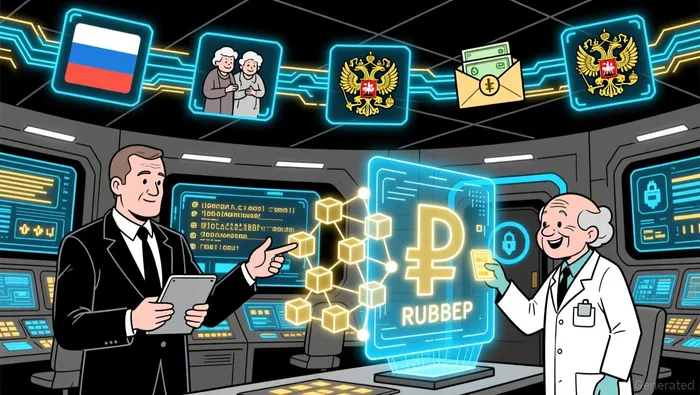
The digital ruble's integration into public sector operations began in January 2026, with federal departments using it for salaries, pensions, and social security payouts. This phase is part of a broader plan to fully roll out the CBDC to the public by September 2026. The CBR has mandated that major banks and institutional clients facilitate these transactions, which are currently free of charge for government-related payments. By reducing transaction costs and streamlining state spending, the digital ruble aims to enhance fiscal efficiency while minimizing reliance on Western financial systems like SWIFT.
This shift is not merely operational but strategic. According to a report by the Carnegie Endowment, the digital ruble is being positioned as a tool to circumvent international sanctions and assert financial sovereignty. Cross-border B2B transactions with Belarus are already being tested, hinting at future expansion into BRICS+ markets. For institutional investors, the government's prioritization of the digital ruble suggests long-term stability in its adoption, particularly in sectors tied to state spending.
Regulatory Framework: Opening Doors for Institutional Investors
Russia's regulatory approach to crypto and CBDCs is evolving to attract institutional capital. The CBR has proposed allowing non-qualified investors to purchase up to 300,000 rubles ($3,300) in crypto annually through authorized intermediaries, provided they pass a risk-awareness test. This marks a departure from earlier restrictions that limited crypto access to qualified investors. The framework also includes plans for tax parity between digital financial assets and traditional bonds.
The DFA market, valued at $13 billion as of 2026, is a key area of growth. Tokenized assets such as cocoa beans and St. Petersburg real estate are being promoted as alternatives to Western-dominated financial instruments. For institutional investors, this creates opportunities in custody solutions, trading platforms, and asset tokenization services. Additionally, the government's legalization of industrial crypto mining-leveraging Siberia's low-cost energy- positions Russia to reclaim its 2024 mining peak of 2.1–2.2 gigawatts by 2026.
Blockchain Infrastructure and Fintech Opportunities
The digital ruble's expansion necessitates robust blockchain infrastructure. Russian banks and fintech firms are being incentivized to integrate the CBDC into existing apps, ensuring seamless user adoption. This has spurred demand for blockchain developers, smart contract platforms, and interoperability solutions. For example, the Moscow Exchange (MOEX) and major banks have launched crypto derivatives linked to global ETFs, signaling a broader embrace of digital assets.
Institutional investors can capitalize on partnerships with fintech firms developing CBDC-compatible tools. The CBR's emphasis on cross-border payments also opens avenues for blockchain projects specializing in B2B transactions. Furthermore, the government's push for tax parity and DFA growth could drive demand for compliance and custody services tailored to institutional clients.
Geopolitical Implications and Market Resilience
The digital ruble's strategic value extends beyond domestic finance. By aligning with BRICS+ and testing cross-border payment systems, Russia aims to create an alternative to Western financial dominance. This geopolitical positioning reduces the risk of external shocks for domestic investors while offering foreign institutions access to a market insulated from traditional sanctions.
However, challenges remain. Over 65% of Russian companies remain uncertain about the digital ruble's benefits, and public adoption hinges on education and trust-building. For institutional investors, this presents both a risk and an opportunity: early engagement with CBDC infrastructure and fintech partners could yield outsized returns as adoption accelerates.
Conclusion: A Strategic Investment Horizon
Russia's digital ruble represents more than a technological innovation-it is a geopolitical and economic recalibration. For institutional investors, the integration of the CBDC into pensions, salaries, and state spending creates a stable foundation for long-term investments in blockchain infrastructure, DFA markets, and regulated crypto assets. As the CBR continues to refine its regulatory framework and expand cross-border capabilities, the digital ruble's ecosystem will likely attract capital seeking resilience in a fragmented global financial landscape.
The coming months will be critical. With the full public rollout scheduled for September 2026, now is the time to assess partnerships, infrastructure needs, and regulatory alignment. In a world increasingly defined by financial fragmentation, Russia's digital ruble offers a compelling case study in sovereignty, innovation, and strategic investment.







Comentarios
Aún no hay comentarios