
Russia's Crypto Surge: A Strategic Opportunity in Emerging Market Digital Assets
Russia's cryptocurrency landscape is undergoing a seismic transformation, driven by a confluence of geopolitical tailwinds, regulatory innovation, and strategic cross-border partnerships. As Western sanctions tighten and global financial systems fracture, Moscow has pivoted to digital assets as a lifeline for economic resilience and a tool for redefining its role in global trade. For investors, this represents a unique opportunity to capitalize on a market where policy shifts and geopolitical imperatives are accelerating crypto adoption at an unprecedented pace.
Regulatory Shifts: From Resistance to Structured Control
The Bank of Russia has moved swiftly to formalize a legal framework for cryptocurrencies, recognizing them as "currency assets" while imposing strict limitations on domestic use. Under the new rules, crypto will be prohibited for retail payments, but a tiered access system will allow retail investors to purchase up to 300,000 rubles' worth of liquid cryptocurrencies annually after passing a knowledge test. Qualified investors, meanwhile, will gain broader access under risk-awareness conditions according to central bank policy. These measures, set to take effect by July 1, 2026, signal a calculated effort to balance innovation with control.
This regulatory pivot follows years of skepticism from the central bank, which previously labeled crypto a threat to financial stability. However, the government's recognition of crypto's role in circumventing sanctions and enabling cross-border trade has forced a pragmatic shift. By legalizing crypto mining and establishing an "experimental legal regime" (ELR) for international transactions, Russia is creating a parallel financial infrastructure that aligns with its geopolitical goals.
Geopolitical Tailwinds: Sanctions, Trade, and the Crypto Workaround
The West's economic pressure on Russia has catalyzed a surge in crypto adoption. According to a RAND Corporation report, Russian companies have increasingly turned to cryptocurrencies to sustain trade with non-sanctioned partners, particularly in Asia and Latin America. A striking example emerged in 2025, when a Russian metallurgical firm used USDT to purchase equipment from Brazil via a Singapore-based exchange. The transaction, completed in six hours with fees under 0.5%, outperformed traditional SWIFT transfers in speed and cost efficiency.
This trend is not isolated. Russia's Central Bank has acknowledged that nearly 20 million citizens now use cryptocurrencies, driven by both retail demand and institutional experimentation. The rise of no-KYC exchanges and the involvement of major banks like Sberbank-Russia's largest retail bank-further underscore the sector's maturation. Sberbank has even explored custody services for crypto, signaling a broader acceptance of digital assets within the traditional financial ecosystem.
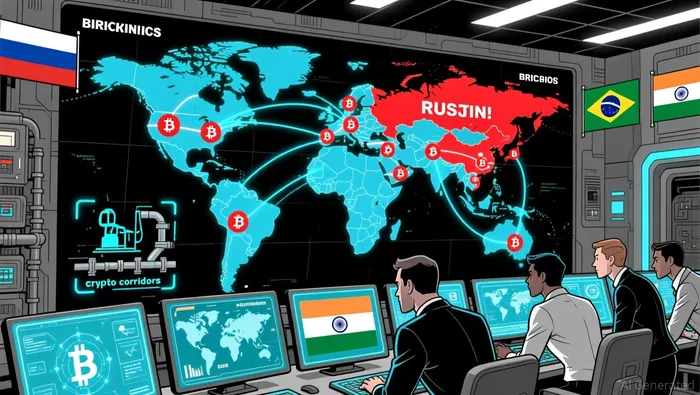
BRICS Partnerships: Building a Crypto-Backed Alternative
Russia's strategic alliances within the BRICS bloc are amplifying its crypto ambitions. At the forefront is the BRICS Pay initiative, a blockchain-based payment system proposed by President Vladimir Putin to reduce reliance on the U.S. dollar. This system aims to integrate national digital currencies and stablecoins, creating a decentralized alternative to SWIFT. By mid-2025, BRICS nations had already begun conducting up to 90% of intermember transactions in local currencies, a shift that crypto could further accelerate.
Collaborative projects are already materializing. The Russian Direct Investment Fund (RDIF) partnered with BitRiver in 2024 to develop Bitcoin mining and AI computing facilities across BRICS countries, laying the groundwork for a crypto-based payment network. Additionally, the mBridge initiative-a cross-border settlement project involving China, India, and Russia-has tested blockchain solutions for trade finance, hinting at a future where BRICS nations leverage digital assets to bypass Western-dominated financial systems.
Market Growth: Transaction Volumes and Institutional Momentum
Quantifiable evidence of Russia's crypto surge is emerging. Between July 2023 and June 2025, Russia recorded $376 billion in crypto transaction value, surpassing the U.K. and Germany to become Europe's largest market. This growth is fueled by institutional-scale transactions and DeFi activity, with the A7A5 ruble-denominated stablecoin emerging as a key vehicle for cross-border settlements.
The government's push to formalize this activity is also gaining traction. By 2027, unauthorized crypto operations will face penalties comparable to unregulated financial crimes, a move designed to curb illicit activity while legitimizing the sector. Meanwhile, plans for new crypto exchanges in St. Petersburg and Moscow indicate a long-term commitment to infrastructure development.
Strategic Implications for Investors
For investors, Russia's crypto surge presents a dual opportunity: exposure to a rapidly growing market and alignment with geopolitical trends reshaping global finance. The interplay of regulatory clarity, sanctions-driven demand, and BRICS-led innovation creates a fertile ground for digital assets. However, risks remain, including the central bank's cautious oversight and the potential for regulatory tightening.
That said, the scale of adoption-20 million users, $376 billion in transactions, and a government-backed stablecoin-suggests that Russia's crypto market is no longer a fringe experiment but a strategic pillar of its economic future. As BRICS Pay and other initiatives gain momentum, early adopters stand to benefit from a financial ecosystem increasingly defined by digital sovereignty and decentralized alternatives.






Comentarios
Aún no hay comentarios