
Russia's Crypto Paradox: A Defiant Path to Financial Independence or a Sanction-Busting Gamble?
Russia's embrace of cryptocurrency in 2025 represents a bold reimagining of its financial architecture, driven by the dual imperatives of evading Western sanctions and asserting economic sovereignty. As the country faces exclusion from SWIFT and dwindling access to traditional banking systems, its pivot to digital assets has sparked a global debate: Is this a calculated move toward financial independence, or a high-stakes gamble that risks entrenching volatility and regulatory backlash? The answer lies in dissecting the strategic, economic, and geopolitical dimensions of Russia's crypto-driven reorientation.
Strategic Reorientation: From Sanctions to Crypto Adoption
Russia's crypto strategy is no longer a fringe experiment but a state-sanctioned pillar of its economic resilience. By legalizing crypto mining in 2024 and easing restrictions on cross-border settlements, the government has institutionalized digital assets as a lifeline for trade with non-Western partners. According to a Rand Corporation report, Russia is leveraging cryptocurrencies, gold, and netting mechanisms to obscure transactions and reduce exposure to sanctioned systems. Major banks like Sberbank and VTB have joined the effort, offering custody services and developing alternative payment infrastructure, while sanctioned institutions like VTB are spearheading international crypto networks.
This shift is underpinned by a broader reorientation of trade toward the Middle East, Southeast Asia, and Central Asia. By 2025, nearly 90% of Russia-China trade is conducted in rubles and yuan, with crypto facilitating the remaining cross-border flows. The Kremlin's push for a CIS-based SWIFT alternative further underscores its intent to bypass Western-dominated financial systems.
Effectiveness and Risks of the Strategy
While Russia's crypto adoption has enabled partial sanctions evasion, its success is far from absolute. Data from Chainalysis reveals that sanctioned nations, including Russia, received $15.8 billion in cryptocurrency in 2024, with Russia processing $49 billion in crypto payments between Q4 2023 and Q1 2024. 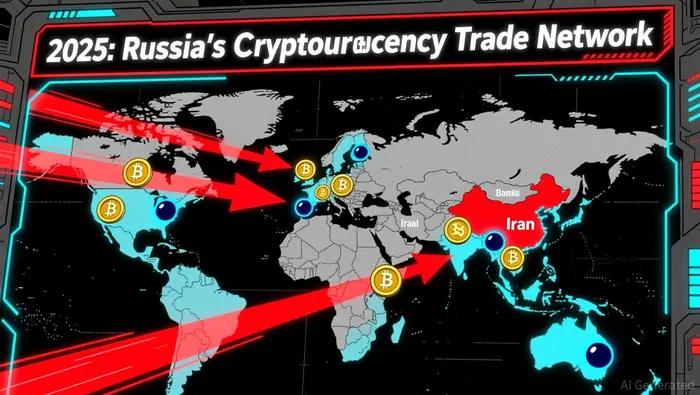 However, the scale of these transactions pales in comparison to the country's $600 billion annual import needs, highlighting scalability challenges.
The U.S. and EU have responded aggressively, sanctioning over 100 no-KYC exchanges and targeting networks like Garantex and Grinex for laundering cybercrime proceeds. The EU's Markets in Crypto-Assets Regulation (MiCA) and U.S. Office of Foreign Assets Control (OFAC) penalties-$430 million in crypto-related fines in 2024-signal a tightening regulatory net. Despite these efforts, Russia's leadership in bitcoin mining and cyberattack capabilities provides a buffer, enabling it to generate revenue through illicit means.
Investment Landscape: Growth and Volatility
The Russian crypto market is experiencing a surge in participation, albeit amid regulatory uncertainty. As of March 2025, Russian citizens held over 827 billion rubles ($10.15 billion) in crypto wallets, with BitcoinBTC-- dominating 62.1% of holdings. The government's proposed relaxation of "highly qualified investor" rules could expand access to middle-income individuals, potentially boosting the market to $4.1 billion in revenue by 2026.
Yet, this growth is shadowed by volatility. A study published in Scientific Direct notes that geopolitical events, such as the Russia-Ukraine War, correlate strongly with crypto market fluctuations. For instance, Bitcoin prices dipped below $104,000 amid war-related tensions but rebounded on ceasefire speculation. Such volatility, coupled with regulatory shifts, poses risks for investors. The default probability for Russian crypto firms, while improved to 0.372 by December 2025, still reflects lingering instability.
Geopolitical Impacts and Market Reactions
Geopolitical dynamics amplify the paradox of Russia's crypto strategy. On one hand, cryptocurrencies act as a hedge against sanctions, with studies showing a positive relationship between geopolitical risk and crypto returns. On the other, heightened tensions increase cybersecurity threats, eroding investor trust through exchange hacks and regulatory crackdowns.
The U.S. and EU's focus on blockchain intelligence has forced Russia to rely more on decentralized platforms and cybercrime-linked revenue streams. Meanwhile, global adoption trends, including the approval of spot Bitcoin ETFs in North America, have created a dual narrative: crypto as both a speculative asset and a tool for geopolitical defiance.
Conclusion: Balancing Defiance and Viability
Russia's crypto paradox lies in its ability to leverage digital assets for both strategic defiance and economic survival. While the country has made strides in institutionalizing crypto as a sanctions-evasion tool, the path to financial independence remains fraught with regulatory, market, and geopolitical risks. For investors, the rewards of a growing Russian crypto market must be weighed against its inherent volatility and the likelihood of intensified international scrutiny.
As the Kremlin continues to refine its crypto policies, the world watches to see whether this defiant experiment will yield a blueprint for financial sovereignty-or collapse under the weight of its own contradictions.






Comentarios
Aún no hay comentarios