
Russia's Crypto Mining Crackdown: Implications for Global Bitcoin Hashrate and Energy Arbitrage Opportunities
In 2025, Russia's crypto mining sector has become a focal point of global attention, marked by a paradoxical mix of rapid growth and regulatory crackdowns. Despite a 44% expansion in active mining farms-surpassing 196,900 operations in 2025 from 136,600 in 2024-the government has intensified enforcement of energy and tax regulations, including AI-driven monitoring tools like MTS EnergyTool to detect unauthorized activity according to reports. This dual narrative of growth and restriction has triggered a redistribution of BitcoinBTC-- hashrate, with Russia's share dropping from 16.6% to 15.5% of the global network. The crackdown, particularly the permanent bans in Siberian regions like Zabaykalsky Krai and Buryatia, has forced miners to seek alternative jurisdictions, creating a ripple effect across the global mining landscape.
The Hashtag Migration: From Russia to Sanctioned-Friendly Jurisdictions
The Russian government's enforcement of permanent mining bans in energy-starved regions has left miners "vulnerable" and prompted a strategic reallocation of capital. As of late 2025, some operations have relocated equipment to other Russian regions with surplus energy, while others have crossed borders to jurisdictions like Kazakhstan. The U.S., in particular, has emerged as a dominant destination, leveraging its access to diverse energy sources-including stranded natural gas and renewable overproduction-to attract capital fleeing regulatory uncertainty in Russia.
This migration is not merely a response to enforcement but a calculated move to exploit energy arbitrage. For instance, converting flared or stranded natural gas into electricity for mining could unlock a $16 billion market opportunity, as highlighted by legal analyses from Steptoe & Johnson according to market research. Miners are also capitalizing on surplus wind and solar generation during off-peak hours, a strategy that reduces costs while aligning with global sustainability trends.
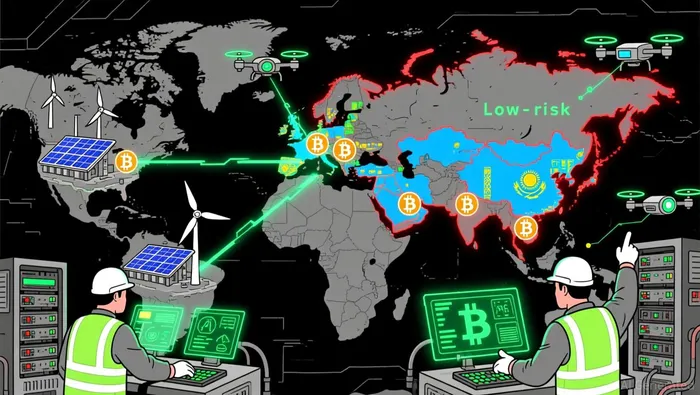
Energy Arbitrage and the New Mining Frontier
Energy costs remain the linchpin of mining profitability. In 2025, the cost to mine one Bitcoin in Russia is estimated at $39,700, significantly lower than the $130,000 average in the U.S. However, regional disparities within Russia itself-such as the 4.2–5.5 rubles per kWh tariffs in Siberia-have made certain areas more competitive than others. This has created a fragmented landscape where miners must balance proximity to low-cost energy with regulatory risk.
The arbitrage opportunities extend beyond energy. Bitcoin miners are diversifying into AI and high-performance computing (HPC) to monetize their energy infrastructure. For example, companies like Core Scientific (CORZ) have secured long-term contracts with AI hyperscalers, generating $9.11 million in annualized revenue per megawatt (MW) of installed capacity at 80% utilization. This dual-use strategy transforms mining operations into hybrid energy-AI hubs, offering a compelling value proposition in regions with grid constraints.
Sanctioned-Friendly Jurisdictions: A New Mining Map
The relocation of Russian capital has accelerated the rise of sanctioned-friendly jurisdictions with low-cost energy. Switzerland, Singapore, and the UAE have emerged as top destinations, each offering unique advantages:
- Switzerland benefits from a robust legal framework (DLT Act) and favorable tax treatment for long-term crypto investments, though its energy costs remain higher than in Russia according to industry analysis.
- Singapore attracts miners with no capital gains tax on long-term holdings and a pro-innovation regulatory environment, despite its reliance on imported fuels according to energy reports.
- The UAE leverages government subsidies and abundant fossil fuels to offer competitive energy rates, though its hot climate necessitates advanced cooling infrastructure according to market data.
Meanwhile, the U.S. has solidified its position as the global leader in Bitcoin hashrate, with Texas and the Pacific Northwest capitalizing on cheap hydroelectric and natural gas resources. The U.S. interest in using excess electricity from the Zaporizhzhia Nuclear Power Plant for mining further underscores the geopolitical dimensions of energy arbitrage according to official statements.
Regulatory Risks and Strategic Considerations
Despite these opportunities, miners face regulatory headwinds. Russia's proposed prison sentences of up to five years for unregistered operations and its 25% corporate tax on mining profits highlight the risks of operating in a volatile environment according to regulatory filings. Conversely, jurisdictions like the UAE and Singapore offer clearer regulatory pathways but lack the energy cost advantages of Russia's Siberian regions.
For investors, the key lies in balancing energy arbitrage with regulatory stability. The migration of Russian capital to sanctioned-friendly jurisdictions is not just a short-term response to crackdowns but a long-term realignment of the global mining map. As Bitcoin's energy consumption rivals that of small countries-417.18 GWh per day in 2025-miners must prioritize locations where energy costs are both low and sustainable according to energy reports.
Conclusion: A New Era of Mining Capitalism
Russia's crypto mining crackdown has catalyzed a global redistribution of hashrate and capital, reshaping the industry's energy and regulatory dynamics. While Russia remains a key player, its internal contradictions-between economic potential and energy constraints-have created openings for jurisdictions with clearer policies and cheaper energy. For investors, the next frontier lies in jurisdictions that combine low-cost energy with regulatory clarity, enabling miners to thrive in an increasingly competitive and energy-intensive landscape.






Comentarios
Aún no hay comentarios