
Russia's Aggressive 100 bps Rate Cut and Its Implications for Emerging Market Debt
Russia's Central Bank has executed a sharp 100-basis-point rate cut in recent months, reducing the key rate to 18% amid a deepening recession and persistent inflation. This move, following a 200-basis-point cut in the prior month, underscores the government's struggle to balance inflation control with economic stagnation. While the rate reductions aim to stimulate credit demand and offset a prolonged downturn, the real interest rate remains elevated at 14% (18% nominal rate minus 4% inflation), continuing to stifle growth[1]. The ruble's recent strength—driven by reduced import costs and falling inflation—has further complicated the Central Bank's calculus, as it erodes export competitiveness and strains fiscal revenues[4].
Macroeconomic Stress and Ruble Dynamics
The rate cuts signal acute macroeconomic stress in Russia, where GDP contraction has outpaced initial forecasts, and corporate defaults are rising. The ruble's appreciation against the U.S. dollar, which hit a seven-week low against the euro and yen in late 2025[2], has created a paradox: while lower import prices ease inflationary pressures, they also weaken Russia's trade balance and reduce the budget's oil revenue. This duality highlights the fragility of the current economic environment. For investors, the ruble's volatility raises questions about currency risk hedging, particularly as global capital flows shift in response to the Fed's anticipated rate cut in September 2025[3].
EM Bond Risk Premiums and Capital Flows
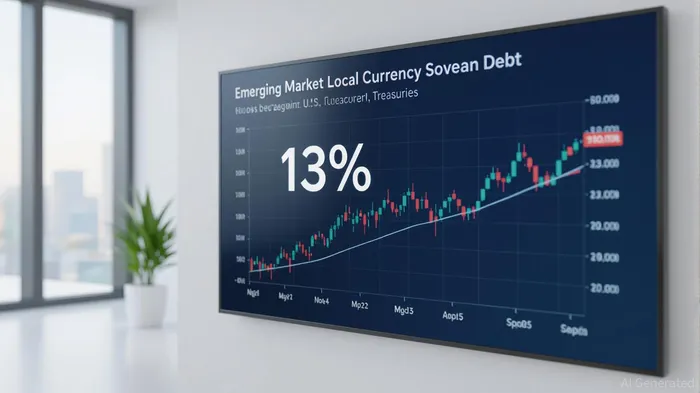
Russia's monetary easing aligns with a broader trend of rate cuts across emerging markets (EMs), as central banks seek to stimulate growth amid slowing global demand. J.P. Morgan Research forecasts EM growth to decelerate to 2.4% annualized in H2 2025, yet EM bond risk premiums have narrowed, reflecting improved fundamentals and a weaker U.S. dollar[2]. Local currency sovereign debt has returned nearly 13% year-to-date, outperforming U.S. Treasuries by a margin of 2% in spread returns[3]. This resilience is partly attributed to structural shifts in EM debt ownership, with institutional investors increasingly allocating to high-yield EM corporates as a hedge against U.S. exceptionalism[1].
However, the Fed's dovish pivot—projected to reduce borrowing costs by 100 bps in 2025—introduces asymmetry. While a weaker dollar bolsters EM debt returns, it also amplifies exposure to geopolitical risks, such as U.S. tariff impositions and regional conflicts. For instance, the Indonesian rupiah's recent slide to 1998-crisis levels underscores how external shocks can destabilize EM markets even amid monetary easing[2]. Russia's rate cuts, therefore, serve as a cautionary case: they highlight the tension between domestic stimulus and external vulnerabilities.
Strategic Implications for Investors
For investors in EM fixed income, the current environment demands a nuanced approach. High-yield EM debt offers attractive risk-adjusted returns, particularly in markets with strong credit ratings and inflation-targeting frameworks[3]. However, hedging strategies must account for currency fluctuations and geopolitical tail risks. Russia's experience illustrates the importance of sectoral diversification: while local currency bonds in EMs with stable fiscal policies (e.g., Brazil, Mexico) have shown recovery, those in structurally vulnerable economies face widening spreads.
A selective entry into high-yield EM debt is warranted, but timing is critical. The Fed's rate cut, expected in September 2025, could catalyze capital inflows into EM markets, temporarily compressing risk premiums. Investors should prioritize EMs with improving current account balances and lower leverage ratios, while avoiding overexposure to currencies like the ruble, which remain sensitive to oil price swings and geopolitical tensions[3].
Conclusion
Russia's aggressive rate cuts reflect a broader EM monetary easing cycle, but they also expose the fragility of economies reliant on external demand. For EM debt investors, the path forward hinges on balancing the tailwinds of a weaker dollar with the headwinds of global growth slowdowns and geopolitical risks. Strategic hedging—particularly against currency volatility—and a focus on high-quality, diversified EM debt positions offer the best opportunity to capitalize on this shifting landscape.







Comentarios
Aún no hay comentarios