
Russia's Accelerated Digital Ruble Rollout: Strategic Opportunities in CBDC Infrastructure and Fintech Partnerships
Russia's digital ruble (DR) is no longer a theoretical concept-it's a rapidly advancing reality. As the Central Bank of Russia (CBR) accelerates its CBDC rollout, the project is emerging as a cornerstone of the country's strategy to bypass Western financial sanctions, assert economic sovereignty, and position itself as a leader in the global CBDC race. With pilot testing already underway and a phased national launch slated for 2025–2026, the DR represents a unique convergence of technological innovation, geopolitical strategy, and financial infrastructure modernization. For investors, this rollout opens a window into a high-stakes, high-reward ecosystem where fintech partnerships, blockchain infrastructure, and BRICS-driven collaboration are reshaping the future of money.
The Digital Ruble: A Strategic Counter to Sanctions and a Tool for Sovereignty
The DR's development is deeply intertwined with Russia's response to Western sanctions. Since 2022, the country has faced unprecedented financial isolation, with its banks cut off from SWIFT and its access to global capital markets restricted. The DR is a direct countermeasure. By creating a digital currency that operates independently of traditional systems, Russia aims to maintain trade flows, reduce reliance on the U.S. dollar, and establish a parallel financial infrastructure.
According to a report, the DR is already being tested in government payments, including salaries for officials and social security disbursements, with a full rollout expected by September 2026. This phased approach allows the CBR to refine the technology and address public skepticism. Over 65% of Russian companies currently perceive no immediate benefits from the DR, citing a lack of clarity on its practical applications. However, the CBR is betting on long-term adoption, with estimates suggesting the DR could generate up to 328 billion rubles annually in B2B transactions if fully integrated.
Fintech and Blockchain Partnerships: The Backbone of the DR Ecosystem
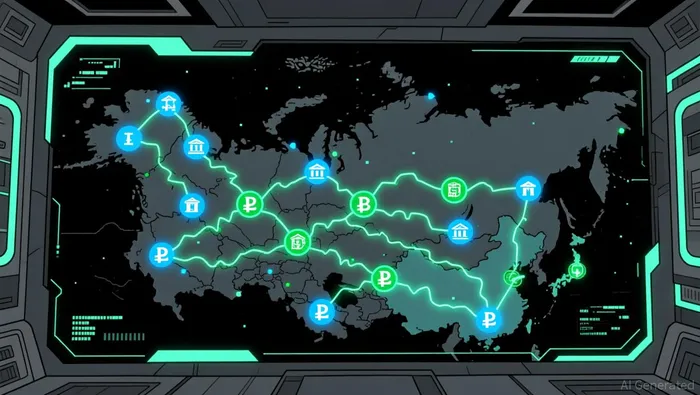 The DR's success hinges on robust infrastructure, and Russia's fintech and blockchain ecosystem is rising to meet the challenge. Major banks like VTB, Sberbank, and Tinkoff have joined the pilot program, with 17 additional institutions expected to participate in 2024. These banks are not just testing the DR-they're integrating it into their systems, enabling dynamic QR code payments, and preparing for cross-border transactions.
Blockchain firms are also playing a pivotal role. Masterchain, a Moscow-based fintech company, has partnered with VTB Bank and the CBR to issue digital financial assets under Russia's legal framework. Similarly, Laitkhaus and Veb3 Tekhnologii are providing blockchain solutions to Sberbank and Alfa-Bank, facilitating the issuance and transfer of digital rubles. These partnerships highlight a critical trend: the DR is not just a currency but a platform for innovation, with programmable features that could enable conditional payments, smart contracts, and real-time settlement.
However, the ecosystem is not without risks. The U.S. Treasury has sanctioned several Russian fintech firms, including B-Crypto and Masterchain, for their role in sanctions evasion. This underscores the geopolitical tensions surrounding the DR and the need for investors to carefully assess regulatory and compliance risks.
BRICS and Cross-Border Integration: A Global Play
Russia's ambitions extend beyond its borders. As the 2024 BRICS president, the country is spearheading the BRICS Bridge system, a platform for CBDC-based settlements that bypass SWIFT. This initiative aligns with broader BRICS goals of de-dollarization and financial sovereignty. A prototype for cross-border B2B transfers between Russia and Belarus has already been developed, signaling the potential for a regional CBDC network.
The BRICS Pay coin, a decentralized cross-border payment platform, is another key project. By integrating the digital ruble with the digital yuan and rupee, Russia aims to create a self-sufficient international payment system. This effort is supported by AI alliances and regulatory frameworks being developed within BRICS, further cementing the group's role in reshaping global finance.
Challenges and Opportunities for Investors
Despite its momentum, the DR faces hurdles. Public skepticism remains high, with only 30% of Russians expressing interest in using the digital ruble. Additionally, the CBR must navigate complex regulatory challenges, including balancing privacy concerns with the need for financial transparency.
For investors, these challenges also represent opportunities. The DR's infrastructure requires continuous innovation in blockchain, AI, and cybersecurity. Firms that can address these needs-while navigating geopolitical risks-stand to benefit. For example, companies developing interoperable CBDC solutions or cross-border payment platforms could capitalize on Russia's BRICS-driven initiatives. Similarly, fintech firms that help businesses adopt the DR for B2B transactions could tap into a market projected to grow significantly.
Conclusion: A High-Stakes Bet on the Future of Money
Russia's digital ruble is more than a response to sanctions-it's a bold experiment in redefining the global financial order. By leveraging fintech partnerships, blockchain innovation, and BRICS collaboration, the CBR is building a CBDC that could reshape cross-border trade and challenge the dominance of traditional systems. For investors, the DR represents a high-stakes opportunity to participate in a transformative project. However, success will require navigating regulatory, technological, and geopolitical complexities. As the DR moves toward its 2026 launch, the world will be watching to see if Russia can turn its digital ambitions into a reality.







Comentarios
Aún no hay comentarios