
Rupee's Resilience Play: Navigating Deficits and Fed Policy Shifts
The Indian rupee has been a standout performer among Asian currencies in 2025, defying expectations despite persistent external deficits and volatile capital flows. While the U.S. dollar has weakened on softening inflation and Fed rate-cut prospects, India's currency has held ground due to strategic corporate hedging, resilient FDI inflows, and a narrowing current account deficit (CAD). This article dissects the forces shaping the rupee's trajectory and identifies opportunities for investors betting on its resilience.
The CAD Conundrum: Pressures and Resilience
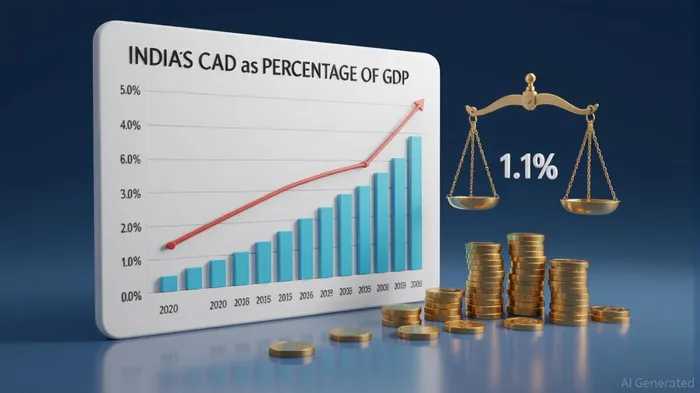
India's CAD widened to $9.7 billion (1.1% of GDP) in Q1 FY2025, driven by a $65.1 billion merchandise trade deficit—up sharply from $56.7 billion a year earlier. Oil and gold imports remain the primary culprits, with crude prices averaging $80/barrel and gold demand surging during festive seasons. However, services exports (up to $39.7 billion) and remittances ($29.5 billion) offset these pressures, keeping the CAD within manageable bounds.
Corporate dollar demand, however, remains a wildcard. While FDI inflows hit $6.3 billion in Q1 FY2025—up 34% year-on-year—foreign portfolio investments (FPI) slumped to $0.9 billion, down 94% from 2024 levels. This divergence underscores a critical point: India's external sector is increasingly dependent on stable FDI rather than volatile FPI.
Fed Policy Shifts: The Dollar's Weakness and Emerging Market Gains
The U.S. Federal Reserve's July 2025 meeting reaffirmed its “data-dependent” stance, holding rates at 4.25%–4.50% amid persistent core inflation (2.6% as of May). While markets had priced in a 5% chance of a July cut, the Fed signaled patience until inflation clearly retreats to 2%.
This cautious approach has weakened the dollar, with the USD Index down 3% year-to-date. For emerging markets like India, a weaker dollar reduces import costs and eases pressure on external debt servicing. More importantly, it could lure capital back to Asia via bond and equity flows.
Why the Rupee Outperforms Asian Peers
While the Thai baht and Indonesian rupiah have dipped 2%–3% against the dollar this year, the rupee has held near 84.50, supported by three key factors:
1. FDI Stability: India's $81 billion FDI inflows in FY2024–25, led by IT and manufacturing sectors, provide a steady dollar inflow.
2. Corporate Hedging: Exporters in IT and pharmaceuticals, which account for 55% of services exports, are locking in forward contracts to mitigate currency risk, reducing speculative pressure.
3. External Reserves: At $698 billion, reserves cover 11 months of imports, acting as a buffer against sudden capital outflows.
Strategic Opportunities: Rupee Forward Premiums
Investors can capitalize on the rupee's resilience through forward contracts, which currently offer a 1.5%–2% annualized premium. This strategy bets on the Fed cutting rates by mid-2026, which would further weaken the dollar and boost capital inflows into India's bond and equity markets.
Risks and Caution Flags
- Geopolitical Volatility: Escalating tensions in the India-Pakistan corridor or a U.S.-China trade spat could disrupt FDI and FPI flows.
- Crude Oil Prices: A spike above $90/barrel could widen the CAD to 1.5% of GDP, testing reserves.
- FPI Reversals: If global equities sell off (e.g., U.S. recession fears), FPI outflows could resume.
Investment Thesis: A Balanced Bet on Resilience
The rupee's divergence from weaker Asian peers is no fluke. Its stability stems from structural strengths—FDI-led growth, diversified exports, and robust reserves—that other emerging markets lack. Investors should consider:
1. Long Rupee Positions: Use forward contracts for hedged exposure, targeting a 7.5% return by year-end.
2. Sector-Specific Plays: Invest in IT and pharma stocks (e.g., Tata Consultancy Services, Dr. Reddy's Laboratories), which benefit from strong dollar inflows.
3. Monitor Crude Prices: Avoid overexposure if oil breaches $90/barrel.
Conclusion
The rupee's resilience in 2025 reflects a maturing economy balancing deficits with strategic investments. While risks linger, the Fed's eventual rate cuts and India's external buffers position the currency to outperform peers. For investors, this is a story of patience and selective opportunism—one where the rupee's divergence could yield asymmetric returns.







Comentarios
Aún no hay comentarios