
RUBBER-Japan Futures and Currency-Automotive Margin Dynamics in Emerging Markets
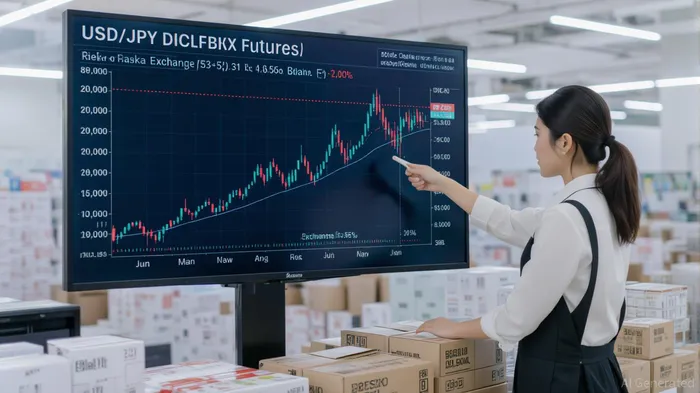
The interplay between RUBBER-Japan Futures, the Japanese yen, and automotive sector margins in emerging markets has become a critical focal point for investors navigating commodity-currency interdependencies. As global supply chains and trade policies evolve, the rubber market—anchored by Japan's Osaka Exchange (OSE)—has emerged as a barometer for broader economic tensions. This analysis unpacks the dynamics driving these markets, emphasizing how currency volatility and trade policy shifts are reshaping profit margins in the automotive industry.
Yen Volatility and Rubber Price Sensitivity
Japan's rubber futures market has demonstrated a clear inverse correlation with the yen, a pattern amplified by trade tensions and geopolitical uncertainties. For instance, when the yen strengthened to 148.70 yen per dollar in March 2025, OSE rubber prices fell by 2.34% [1]. Conversely, a weaker yen—such as the 145 yen/USD threshold—has historically supported rubber prices by enhancing the affordability of yen-denominated assets for foreign investors [1]. This dynamic is rooted in the yen's dual role: as a currency affecting export competitiveness and as a pricing mechanism for commodities.
Recent data underscores this sensitivity. In early September 2025, the yen hit a one-month high of 146.22 yen/USD, coinciding with a 0.47% drop in the OSE rubber contract for February delivery [3]. Analysts estimate that a yen below 145/USD could boost rubber prices by 1.5–2%, while further appreciation could trigger a 3–4% decline [2]. These fluctuations highlight the yen's outsized influence on rubber markets, particularly in emerging economies where automotive demand drives a significant portion of consumption.
Trade Policy and Tariff-Driven Volatility
Trade tensions, particularly between the U.S. and China, have compounded these dynamics. In late April 2025, U.S. duties on Chinese imports reached 145%, while China retaliated with 125% tariffs, causing a 15.79% drop in the October 2025 OSE rubber contract between February and April [1]. However, easing tariffs in May 2025 led to a 2.1% weekly rise in the May contract [1]. This volatility underscores the rubber market's sensitivity to geopolitical shifts, with historical data showing that a 1% reduction in tariffs could lift rubber prices by 0.8% [2].
The automotive sector, a major consumer of rubber, has borne the brunt of these disruptions. U.S. auto tariffs of $7,600 per vehicle in 2025 have indirectly pressured rubber demand, as automakers face higher production costs [1]. Meanwhile, China's auto exports surged 16% in Q1 2025, signaling growing rubber demand for tire production, which accounts for 70% of global rubber usage [4]. Yet, oversupply from Southeast Asia and Yunnan, China, has constrained prices near 300 yen/kg [1].
Automotive Sector Margin Compression
The automotive industry's margins have been squeezed by a trifecta of challenges: rubber price volatility, yen dynamics, and global supply chain bottlenecks. According to the Global Automotive Supplier Study 2025, the industry's average EBIT margin fell to 4.7% in 2024, down from 5.3% in 2023 [5]. Japanese automakers, in particular, have faced headwinds from U.S. tariffs, which reduced the value of auto exports to the U.S. by 28.4% [4]. This margin compression is exacerbated by the fact that rubber constitutes 20–40% of tire weight, making it a critical cost driver [3].
Emerging markets are especially vulnerable. For example, Indian tyre manufacturers saw operating margins decline from 16% in fiscal 2024 to 14% in Q1 2025 due to elevated rubber prices [3]. Similarly, Chinese automakers have grappled with a domestic price war, which has suppressed tire demand and further pressured rubber futures [3]. These trends are compounded by supply-side constraints, including Thailand's monsoon-related production disruptions and leaf disease outbreaks in key rubber-producing regions [4].
Strategic Implications for Investors
Investors must navigate these interdependencies by monitoring three key indicators:
1. USD/JPY Exchange Rate: A weaker yen could provide a tailwind for rubber prices and Japanese exporters, while further appreciation risks margin compression.
2. Trade Policy Developments: Easing U.S.-China tensions could stabilize rubber prices, whereas renewed tariffs may reignite volatility.
3. Automotive Demand Trends: China's auto exports and infrastructure stimulus efforts are critical for sustaining rubber demand.
For the automotive sector, structural cost improvements and strategic partnerships are essential. As noted by Roland Berger, suppliers must streamline product offerings and adopt flexible manufacturing platforms to accommodate both battery electric vehicles (BEVs) and internal combustion engine (ICE) models [5]. Toyota's use of forward foreign exchange contracts and currency options to hedge yen risks offers a blueprint for managing currency exposure [2].
Outlook
The rubber market remains in a fragile equilibrium, with prices oscillating between 285–300 yen/kg as traders weigh yen movements, trade policy shifts, and supply constraints [1]. While short-term relief from tariff easing has provided a modest boost, sustained recovery will depend on broader geopolitical stability, stronger auto demand, and a weaker yen [1]. For investors, the path forward lies in hedging against currency risks, capitalizing on emerging market demand, and positioning for long-term supply chain resilience.







Comentarios
Aún no hay comentarios