
RTX's $53M Expansion of Air and Missile Defense Sensors: Strategic Positioning in the Defense-Tech Boom and Long-Term Shareholder Value Creation
The global defense-tech sector is undergoing a seismic shift, driven by escalating geopolitical tensions, the proliferation of hypersonic weapons, and the urgent need for AI-enhanced military systems. According to a report by ResearchAndMarkets.com, the air and missile defense (AMD) market is projected to grow at a compound annual growth rate (CAGR) of 6.8%, reaching $985.4 billion by 2034[1]. Within this landscape, Raytheon Technologies Corporation (RTX) has positioned itself as a dominant player through its $53 million expansion of the Lower Tier Air and Missile Defense Sensor (LTAMDS) production facility in Andover, Massachusetts. This strategic move not only aligns with the sector's trajectory but also underscores RTX's commitment to long-term shareholder value creation.
Strategic Alignment with Market Trends
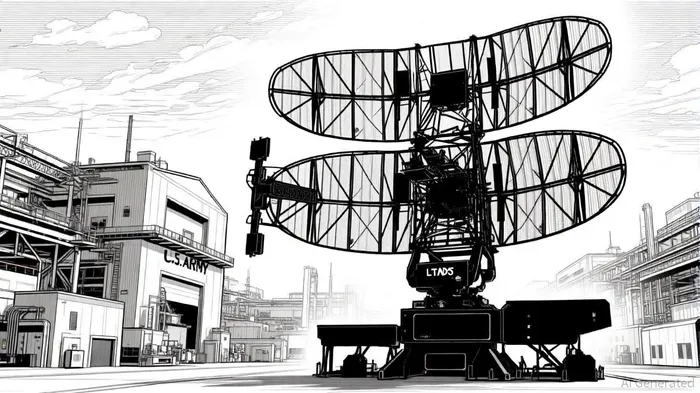
RTX's LTAMDS expansion is a direct response to the surging demand for advanced radar systems capable of countering hypersonic threats and drone swarms. The LTAMDS, a 360-degree radar system, has transitioned from prototype to production after passing eight rigorous flight tests and achieving the Department of Defense's Major Capability Acquisition Milestone C[2]. This system is now a cornerstone of the U.S. Army's Integrated Air and Missile Defense (IAMD) network, offering layered protection against cruise missiles, hypersonic glide vehicles, and unmanned aerial systems[3].
The timing of RTX's expansion is critical. With the U.S. Army planning to procure 94 LTAMDS radars and international demand growing-Poland has already secured 12 units and joined the supply chain as an energy storage module supplier-the company is scaling production from eight to 12 units annually[4]. This capacity increase ensures RTXRTX-- can meet both domestic and global demand while reducing production timelines from 40 to 36 months[5]. Such agility is rare in defense manufacturing and positions RTX to capture a larger share of a market expected to grow to $130 billion by 2033[6].
Financial Strength and Revenue Visibility
RTX's expansion is underpinned by a robust backlog of defense contracts, including a $1.7 billion low-rate initial production deal for LTAMDS and $2.89 billion in potential future options for AN/SPY-6(V) radar support[7]. These contracts, combined with a $1.1 billion AIM-9X Block II missile production deal and a $2.13 billion SM-3 missile system support contract, provide clear revenue visibility[8]. In 2024, RTX reported a 17.15% year-over-year revenue increase to $80.74 billion and a 49.42% surge in net income to $4.77 billion[9]. The company has since raised its 2025 adjusted sales guidance to $84.75–$85.50 billion, reflecting confidence in its defense and aerospace electrification initiatives[10].
The expansion also aligns with RTX's broader diversification into sustainable aviation technologies. Through its Collins Aerospace division, the company is developing electric thrust reverser systems (elecTRAS), which offer a 15–20% weight reduction compared to traditional systems[11]. This move taps into the $11.85 billion electric aircraft propulsion market, projected to grow at a 12.1% CAGR through 2029[12]. By balancing defense and aerospace innovation, RTX is mitigating sector-specific risks while capitalizing on cross-industry synergies.
Shareholder Value and Future Outlook
RTX's strategic investments are translating into tangible shareholder value. The company's free cash flow guidance of $7.0–$7.5 billion for 2025, despite short-term headwinds like tariffs and tax changes, highlights its operational resilience[13]. Additionally, partnerships like the one with Shield AI-aimed at integrating AI-driven technologies such as Networked Collaborative Autonomy (NCA) and Visual Detection and Ranging (ViDAR)-are enhancing the combat effectiveness of RTX's systems and securing a competitive edge[14].
Conclusion
RTX's $53 million LTAMDS expansion is more than a capital investment-it is a calculated bet on the future of defense technology. By aligning with the AMD market's growth trajectory, securing high-margin contracts, and diversifying into aerospace electrification, RTX is fortifying its position as a leader in both traditional and emerging defense sectors. For investors, this strategic clarity, coupled with strong financial performance and revenue visibility, presents a compelling case for long-term value creation.





Comentarios
Aún no hay comentarios