
RTW Biotech's NAV Surge: Strategic and Financial Implications of the Biogen Licensing Deal
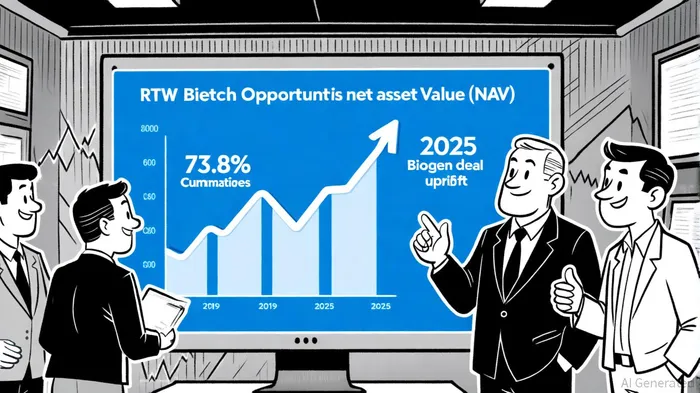
The recent $85 million licensing deal between BiogenBIIB-- and Alcyone Therapeutics—part of RTW Biotech Opportunities Ltd's portfolio—has catalyzed a significant 242% uplift in RTW's carrying value for the asset, contributing $5.0 million to its net asset value (NAV) [1]. This transaction, coupled with RTW's broader 2024 NAV growth from $399 million to $607 million [3], underscores the company's ability to identify and scale high-impact biotech innovations. For investors, the deal exemplifies the strategic and financial potential of early-stage biotech platforms that leverage cutting-edge therapeutic technologies.
Financial Implications: A Catalyst for NAV Appreciation
Biogen's upfront payment of $85 million, alongside milestone-based incentives, reflects the growing industry trend of prioritizing late-stage, high-value assets [2]. For RTW, this deal not only validates the commercial viability of Alcyone's ThecaFlex DRx™—an implantable intrathecal delivery device—but also amplifies its NAV through a combination of immediate cash flow and future upside. The 242% uplift from RTW's $2.1 million initial investment highlights the compounding returns achievable in biotech licensing, particularly when partnering with industry leaders like Biogen [1].
Historically, RTW has demonstrated a knack for capitalizing on such opportunities. Its 2024 annual report revealed a 73.8% NAV growth since its 2019 IPO, outperforming major biotech indices like the Nasdaq Biotech (34.6%) and Russell 2000 Biotech (6.5%) [3]. This trajectory was fueled by strategic exits, including the $1.25 billion acquisition of Numab's lead asset by Johnson & Johnson and robust returns from Avidity Biosciences (+221%) and Tarsus Pharmaceuticals (+173%) [3]. The Biogen deal now adds another layer of momentum, with analysts noting that such licensing events are critical for sustaining NAV growth in an increasingly risk-averse biotech landscape [2].
Strategic Implications: Biogen's Vision and RTW's Portfolio Resilience
Biogen's acquisition of Alcyone aligns with its 2025 strategic priorities to expand its drug delivery solutions portfolio, particularly for neurological therapies like Spinraza (nusinersen) [4]. ThecaFlex DRx™, which has received FDA Breakthrough Device Designation and a CE Mark in Europe, is positioned to revolutionize the administration of antisense oligonucleotides (ASOs) by replacing invasive lumbar punctures with a patient-centric implantable system [1]. For Biogen, this technology not only enhances the value proposition of its existing therapies but also opens pathways for future pipeline candidates, including RNAi-based treatments [5].
RTW's role in this ecosystem is equally strategic. By spinning off Alcyone's remaining assets—such as its Falcon™ drug transport modeling platform—into a new entity, Neela Therapeutics, and securing Biogen's participation in its financing, RTW has ensured continued value extraction from the original investment [1]. This approach mirrors the company's broader strategy of maximizing returns through staged exits and partnerships, a model that has proven resilient amid macroeconomic headwinds like rising interest rates [2].
Market Trends and Investment Potential
The biotech licensing landscape in 2025 is characterized by a shift toward high-value, later-stage assets, driven by pharma companies' need to offset patent expirations and investor pressures [2]. While deal volume has declined post-pandemic, the average deal size has increased, reflecting a more selective approach. For early-stage platforms like RTW, this environment presents both challenges and opportunities. On one hand, rising capital costs have constrained smaller biotechs; on the other, the demand for innovative delivery systems—like ThecaFlex DRx—has created a niche where RTW's portfolio can thrive [5].
Investors should also consider the geopolitical and technological dynamics shaping the sector. The integration of AI in drug development, for instance, is reducing R&D costs and accelerating timelines, factors that could enhance the commercial viability of assets like ThecaFlex DRx [2]. Meanwhile, geopolitical risks—such as U.S.-China collaboration tensions—remain a wildcard, though RTW's focus on Western partnerships mitigates this exposure [5].
Conclusion: A Model for Biotech Investment
RTW Biotech's success with the Biogen deal and its broader 2024 performance illustrate the potential of early-stage biotech platforms to deliver outsized returns through strategic licensing and portfolio diversification. For investors, the key takeaway is clear: platforms that combine scientific innovation with agile capital allocation—like RTW—are well-positioned to navigate the evolving biotech landscape. As ThecaFlex DRx moves toward its 2028 launch and RTW continues to execute on its exit strategy, the company's NAV trajectory offers a compelling case study in the power of biotech dealmaking.





Comentarios
Aún no hay comentarios