
Royce Global Trust: Navigating the Alternative Income Landscape in 2025
The alternative income market in 2025 is undergoing a profound transformation, driven by the convergence of traditional and alternative asset strategies, rising demand for private credit, and a global shift toward diversified, high-conviction investments. Against this backdrop, Royce Global Trust (RGT), a closed-end fund focused on global small-cap equities, has carved out a compelling niche. By leveraging a disciplined value approach and a long-term compounding strategy, RGTRGT-- aligns with key trends in the evolving income landscape while mitigating risks inherent to its asset class.
Strategic Positioning: Value Investing in a Globalized World
RGT's investment thesis centers on identifying undervalued small- and mid-cap companies across both U.S. and international markets. As of August 31, 2025, the fund's portfolio is weighted toward Financials (29.4%) and Industrials (27.2%), with a global allocation of at least 65% to non-U.S. equities [1]. This geographic diversification aligns with the broader trend of “home country bias” reversal, where investors are increasingly reallocating capital to non-domestic opportunities to capitalize on relative valuations and growth potential [2].
The fund's weighted average P/E ratio of 25.1x and P/B ratio of 3.1x suggest a focus on companies with strong fundamentals but potentially overlooked by broader markets [1]. This value-oriented strategy resonates in an environment where investors are seeking alternatives to traditional income sources, such as bonds, which face pressure from higher interest rates. RGT's emphasis on high returns on invested capital and long-term compounding further positions it to benefit from the “great convergence” between public and private markets, where semi-liquid products and hybrid strategies are gaining traction [3].
Performance and Risk: A Balancing Act
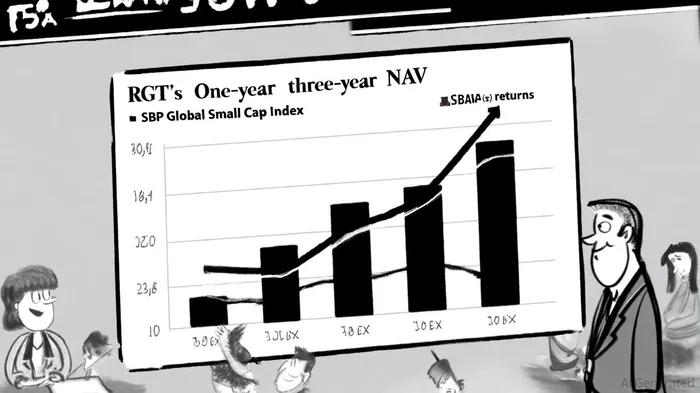
RGT's performance metrics underscore its effectiveness in navigating volatile markets. As of August 31, 2025, the fund's net asset value (NAV) stood at $14.83, while its market price traded at $12.74—a 14% discount to NAV [1]. This discount reflects market skepticism toward small-cap and international equities, which are inherently more volatile than large-cap domestic stocks. However, the fund's one-year and three-year total returns at NAV were 15.63% and 15.80%, respectively, outperforming the S&P Global Small Cap Index [1]. Year-to-date returns of 18.17% at NAV highlight its resilience in a challenging macroeconomic climate.
The fund's risk profile is shaped by its exposure to small-cap and foreign securities, which carry higher volatility and geopolitical risks. For instance, its top holdings include companies like Tel Aviv Stock Exchange and Sprott, which are sensitive to regional economic shifts [1]. Yet, RGT's manager, Royce & Associates, has mitigated these risks through rigorous due diligence and a 50-year track record in managing small-cap portfolios [1].
Dividend Yield and Income Generation
With a projected 2025 dividend yield of 3.61%, RGT offers an attractive income stream for investors seeking alternatives to traditional fixed-income assets [4]. This yield, while lower than the top quartile of financial services sector peers, exceeds the average of the bottom 25% of U.S. dividend payers [4]. The fund's income generation is derived from dividends of its portfolio companies, many of which operate in sectors with strong cash flow generation, such as Financials and Industrials [1].
The rising interest rate environment has made income strategies more competitive, particularly as private credit and infrastructure investments gain traction. RGT's focus on equities with durable cash flows complements these trends, offering a hybrid approach that balances growth and income.
Alignment with Market Trends
The alternative income market in 2025 is characterized by three key dynamics:
1. Private Credit Expansion: Projected to reach $2.6 trillion by 2029, private credit is increasingly seen as a complement to traditional credit, offering tailored financing solutions [5]. While RGT is not a private credit fund, its emphasis on small-cap equities with strong balance sheets aligns with the sector's focus on high-quality, asset-backed investments.
2. Global Diversification: Investors are rotating into non-U.S. markets to exploit valuation spreads and macroeconomic divergences. RGT's 65% international allocation positions it to capitalize on this trend, particularly in emerging markets where small-cap growth opportunities are abundant [2].
3. Convergence of Public and Private Markets: Innovations like semi-liquid products are blurring the lines between public and private investing. RGT's closed-end structure and active management model mirror the flexibility of private funds while retaining public market liquidity, making it a hybrid solution for investors seeking both growth and income [3].
Conclusion: Opportunities and Challenges
Royce Global Trust's strategic positioning in the alternative income market is both timely and robust. Its value-driven approach to global small-cap equities, combined with a disciplined risk management framework, offers a compelling proposition for investors seeking long-term capital growth and income. However, the fund's exposure to volatile sectors and foreign markets necessitates careful consideration of macroeconomic risks, particularly in regions with political or currency instability.
As the alternative income landscape continues to evolve, RGT's ability to adapt to shifting investor preferences—whether through sector reallocation or enhanced liquidity solutions—will be critical to sustaining its performance. For now, its strong returns, competitive dividend yield, and alignment with macro trends make it a noteworthy player in the 2025 investment arena.





Comentarios
Aún no hay comentarios