
Royal Gold's $3.5 Billion Merger with Sandstorm Gold: A Strategic and Financial Deep Dive for Long-Term Gold Investors
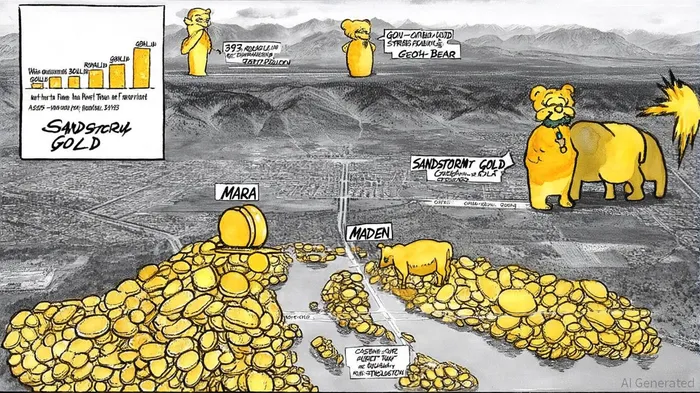
The proposed merger between Royal GoldRGLD--, Inc. (RGLD) and Sandstorm Gold Ltd.SAND-- represents a seismic shift in the precious metals streaming and royalty sector. Valued at approximately $3.5 billion for SandstormSAND-- and $196 million for Horizon Copper, the all-stock transaction is poised to create the largest and most diversified entity in its category. For long-term gold investors, this deal raises critical questions: Does the merger enhance strategic positioning? What are the financial implications for growth and risk mitigation? And how does it align with broader market dynamics?
Strategic Rationale: Scale, Diversification, and Institutional Appeal
The merger's primary strategic benefit lies in its ability to consolidate two industry leaders into a single entity with unparalleled scale. Royal Gold, already a dominant player in the royalty and streaming space, will now control 393 royalties and streams, including 80 cash-flowing assets and 47 development-stage projects. This diversification is a key differentiator: no single asset accounts for more than 13% of net asset value, reducing exposure to operational risks at individual mines [1].
According to a report by Panabee, the combined portfolio will generate 75% of its revenue from gold and 87% from precious metals overall, maintaining Royal Gold's gold-dominant profile while broadening its revenue streams [2]. This balance is critical in a sector where volatility is inherent. By integrating Sandstorm's high-growth development assets—such as MARAMARA-- (Glencore), Hod Maden (SSR Mining), and Platreef (Ivanhoe Mines)—the new entity gains exposure to projects with significant upside potential [3].
The merger also enhances institutional appeal. As noted by Sandstorm Gold's official announcement, the expanded scale and liquidity are expected to attract a larger base of institutional investors, a demographic that typically drives long-term valuation growth [4]. This is a strategic win for Royal Gold, which has historically traded at a discount to its intrinsic value due to its smaller size.
Financial Implications: Production Growth and Valuation Metrics
Financially, the merger is a catalyst for production growth. Royal Gold anticipates a 26% increase in 2025 gold equivalent ounce (GEO) production, adding between 65,000 and 80,000 GEOs to its output [2]. This growth is not just quantitative but qualitative: the combined portfolio's emphasis on cash-flowing assets (80 in total) ensures a stable revenue base even as development projects mature.
Valuation metrics also appear favorable. The 21% premium offered to Sandstorm shareholders—based on a 20-day volume-weighted average price—signals confidence in the deal's accretive potential [1]. Analysts at H.C. Wainwright have reiterated a “Buy” rating on Sandstorm GoldSAND-- stock, maintaining a price target of $11.75, which reflects optimism about the merger's value creation [5].
However, the all-stock structure raises questions about dilution. Royal Gold shareholders will own 77% of the combined entity, while Sandstorm shareholders will hold 23%. While this dilution is significant, the expanded asset base and operational synergies are expected to offset it over time [3].
Market Sentiment and Risk Considerations
Market reaction has been largely positive. Sandstorm Gold's stock surged 6.3% following the announcement, reflecting investor enthusiasm [5]. Analysts highlight the merger's potential to unlock a valuation premium typically reserved for large-cap streaming companies. As Reuters noted, the deal strengthens Royal Gold's position as a North American leader in the sector [5].
That said, risks remain. Regulatory and shareholder approvals are still pending, with the merger expected to close in Q4 2025 [1]. Integration challenges—such as aligning corporate cultures and optimizing asset management—could also impact short-term performance. Additionally, the all-cash acquisition of Horizon Copper for $196 million, while a smaller component of the deal, adds complexity to the capital structure [2].
Conclusion: A Win for Long-Term Investors?
For long-term gold investors, the Royal Gold-Sandstorm merger offers a compelling mix of scale, diversification, and growth. The combined entity's robust portfolio, enhanced liquidity, and institutional appeal position it to outperform in a sector where volatility is the norm. While risks like regulatory delays and integration costs exist, the strategic and financial benefits appear to outweigh them.
As the fourth quarter of 2025 approaches, investors should monitor key milestones: shareholder votes, regulatory approvals, and the performance of development assets like MARA and Hod Maden. If executed successfully, this merger could redefine the precious metals streaming sector—and deliver substantial value to those with a long-term horizon.





Comentarios
Aún no hay comentarios