
Royal Caribbean's Post-Pandemic Struggles: A Strategic Analysis of Underperformance in the Cruise Recovery
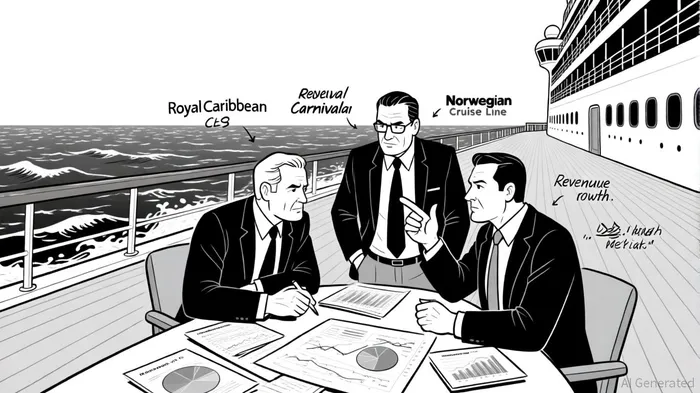
The post-pandemic cruise industry has witnessed a remarkable rebound, with companies like CarnivalCCL-- Corporation surging ahead in both revenue and stock performance. Royal Caribbean Group (RCL), however, has lagged behind, raising questions about its strategic positioning and operational execution in a market that has otherwise shown robust recovery. This analysis examines RCL's underperformance relative to peers like Carnival (CCL) and Norwegian CruiseNCLH-- Line (NCLH), focusing on financial metrics, capital allocation, and competitive strategies.
Financial Performance: A Tale of Two Recoveries
Royal Caribbean's Q1 2024 results reflect a 29% year-over-year revenue increase to $3.7 billion, driven by a 107% load factor—a sign of strong demand for its premium itineraries [2]. However, this growth pales in comparison to Carnival's $5.4 billion quarterly revenue in the same period, which marked a record for the company and surpassed 2023 levels [3]. Carnival's stock price surged 133% in 2023 alone, fueled by its “SEA Change” strategy to boost profitability per available guest bed day (ALBD) and reduce debt [1].
Norwegian Cruise Line, meanwhile, reported $2.2 billion in Q1 2024 revenue—a 20% year-over-year increase—but faces a more precarious financial position. While its total debt of $13.7 billion is lower than RCL's $20.5 billion, Norwegian's shareholders' equity of just $362 million versus RCL's $5.3 billion highlights its vulnerability to market volatility [2]. This contrast underscores RCL's stronger balance sheet, yet its stock has not translated this into market leadership, suggesting misalignment between financial strength and investor sentiment.
Strategic Divergence: Innovation vs. Profitability
Royal Caribbean has prioritized fleet expansion and product innovation, allocating $3.4 billion to add new ships—a stark contrast to Norwegian's $575 million in capital expenditures [2]. The company's focus on “destination-focused itineraries,” such as cruises from Singapore to Tokyo, and the 2025 debut of the Star of the Seas, signals a bet on premium, experience-driven travel [3]. While these initiatives align with growing demand for unique cruise experiences, they also require significant upfront investment, potentially delaying profitability.
Carnival, by contrast, has leaned into cost discipline and operational efficiency. CEO Josh Weinstein's “SEA Change” plan emphasized reducing costs per ALBD and accelerating debt reduction, which helped the company cut total debt from $31.89 billion in 2023 to $28.88 billion in 2024 [3]. This focus on profitability over aggressive expansion has resonated with investors, particularly in a high-interest-rate environment where cash flow is king.
Norwegian's “More At Sea™” all-inclusive package and new ship launches, such as the Norwegian Aqua, aim to enhance guest value while boosting onboard revenue [3]. However, its reliance on high-margin ancillary offerings may not scale as effectively as RCL's diversified approach, leaving it in a middle ground between innovation and profitability.
Operational Challenges: Debt, Capacity, and Market Positioning
RCL's underperformance may also stem from its heavy debt burden and capital-intensive strategy. While its $20.5 billion in debt is manageable given its $5.3 billion in shareholders' equity, the company's $3.4 billion in planned capital expenditures could strain liquidity if demand softens [2]. Carnival's $4.5 billion revolving credit facility, secured in 2025, provides a liquidity buffer that RCLRCL-- lacks, enabling more flexible fleet modernization and sustainability upgrades [3].
Strategically, RCL's premium positioning has both advantages and risks. Its focus on adventure and luxury itineraries appeals to a niche market, but Carnival's budget-conscious “party” brand and Norwegian's all-inclusive packages have broader mass-market appeal [1]. This differentiation may explain why RCL's load factors, while strong, have not translated into outsized revenue growth compared to peers.
Conclusion: A Path Forward
Royal Caribbean's post-pandemic recovery hinges on balancing its innovative brand with financial prudence. While its fleet expansion and global itineraries position it to capture premium segments, the company must address investor concerns about debt sustainability and profitability. Carnival's disciplined approach and Norwegian's value-driven strategies offer contrasting models for navigating the sector's evolving dynamics. For RCL to reclaim its market leadership, it will need to demonstrate that its capital-intensive bets will yield returns that outpace both its peers and the broader market.





Comentarios
Aún no hay comentarios