
Royal Bank of Canada (RY): A Defensive Income Powerhouse in a High-Interest-Rate World
In an era of persistent high interest rates, income-focused investors are increasingly prioritizing stocks that combine reliable dividends with robust financial resilience. Royal Bank of CanadaRY-- (RY), Canada's largest bank by market capitalization, emerges as a compelling candidate for such a strategy. With a 31-year streak of consecutive dividend increases, a fortress-like balance sheet, and a global footprint that buffers against regional economic volatility, RY exemplifies the qualities of a top-tier defensive income play.
Dividend Reliability: A Track Record Forged in Economic Fire
RY's dividend history is a testament to its commitment to shareholder value, even during periods of macroeconomic stress. As of 2025, the bank distributes an annual dividend of C$5.40 per share, translating to a trailing twelve-month (TTM) yield of 2.91% [1]. This yield, while modest compared to the peak of 12.19% in 2008 [2], reflects a disciplined approach to balancing returns with sustainability.
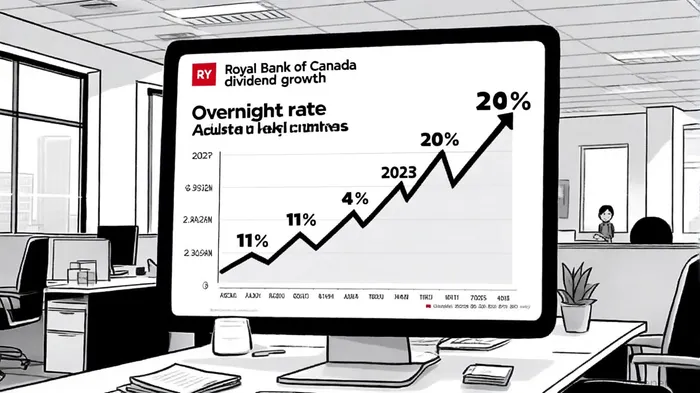
The bank's ability to raise dividends consistently—averaging 6.59% annual growth over five years [3]—is underpinned by a payout ratio of 45.81% [1], ensuring ample retained earnings to weather downturns. During the 2008 financial crisis, RY avoided dividend cuts despite broader market turmoil, and in the post-2022 rate-hiking cycle, it increased payouts by 4% in July 2023 and 4.87% in 2024 [4]. These adjustments highlight RY's adaptability to shifting interest rate environments, a critical trait for defensive investing.
Balance-Sheet Strength: A Pillar of Stability
RY's financial fortitude is a cornerstone of its dividend resilience. As of October 2024, the bank reported C$1.56 trillion in total assets and a Common Equity Tier 1 (CET1) ratio of 13.2% [5], exceeding regulatory requirements and providing a buffer against credit risks. Its debt-to-equity ratio, while variable depending on accounting methods (15.43x for long-term debt vs. 2.41x for total debt) [6], remains manageable given its strong liquidity position and low leverage relative to peers.
The bank's diversified business model further enhances its stability. In Q3 2025, RY's net interest income rose 14% year-over-year in Personal Banking and 8% in Commercial Banking, driven by higher lending rates [7]. This operational leverage allows RY to capitalize on rate hikes while maintaining profitability, a dynamic that supports consistent dividend payments.
Global Resilience: Diversification as a Strategic Advantage
RY's international presence—spanning 55 countries and 80,000 employees [8]—acts as a natural hedge against regional economic shocks. While Canadian operations remain its core, growth in segments like Capital Markets and Global Wealth Management has diversified revenue streams. For instance, its Corporate & Investment Banking division has benefited from increased M&A activity in a high-rate environment, offsetting slower domestic retail banking growth.
This global diversification also mitigates currency and regulatory risks. RY's investments in technology and talent, coupled with its C$204 billion market capitalization [8], position it to navigate geopolitical uncertainties while maintaining competitive margins.
Why RY Stands Out in a High-Rate World
While rising interest rates can pressure banks by increasing borrowing costs, RY's net interest margin (NIM) expansion—such as the 24-basis-point improvement to 2.61% in Q3 2025 [7]—demonstrates its ability to turn rate hikes into profit drivers. Additionally, its 49.78% payout ratio [3] ensures dividends remain well-covered, even if earnings temporarily contract.
Analysts project RY's payout ratio will decline to 43% over the next three years [9], suggesting further room for growth without compromising financial health. This forward-looking optimismOP-- is supported by RY's $1.56 trillion asset base and $91.25 billion in shareholders' equity [5], which provide ample capacity for both dividends and strategic reinvestment.
Historical data on RY's stock price reactions to earnings releases since 2022 reveals a mixed and generally muted pattern. Over 14 analyzed events, the average cumulative return within a 30-day window was approximately -0.7%, slightly underperforming the +0.8% benchmark. The win rate for positive returns hovered near 50%, indicating no statistically significant edge for timing trades around earnings announcements. Short-term price movements (1–10 days post-earnings) also showed a slight negative drift, though results remained within confidence bands, suggesting no material predictability. These findings underscore that RY's stock performance is more influenced by its underlying fundamentals—such as NIM expansion and disciplined payout ratios—than by short-term earnings-driven volatility.
Conclusion: A Dividend Champion for the Long Term
Royal Bank of Canada's combination of consistent dividend growth, a rock-solid balance sheet, and global diversification makes it a rare gem in today's high-interest-rate landscape. While no stock is immune to systemic risks, RY's historical performance during past rate cycles—such as the 2000s and post-2022 periods—proves its ability to adapt and thrive. For income investors seeking stability and long-term growth, RY offers a compelling case: a dividend that has never missed a payment for over three decades, backed by a business model built to endure.





Comentarios
Aún no hay comentarios