
Romania's Trump Moment: The Geopolitical Risks and Investment Implications of George Simion's Presidential Bid
The 2025 Romanian presidential election rerun has become a battleground for far-right populism, with George Simion of the Alliance for the Union of Romanians (AUR) positioning himself as the "MAGA of Eastern Europe." Simion’s campaign, blending Trump-style rhetoric with irredentist nationalism, has captured the political imagination of a nation weary of corruption and EU dominance. 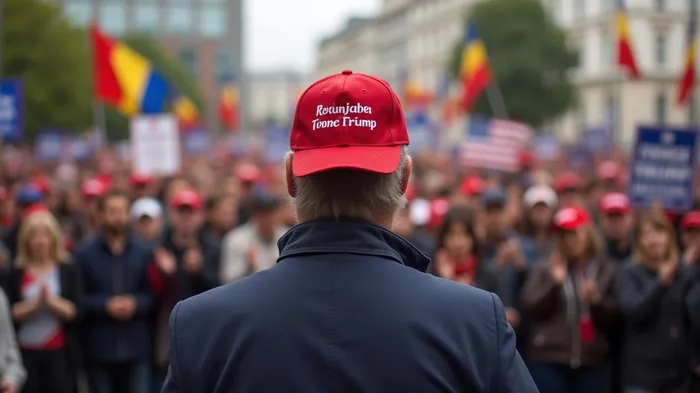 . His rise raises profound questions for investors: How might his victory reshape Romania’s geopolitical stance, and what does it mean for its economy and markets?
The Domestic Political Landscape: A Far-Right Surge
Simion’s platform mirrors Trump’s “America First” playbook: sovereignty, anti-establishment anger, and skepticism toward global institutions. He demands Romania increase defense spending to 4% of GDP—a higher target than NATO’s 2% requirement—and opposes military aid to Ukraine, framing it as a drain on national resources. His rhetoric resonates with rural, working-class voters, who constitute 34% of Romania’s population and have long felt sidelined by urban elites.
The campaign has also weaponized nostalgia, reviving claims to pre-1940 borders in Ukraine, Moldova, and Bulgaria—a stance that has drawn accusations of irredentism. Simion’s ties to Trump’s inner circle, including former adviser Steve Bannon, have amplified his profile, while his party’s social media prowess—particularly on TikTok—has fueled a surge in support.
The BVB index has dipped 8% since Simion’s rise began in early 2024, reflecting investor anxiety over political instability. Meanwhile, AUR’s 29% poll lead underscores the fragility of centrist alternatives like centrist mayor Nicusor Dan (18%) and Social Democrat Crin Antonescu (22%), who advocate EU/NATO alignment and support for Ukraine.
Geopolitical Crossroads: NATO, the EU, and Regional Tensions
Simion’s victory could fracture Romania’s position as a NATO/EU stalwart. His calls to cut aid to Ukraine and prioritize territorial claims risk destabilizing the Black Sea region, a key corridor for energy exports to Europe.
The EU’s response is critical: Brussels has already threatened sanctions over AUR’s far-right rhetoric and alleged Russian ties. Simion’s denial of pro-Russian sympathies contrasts with his pledge to grant a top role to Calin Georgescu—a banned pro-Kremlin candidate—raising red flags.
While Romania currently spends 2.1% of GDP on defense, Simion’s 4% pledge could strain budgets already burdened by pension reforms and public debt (36% of GDP in 2023). Such fiscal pressures may deter foreign investment in sectors like energy and infrastructure, which depend on stable public finances.
Market Reactions and Investment Risks
Foreign investors, particularly in sectors tied to EU funding or defense, face heightened uncertainty. Romania’s energy sector—reliant on EU subsidies for renewables—could suffer if Simion’s anti-EU stance weakens regulatory alignment. Meanwhile, his defense spending pledge might boost local contractors, but the diversion of resources from other areas could stifle growth.
Political risk consultancy Verisk Maplecroft has upgraded Romania’s risk score to “high,” citing Simion’s irredentism and ties to global far-right networks. This could deter foreign direct investment (FDI), which fell 15% in 2023 amid existing concerns about corruption and bureaucracy.
Simion’s campaign also faces legal hurdles: Romania’s electoral authority is investigating his party’s use of a $1.5 million U.S. lobbying firm to secure media access—a potential violation of election laws. Such scandals could undermine investor confidence, though they may not derail his momentum.
Conclusion: Populism vs. Pragmatism
Simion’s success hinges on his ability to channel public frustration with corruption and EU overreach. Yet his victory carries significant risks. A Romania that turns inward, prioritizes territorial claims, and strains NATO ties could see its economy shrink as foreign investors retreat and trade barriers rise.
Historically, far-right populism has exacted economic costs: Poland’s Law and Justice Party saw GDP growth drop to 2.3% in 2022 from 5.1% in 2015 after clashing with the EU. Meanwhile, AUR’s 29% support mirrors Trump’s 2016 base—roughly 30% of U.S. voters—but the economic fallout could be worse for a smaller, export-dependent economy like Romania’s.
Investors should prepare for volatility. A Simion win would likely pressure the leu, already down 7% against the euro since 2023, and shrink the BVB index further. Prudent investors might hedge with short positions in Romanian equities or shift to EU-aligned sectors like tech or green energy. The stakes are high: this election tests whether democracies can resist the siren call of populist nationalism—or pay the price of trying.







Comentarios
Aún no hay comentarios