
Roman DBDR Acquisition Corp II's SPAC Strategy and Growth Potential
Roman DBDR Acquisition Corp II's SPAC Strategy and Growth Potential
Roman DBDR Acquisition Corp II (DRDB) has positioned itself as a strategic player in the evolving SPAC landscape, leveraging its $230 million IPO proceeds to pursue a business combination in high-growth sectors such as cybersecurity, artificial intelligence (AI), and financial technology (FinTech), as noted in a PR Newswire release. As the SPAC market enters a new phase-often termed "SPAC 4.0"-characterized by enhanced governance and investor protections, DRDB's strategy reflects both the opportunities and challenges of this maturing environment, as discussed in a JD Supra article. However, the potential merger with John J. Birm's portfolio company introduces a nuanced case study, blending sector-specific dynamics with broader market trends.
Strategic Alignment and Sector Dynamics
DRDB's focus on cybersecurity, AI, and FinTech aligns with industries experiencing rapid innovation and capital inflows. For instance, AI spending in financial services is projected to surge from $35 billion in 2023 to $97 billion by 2027, driven by applications like hyper-personalization and synthetic data analytics, according to a Forbes article. Meanwhile, cybersecurity remains a critical concern, particularly as AI-driven threats evolve. These sectors offer DRDBDRDB-- a runway for value creation, provided it secures a target with scalable technology and defensible market positioning.
John J. Birm's portfolio company, however, operates in a different arena: flywheel-based power boosting solutions for EV charging infrastructure. While this business completed a merger with Pegasus Digital Mobility Acquisition Corp in April 2024, according to an Earlybird list, its relevance to DRDB's target sectors is indirect. The EV charging market, though distinct from FinTech or AI, is itself a high-growth industry, projected to expand from $28.47 billion in 2025 to $76.31 billion by 2032 at a 15.1% CAGR, as reported in a Yahoo Finance report. This divergence raises questions about strategic fit but also highlights the flexibility of SPACs to pivot based on market conditions.
Market Context and SPAC 4.0 Trends
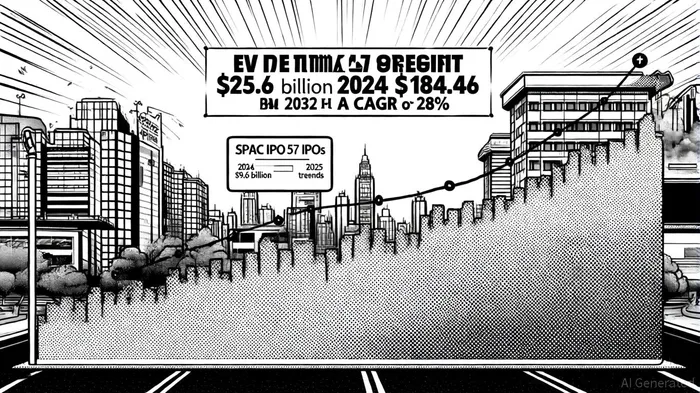
The SPAC market's resurgence in late 2024-marked by 57 IPOs and $9.6 billion raised-underscores renewed investor appetite for structured growth opportunities. The JD Supra article referenced above highlights this resurgence and the emergence of SPAC 4.0. SPAC 4.0 iterations emphasize transparency, with stricter SEC rules requiring detailed disclosures on conflicts of interest and financial projections, as outlined in the SEC draft taxonomy. For DRDB, this means navigating a more rigorous regulatory environment while demonstrating the merits of its target. If Birm's EV charging company is indeed the focus, its technological differentiation (e.g., flywheel-based solutions) could justify a premium valuation, particularly given government incentives like the U.S. $7.5 billion Infrastructure Investment and Jobs Act and broader market analysis from the Yahoo Finance report referenced above.
Investment Case: Risks and Rewards
The investment case for DRDB hinges on three pillars: market potential, financial leverage, and strategic execution.
1. Market Potential: If DRDB targets Birm's EV charging business, it taps into a sector poised for explosive growth. Charge point operators (CPOs), which dominate revenue generation through integrated solutions, are expected to capture 65% of the EVSE market by 2030, according to the Yahoo Finance report cited earlier. This aligns with Birm's flywheel technology, which could enhance grid efficiency and reduce infrastructure costs.
2. Financial Leverage: DRDB's $230 million war chest provides flexibility to negotiate favorable terms, especially in a competitive M&A environment. However, the 24-month deadline to complete a deal introduces urgency, necessitating a balance between speed and due diligence.
3. Strategic Execution: The success of the merger depends on post-combination integration. For example, if Birm's EV charging company lacks FinTech or AI synergies, DRDB may need to pivot or invest in cross-sector capabilities-a risk given SPACs' limited timeframes.
Conclusion
Roman DBDR Acquisition Corp II's SPAC strategy encapsulates the duality of the 2025 market: a blend of sector-specific innovation and macroeconomic tailwinds. While the potential merger with John J. Birm's EV charging company diverges from DRDB's stated focus areas, it underscores the adaptability required in today's SPAC landscape. Investors must weigh the sector's growth potential against integration risks and regulatory scrutiny. For DRDB, the path forward will depend on its ability to articulate a compelling narrative that bridges technological differentiation with long-term value creation.





Comentarios
Aún no hay comentarios