
The Role of Technology and Materials Sectors in Driving U.S. Equity Gains
In late-stage bull markets, the interplay between sectoral momentum and re-rating potential often defines the trajectory of equity gains. As of Q3 2025, the technology and materials sectors stand at critical junctures, shaped by macroeconomic shifts, innovation cycles, and valuation dynamics. This analysis examines their roles in driving U.S. equity performance, focusing on their distinct drivers and risks.
Technology Sector: AI-Driven Momentum and Attractive Valuations
The technology sector has emerged as a cornerstone of market resilience in 2025, fueled by the rapid adoption of artificial intelligence (AI) and cloud computing. According to Deloitte's 2025 technology outlook, global IT spending is projected to rise by 9.3% in 2025, with data center and software segments growing at double-digit rates. This surge is underpinned by enterprises prioritizing AI-powered applications and scalable infrastructure, as shown in Siblis Research data indicating 78% of companies plan to boost cloud investments in the second half of 2025.
Valuation metrics further highlight the sector's appeal. Siblis Research reports the technology sector's forward price-to-earnings (P/E) ratio of 22x is currently a discount to its five-year average of 28x, suggesting undervaluation relative to historical norms. Major cloud providers have stabilized revenue growth at 25–30% annually, with profit margins expanding due to operational leverage, according to the same Siblis Research dataset. Additionally, the Deloitte outlook projects AI chip demand to grow at a 28% compound annual growth rate (CAGR) through 2030, reinforcing long-term re-rating potential.
However, the sector's dominance in the S&P 500-accounting for over 40% of market capitalization-raises concerns about concentration risk, as noted in the Charles Schwab outlook. While innovation remains robust, investors must monitor macroeconomic headwinds, such as interest rate volatility, which could temper growth in capital-intensive tech ventures.
Materials Sector: Cyclical Recovery and Valuation Divergence
The materials sector, in contrast, reflects the cyclical nature of commodity markets and interest rate sensitivity. As of Q2 2025, the sector's trailing twelve months (TTM) P/E ratio stood at 24.80, significantly above its five-year average range of [16.09, 22.92], according to Siblis Research. This overvaluation is compounded by a three-year earnings decline of 23% and annual revenue contractions of 4.2%, as detailed in a Simply Wall St analysis, driven by U.S. economic uncertainty and a Chinese slowdown in 2024 highlighted in Fidelity's research.
Yet, the sector is positioned for a potential rebound. Fidelity's materials outlook notes that falling interest rates in major economies and the possibility of Chinese stimulus could catalyze a recovery in 2025. Copper producers, for instance, may benefit from both short-term economic recovery and long-term supply-demand imbalances, while chemical producers could see improved margins if further rate cuts materialize, according to the same Fidelity outlook.
The sector's re-rating potential hinges on macroeconomic clarity and trade policy stability. As highlighted by the Charles Schwab Center for Financial Research, trade policy uncertainty currently constrains sectoral ratings, with all sectors maintaining a "Marketperform" outlook. Investors should closely monitor global demand signals and central bank policies to gauge timing for entry.
Comparative Analysis and Investment Implications
While the technology sector offers growth-driven momentum and attractive valuations, the materials sector's recovery is contingent on cyclical and macroeconomic factors. The former's innovation tailwinds-particularly in AI and cloud infrastructure-position it as a long-term driver of equity gains, as Deloitte's 2025 technology outlook emphasizes, whereas the latter's re-rating depends on external catalysts like rate cuts and geopolitical stability, per Fidelity's materials outlook.
For investors, a balanced approach is prudent. Technology stocks, especially those with exposure to AI infrastructure and cloud services, provide upside potential amid a bull market's later stages, supported by Siblis Research valuation and earnings data. Conversely, materials equities may serve as a hedge against inflationary pressures or a cyclical rebound, though their current overvaluation warrants caution, according to the Siblis Research metrics.
Conclusion
The technology and materials sectors exemplify the duality of late-stage bull markets: one driven by innovation and undervaluation, the other by cyclical recovery and macroeconomic sensitivity. As the U.S. equity landscape evolves, investors must weigh sector-specific dynamics against broader market trends to capitalize on re-rating opportunities.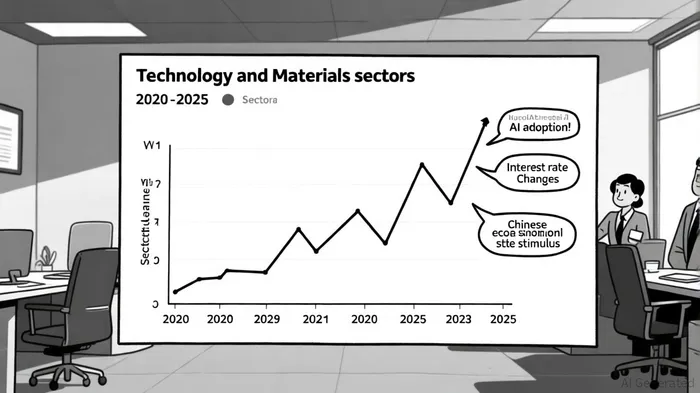







Comentarios
Aún no hay comentarios