
The Role of LULD Circuit Breakers in Containing Volatility: A Case Study of Mega Fortune Company (MGRT)
In the wake of financial crises like the 1987 Black Monday crash and the 2010 "flash crash," regulators introduced mechanisms to stabilize markets during extreme volatility. Among these, the Limit Up-Limit Down (LULD) circuit breakers have emerged as critical tools for managing price swings in individual securities. This article examines how LULD mechanisms function, their intended purpose, and their real-world impact on market behavior and investor strategy, using the case of Mega Fortune CompanyMGRT-- (MGRT) to illustrate key dynamics.
LULD vs. Market-Wide Circuit Breakers: Mechanisms and Objectives
Circuit breakers and LULD mechanisms serve distinct but complementary roles. Market-wide circuit breakers, triggered by percentage declines in the S&P 500 index, impose trading halts to slow panic selling and allow time for information dissemination. For example, a 7% decline (Level 1) halts trading for 15 minutes, while a 20% decline (Level 3) stops trading for the remainder of the day according to Investopedia. These measures, refined since their 1987 introduction, aim to prevent cascading sell-offs.
In contrast, LULD mechanisms apply to individual stocks, limiting price movements within predefined bands. For Tier 1 stocks like those in the S&P 500, a 5% price band is enforced during most of the trading day. If a stock moves beyond these bands and remains there for 15 seconds, trading halts for five minutes. Introduced in 2012 by the SEC following the 2010 flash crash, LULD seeks to prevent rapid price dislocations and ensure orderly trading.
Case Study: MGRT's LULD Activations in 2025
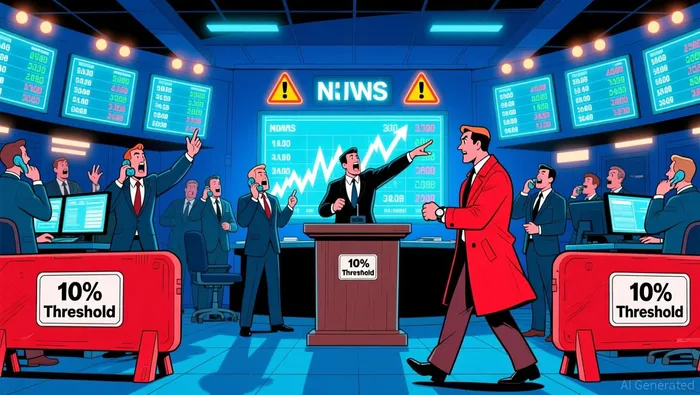 Mega Fortune Company (MGRT) provides a compelling example of LULD in action. On December 17, 2025, at 3:25 PM, MGRT's stock triggered a LULD halt after its price fluctuated beyond the 10% threshold over a rolling five-minute window. A second halt occurred on December 18 at 10:20 AM, attributed to similar volatility. These events highlight how LULD responds to rapid price swings, even in the absence of broader market turmoil.
Investor reactions were mixed. Active traders viewed the halts as opportunities for short squeezes or large block orders, generating positive sentiment. However, institutional buyers expressed concerns about reduced liquidity and increased execution risk, deterring long-term investment during halted periods according to MarketBeat. Notably, MGRT's stock closed at $6.42 on November 26, 2025, with a range of $6.31 to $6.49, indicating relatively stable conditions prior to the December volatility.
Impact on Market Behavior and Investor Strategy
LULD mechanisms influence market behavior in nuanced ways. On one hand, they create "breathing space" for investors to reassess positions, potentially curbing panic-driven decisions. On the other, they can amplify volatility through unintended consequences. For instance, trading halts may trigger a "magnet effect", where the anticipation of a pause increases selling pressure, pushing prices toward the threshold. This dynamic was evident in MGRT's case, where repeated halts in December 2025 coincided with heightened short-term trading activity.
Investors must also adapt their strategies to LULD rules. During halts, options may still be exercised, but liquidity constraints can distort price discovery. Long-term holders face downside risks if halts coincide with negative news, while active traders may exploit volatility to capitalize on post-halt price gaps according to MarketBeat. Advisors caution against building large positions during halted trading, emphasizing the importance of monitoring company announcements and regulatory filings for clarity according to MarketBeat.
Conclusion: Balancing Stability and Market Integrity
The LULD mechanism for MGRTMGRT-- underscores both the efficacy and limitations of individual stock circuit breakers. While these tools aim to prevent disorderly price movements, their implementation can sometimes exacerbate volatility, particularly in highly speculative or thinly traded stocks. For investors, understanding LULD thresholds and their potential market impact is critical in high-volatility scenarios. Regulators must continue refining these mechanisms to ensure they align with evolving market dynamics, balancing stability with the integrity of price discovery.
As markets navigate an era of increasing algorithmic trading and retail investor participation, the role of LULD and similar tools will remain pivotal. The MGRT case study serves as a reminder that while circuit breakers can mitigate panic, they also require careful calibration to avoid unintended consequences.







Comentarios
Aún no hay comentarios