
The Role of Leverage in Crypto Market Volatility and Risk Management
Leverage as a Catalyst for Volatility
Leverage in crypto futures trading has long been a source of controversy. While it enables retail and institutional traders to amplify returns, it also creates a pro-cyclical feedback loop: rising prices attract speculative inflows, which further inflate asset values, only for a sudden reversal to trigger cascading liquidations. In October 2025, regulatory shifts and cyberattacks triggered a sharp sell-off, exposing the vulnerabilities of concentrated leveraged positions and shallow liquidity pools. Bitcoin's open interest-a proxy for leveraged exposure-plummeted by 8,500 BTC ($700 million) during this 48-hour crisis, with long positions accounting for nearly half of the liquidations according to data.
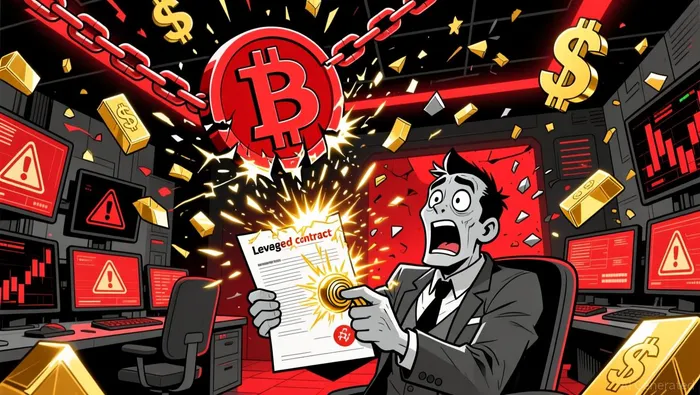 The fragility of leveraged positions is compounded by the nature of crypto liquidity. During bullish cycles, trading volume is often driven by short-term "hot money" that evaporates rapidly in bearish environments as reported. This dynamic was starkly illustrated by the plight of high-profile traders: one whale saw profits collapse from $63 million to $4 million, while trader Jeff "Machi Big Brother" Huang's balance sheet swung from a $44.8 million profit to a $20 million deficit in weeks according to analysis. These cases highlight how leverage transforms market corrections into existential threats for overexposed participants.
Risk Mitigation Strategies in High-Volatility Environments
To navigate the inherent risks of leveraged futures trading, traders and platforms must adopt a multi-layered approach to risk management.
1. Position Sizing and Stop-Loss Orders
Disciplined position sizing remains foundational. The 1% rule-limiting risk per trade to 1% of total capital-helps preserve account longevity. Coupled with stop-loss orders, which automatically close positions at predefined price thresholds, this strategy prevents minor losses from spiraling into account-destroying drawdowns as research shows. For example, a trader using 10x leverage on BitcoinBTC-- could set a stop-loss just below a key support level to avoid liquidation during sudden price swings.
2. Conservative Leverage and Margin Monitoring
Excessive leverage (e.g., 50x or 100x) drastically increases liquidation risk, particularly in fast-moving markets. A more prudent approach involves using 5x–10x leverage, which allows positions to weather minor volatility without triggering forced closures according to market analysis. Real-time margin monitoring tools are essential for tracking liquidation prices and ensuring sufficient collateral as market data shows.
3. Diversification and Hedging
Diversifying across assets, strategies, and markets reduces exposure to adverse price movements. Hedging-taking offsetting positions in spot and futures markets-can further mitigate risk. For instance, a Bitcoin holder might short BTC futures to protect against price declines according to market guidance. Similarly, arbitrage strategies like cash-and-carry arbitrage exploit price discrepancies between spot and futures markets, offering low-directional-risk opportunities as research indicates.
4. Emotional Discipline and Technical Analysis
Psychological biases such as greed and FOMO often lead to impulsive trading. Predefined entry/exit rules, combined with technical indicators (e.g., RSI, moving averages), help avoid emotional decisions. Fundamental analysis of broader market conditions and project fundamentals also provides context for strategic positioning according to industry analysis.
5. On-Chain Stress-Testing and Circuit Breakers
The October 2025 USDe crisis revealed critical flaws in passive liquidity management. In response, new circuit breaker mechanisms now prioritize active liquidity injection using composite indicators like Cross-Platform Reference Price Deviation (CVD) and Order Book Depth (https://www.markets.com/news/circuit-breaker-mechanism-crypto-market-2346-en). These tools detect abnormal market behavior and trigger protocols to isolate risk and stabilize prices. Designated liquidity providers (DLPs) are also granted priority access during crises, ensuring orderly recovery as market data shows.
The Path Forward
The 2025 liquidity crisis demonstrated that leverage, while a powerful tool, cannot exist in isolation from systemic safeguards. Platforms must integrate circuit breakers, on-chain stress-testing, and real-time margin management to prevent future meltdowns according to analysis. Regulators, too, have a role to play in enforcing transparency and accountability, particularly in decentralized lending systems that remain vulnerable to cascading failures according to market reports.
For individual traders, the lesson is clear: leverage demands respect. Without rigorous risk management, even the most sophisticated strategies can unravel in moments of panic. As the crypto market matures, the integration of institutional-grade risk protocols will be critical to transforming volatility from a liability into a manageable variable.







Comentarios
Aún no hay comentarios