
Roku's Streaming Ad-Tech Dominance and Monetization Potential: A Case for Outperformance in 2025
Roku (NASDAQ: ROKU) has cemented its position as a leader in the streaming ad-tech sector, outperforming broader market trends through its dominance in connected TV (CTV) advertising and strategic monetization innovations. As the streaming wars intensify, Roku's unique value proposition—combining a robust platform ecosystem with cutting-edge ad technology—positions it to capitalize on underpenetrated growth opportunities, even as competition tightens.
Market Share and Growth: A CTV Advertising Powerhouse
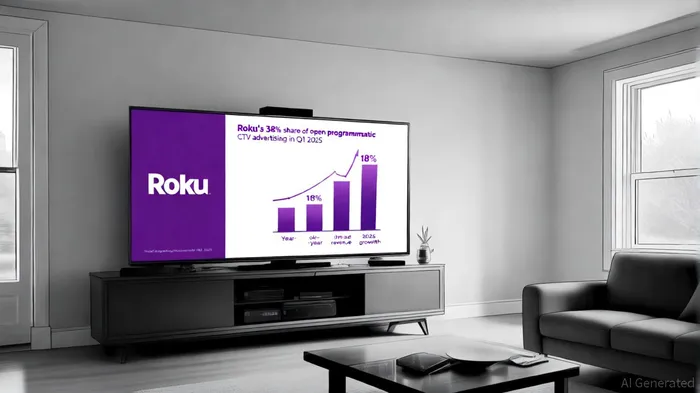
Roku's dominance in the CTV ad-tech space is underscored by its commanding market share. According to Pixalate's Q1 2025 "CTV Device Market Share" report, RokuROKU-- holds 38% of the open programmatic CTV device market in the U.S., far outpacing Amazon Fire TV (18%) and Apple (13%) [2]. This leadership is not static: In Q2 2025, Roku's platform revenue surged 18% year-over-year to $975 million, outpacing the broader U.S. OTT and digital ad markets [3]. The company's 35.4 billion streaming hours in Q2 2025 further highlight its scale, with the Roku Channel alone accounting for 5.4% of total U.S. TV streaming time in June 2025 [3].
However, Roku's dominance faces challenges. Amazon Fire TV's share grew 40% year-over-year globally in Q3 2025, and Samsung and Apple are gaining traction in key regions [1]. Despite this, Roku's 37% share of open programmatic CTV ads in North America remains unmatched, and its 45% ad delivery lead in Latin America—a region where its share increased 81% year-over-year—demonstrates its ability to adapt to regional dynamics [1].
Strategic Monetization: Innovating Beyond the Platform
Roku's outperformance stems from its aggressive monetization strategies. The company has deepened partnerships with demand-side platforms (DSPs) like Amazon DSP and The Trade Desk, enhancing programmatic access to its inventory and improving ad efficiency for advertisers [3]. Additionally, Roku's suite of ad-tech tools—Roku Data Cloud, Roku Exchange, and Roku Ads Manager—enables precise audience targeting and performance optimization, attracting brands seeking high ROI in the fragmented streaming landscape [1].
A critical growth lever is Roku's focus on increasing average revenue per user (ARPU). While ARPU stood at $41.49 in Q2 2025 (up just 1% since 2021), the company aims to boost this metric to $45 annually through targeted pricing strategies and expanded ad-supported tiers [1]. This aligns with broader industry trends: As consumers shift away from traditional TV, advertisers are willing to pay a premium for access to Roku's 60 million active accounts [3].
Competitive Dynamics: Navigating Threats and Opportunities
Roku's primary challenge lies in the rise of content-heavy competitors like Netflix and Disney, which are expanding ad-supported tiers and developing proprietary ad tech [3]. However, Roku's platform-centric model offers a distinct advantage: Unlike content providers, Roku's business is not constrained by production costs, allowing it to scale advertising revenue with minimal marginal expenses.
Internationally, Roku is also gaining ground. Its 45% ad delivery share in Latin America—a region with rapidly growing CTV adoption—highlights its potential to replicate U.S. success in emerging markets [1]. Meanwhile, Samsung's dominance in EMEA (33% programmatic ad share) and Xiaomi's lead in APAC (24%) underscore the need for Roku to diversify its regional strategies [3].
The Road Ahead: Sustaining Growth in a Competitive Landscape
Roku's 2025 guidance of $4.61 billion in platform revenue—12% growth year-over-year—reflects confidence in its ability to sustain momentum [1]. The company's focus on international expansion, ARPU growth, and ad-tech innovation positions it to outperform the broader market, particularly as the CTV ad spend is projected to surpass $10 billion by 2026.
Investors should also note Roku's strategic emphasis on profitability. By prioritizing high-margin ad revenue over subscription growth, Roku is aligning itself with the long-term trajectory of the streaming industry, where ad-supported models are becoming increasingly critical to sustainability [3].
Conclusion
Roku's dominance in the CTV ad-tech sector, coupled with its underpenetrated monetization opportunities, makes it a compelling investment in 2025. While competition from Amazon, Samsung, and content providers remains a risk, Roku's platform-first approach, global expansion, and ad-tech innovations provide a durable moat. For investors seeking exposure to the streaming revolution, Roku's trajectory offers a rare combination of scale, innovation, and growth potential.





Comentarios
Aún no hay comentarios