
ROHM's Technological Edge in AI Server Power Solutions: A Strategic Investment Analysis
ROHM's Technological Breakthroughs
ROHM's latest MOSFETs, particularly the RY7P250BM, exemplify the company's focus on efficiency and thermal management. With an RDS(on) of 1.86mΩ at VGS=10V-18% lower than comparable 100V MOSFETs in the same package size-the RY7P250BM minimizes conduction losses in 48V power systems. This is critical for AI servers, where even marginal improvements in power efficiency translate to significant cost savings in cooling and energy consumption. The device's wide SOA, and 50A at 1ms under 48V conditions, ensures robust performance during inrush currents and transient overloads.
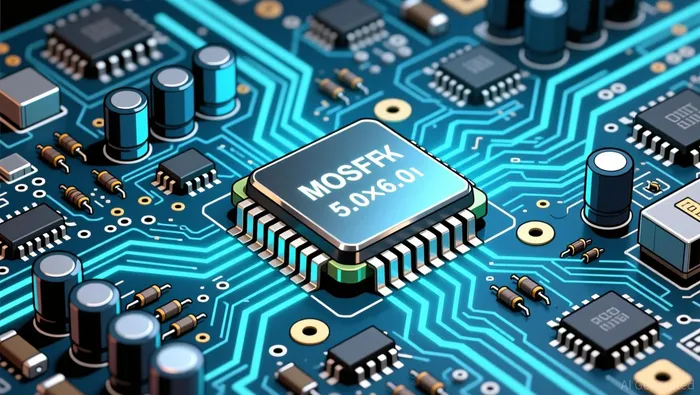
The compact DFN8080-8S (8.0×8.0mm) and DFN5060-8S (5.0×6.0mm) packages further underscore ROHM's design philosophy. These dimensions enable higher power density in server motherboards, a key requirement as data centers prioritize space optimization. For context, TI's CSD965203B dual-phase smart power stage, while delivering 100A per phase in a 5×5mm package, lacks the SOA flexibility of ROHM's offerings.
Competitive Positioning in a Crowded Market
ROHM's strategy contrasts with competitors' approaches. ON Semiconductor, for instance, is pivoting toward silicon carbide (SiC) technology, securing a €450M EU grant to build a 200mm SiC manufacturing facility in the Czech Republic. While SiC offers superior efficiency for high-frequency applications, its higher cost and complexity make it less accessible for mainstream AI server designs. ROHM's silicon-based MOSFETs, by contrast, deliver a cost-effective solution that aligns with current infrastructure requirements.
TI's power modules, such as the CSDM65295, integrate inductors and power stages to reduce size by 2× compared to discrete solutions. However, these modules are optimized for multi-phase power delivery rather than the hot-swap and transient protection scenarios where ROHM's MOSFETs excel. Infineon's AI server offerings remain less transparent in the public domain, but ROHM's tailored SOA and RDS(on) metrics position it to capture market share in applications demanding rapid load changes and high reliability.
Market Validation and Strategic Expansion
ROHM's RY7P250BM has already secured certification as a recommended component by a leading global cloud platform provider, a testament to its readiness for mass adoption. The company is also expanding its DFN5060-8S lineup with devices like the RS7E200BG (0.53mΩ) and RS7N200BH (1.7mΩ), further solidifying its footprint in 12V and 48V power architectures. This product diversification aligns with the AI server market's demand for scalable, modular power solutions.
Financially, ROHM's timing is fortuitous. The AI server MOSFET market is projected to grow at a 21.8% CAGR, driven by the proliferation of GPU and CPU core power systems. With competitors like ON Semiconductor facing revenue pressures in power-electronics applications according to financial reports, ROHM's focus on niche, high-performance silicon-based solutions could yield disproportionate market gains.
Investment Implications
For investors, ROHM's innovations represent a strategic bet on the intersection of AI growth and power efficiency. The company's ability to deliver compact, high-SOA MOSFETs at lower costs than SiC alternatives positions it to benefit from both near-term demand and long-term infrastructure upgrades. As data centers grapple with thermal and spatial constraints, ROHM's tailored approach-prioritizing RDS(on) and SOA without compromising form factor-offers a compelling value proposition.
In a market where TI and ON Semiconductor are investing in broader, more generalized technologies, ROHM's targeted innovation in AI-specific power solutions could translate into outsized returns. With the AI server MOSFET market set to quintuple by 2031, ROHM's current trajectory suggests it is not merely a participant but a potential leader in this high-growth segment.







Comentarios
Aún no hay comentarios