
Rocket Lab's Strategic Positioning: Untapped Growth and Operational Momentum in the Small Satellite Launch Market
The small satellite launch market is undergoing a transformative phase, driven by surging demand for cost-effective, scalable solutions across commercial, scientific, and defense applications. Rocket LabRKLB--, a pioneer in this niche, has positioned itself at the forefront of this evolution through a combination of strategic partnerships, technological innovation, and operational excellence. As the company enters 2026, its recent contracts, advancements in reusable launch technology, and alignment with favorable industry tailwinds paint a compelling picture of untapped growth potential and sustained momentum.
Strengthening Strategic Alliances: A Catalyst for Growth
Rocket Lab's recent expansion into Japan's burgeoning space sector underscores its ability to secure high-value, long-term contracts. In 2025, the company inked a multi-launch agreement with the Institute for Q-shu Pioneers of Space, Inc. (iQPS), adding three dedicated Electron missions to its existing portfolio of four, all aimed at deploying Earth-imaging synthetic aperture radar (SAR) satellites for iQPS' constellation. Separately, Rocket Lab secured a direct contract with Japan Aerospace Exploration Agency (JAXA) for two dedicated Electron launches in 2025 and 2026 to support JAXA's Innovative Satellite Technology Demonstration Program. These agreements not only diversify Rocket Lab's geographic footprint but also reinforce its reputation as a reliable partner for both commercial and government clients. With seven missions already booked for iQPS and a fourth launch scheduled for 2026, the company is capitalizing on Japan's aggressive push to expand its space capabilities.
Reusable Technology and the Neutron Rocket: A Game-Changer
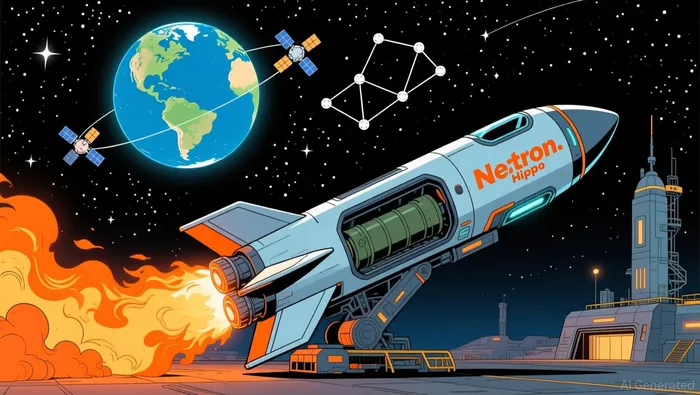
While the Electron rocket has solidified Rocket Lab's dominance in the small satellite launch market, the company's next-generation Neutron rocket represents a leap into larger, higher-value missions. Set to debut in early 2026, the Neutron rocket boasts a payload capacity of 13,000 kg-six times greater than the Electron-and incorporates the innovative "Hungry Hippo" fairing system, which remains attached during launch and landing to simplify operations and reduce costs. This design, coupled with reusable technology, positions Rocket Lab to compete with heavyweights like SpaceX and Blue Origin in mid-sized launch markets. Analysts estimate that the Neutron could unlock six times more revenue opportunities compared to the Electron.
 Rocket Lab's 2025 performance further validates its operational prowess: the company achieved 20 successful Electron launches, a record that highlights its reliability and capacity to meet growing demand. With a contract backlog of $1.1 billion in Q3 2025, driven by both commercial and government clients, the firm is well-positioned to sustain its momentum as the Neutron enters service.
Favorable Industry Tailwinds: A Booming Market Landscape
The small satellite market is poised for robust growth, driven by key industry tailwinds. According to a report by Stratview Research, the global small satellite market is projected to reach $7.7 billion by 2030, with a compound annual growth rate (CAGR) of 2.2%. Meanwhile, the U.S. market is expected to grow at a more aggressive 12.1% CAGR, expanding from $2.3 billion in 2025 to $7.3 billion by 2035. This growth is fueled by the proliferation of satellite constellations for global internet coverage (e.g., SpaceX's Starlink and Amazon's Project Kuiper), advancements in satellite miniaturization, and the rising demand for cost-effective solutions in Earth observation, defense, and scientific research. According to Allied Market Research, the small satellite market is expanding.Rocket Lab's focus on rapid, frequent launches aligns perfectly with these trends. The company's ability to deploy satellites quickly and affordably addresses a critical pain point for clients seeking to build and maintain large constellations. Additionally, the development of compact satellites, such as CubeSats, has democratized access to space, enabling universities and startups to conduct experiments at a fraction of traditional costs. Rocket Lab's Electron rocket, with its ability to launch small satellites into precise orbits, is uniquely suited to serve this expanding ecosystem.
Challenges and Opportunities
Despite its strengths, Rocket Lab faces challenges inherent to the small satellite market. The limited lifespan of these satellites-often constrained by propulsion and power systems-necessitates frequent replacements, creating both a challenge and an opportunity for launch providers. Rocket Lab's operational efficiency and growing backlog suggest it is well-equipped to capitalize on this recurring demand. Furthermore, the company's investment in reusable technology through the Neutron rocket could mitigate long-term costs and enhance profitability.
Investment Outlook
Rocket Lab's strategic positioning in the small satellite launch market is underpinned by a trifecta of factors: a robust pipeline of contracts, cutting-edge technology, and favorable industry trends. With the Neutron rocket nearing launch readiness and a $1.1 billion contract backlog, the company is poised to transition from a niche player to a major force in the global launch industry. Analysts remain optimistic, with price targets ranging from $47 to $83 per share reflecting confidence in Rocket Lab's ability to scale, to capture a larger share of the growing market.
For investors, Rocket Lab represents a high-conviction opportunity in a sector defined by innovation and demand. As the company continues to execute on its vision of making space accessible, its strategic alliances, technological advancements, and alignment with industry tailwinds position it to deliver outsized returns in the years ahead.







Comentarios
Aún no hay comentarios