
Rocket Lab's Strategic Expansion and Path to Profitability: A 2026 Launchpad for Long-Term Growth
The Neutron Rocket: A Calculated Delay, A Bigger Opportunity
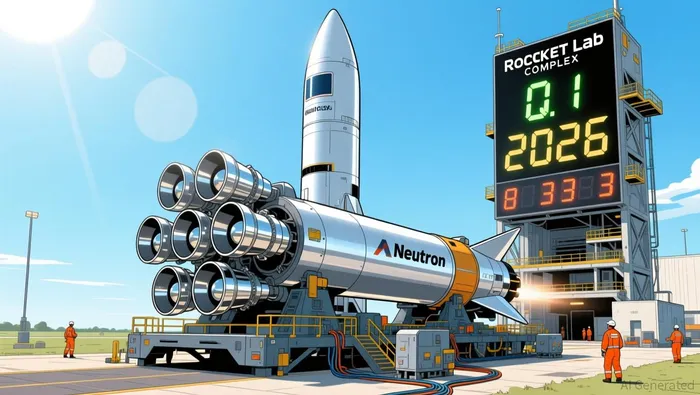
Rocket Lab's Neutron rocket, a partially reusable medium-lift vehicle, has been pushed to Q1 2026, with the first launch pending qualification testing, as SpaceNews reported. While this delay may frustrate short-term optimists, CEO has been clear: the company is prioritizing reliability over speed. "Our aim is to make it to orbit on the first try," Beck stated, echoing lessons from past industry failures, as The Register reported. This cautious approach is prudent, given the high stakes of reusable rocketry. The Neutron's 13,000 kg payload capacity to Low Earth Orbit positions it to directly compete with SpaceX's Falcon 9, a market segment projected to grow significantly as demand for satellite constellations and deep-space missions accelerates, as Newsable reported.
The delay has added $50 million to Neutron's development costs, now totaling $300 million, as SpaceNews reported, but Rocket Lab's $1.1 billion in liquidity provides ample runway to absorb these expenses while pursuing strategic acquisitions like Mynaric and Geost, as StockTitan reported. These moves underscore a broader strategy: diversifying beyond launch services into higher-margin space systems and defense contracts.
Operational Scalability and Margin Potential: A Dual Engine for Growth
Rocket Lab's Q3 2025 results were a masterclass in operational execution. , , as StockTitan reported. The company's backlog, , as TechSpot reported, provides a clear line of sight to 2026. This diversification is critical: while launch services remain the backbone, space systems (including satellite components and defense tech) offer fatter margins and recurring revenue.
Looking ahead, , as StockTitan reported. However, near-term profitability remains elusive, with adjusted EBITDA losses expected due to Neutron-related R&D and stock-based compensation, as TechSpot reported. For now, investors must balance these costs against the long-term value of a reusable rocket that could slash per-launch expenses and open new revenue streams.
Competitive Positioning: Navigating a Crowded Market
The medium-lift launch market is no longer a niche. SpaceX's Falcon 9 dominates, but Rocket Lab's Neutron offers a compelling alternative with its focus on reusability and rapid turnaround. , as Newsable reported, .
Moreover, Rocket Lab's recent foray into (via its HASTE missions) and its acquisition of Geost for electro-optical payloads, as TechSpot reported, highlight a strategic pivot toward defense and government contracts-segments with sticky, high-margin opportunities. This diversification reduces reliance on commercial launch cycles and insulates the company from market volatility.
The 2026 Launchpad: Risks and Rewards
The Neutron's 2026 debut is both a risk and a reward. If successful, it could transform Rocket Lab from a launch services provider into an end-to-end space solutions company, with reusability driving down costs and margins. However, technical hurdles-such as perfecting the self-landing capability for the second flight, as BusinessDesk reported-remain. Investors should monitor the first launch closely, as a flawless debut would validate Rocket Lab's engineering rigor and unlock broader institutional confidence.
In the interim, Rocket Lab's financial flexibility and operational discipline provide a safety net. , as TechSpot reported, the company can afford to play the long game. For now, the shares trade at a discount to their long-term potential, making the current pullback an opportunity for patient investors.
Conclusion: A Calculated Bet on the Future of Space
Rocket Lab's path to profitability hinges on the Neutron's success, but the company's operational execution and strategic agility are already laying the groundwork. By prioritizing reliability, diversifying its revenue streams, and leveraging its liquidity, Rocket Lab is positioning itself to capitalize on the next phase of the space economy. For investors, the 2026 launch window represents not just a technical milestone but a catalyst for sustainable value creation. As the countdown to Q1 2026 ticks on, the question isn't whether Rocket Lab can succeed-it's how much it will grow once it gets off the launchpad.





Comentarios
Aún no hay comentarios