
Rocket Lab's Strategic Expansion into Earth Observation: A Catalyst for Long-Term Growth in the Satellite Imaging Sector
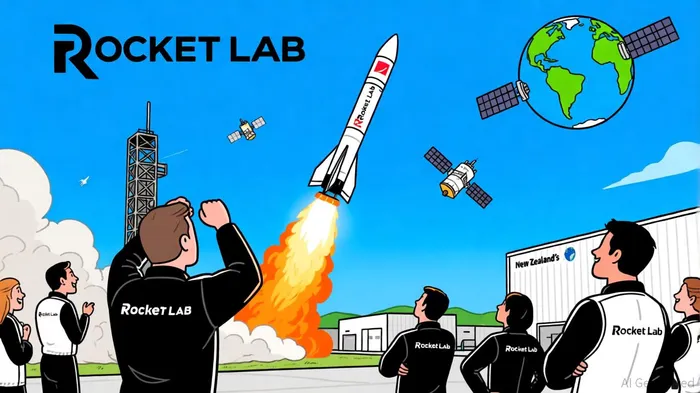
Rocket Lab, a pioneer in small satellite launch services, is accelerating its strategic expansion into the Earth observation (EO) sector through a combination of dedicated missions, technological innovation, and strategic acquisitions. As the global EO market surges-projected to grow from $8.22 billion in 2025 to $22.27 billion by 2034 at a 10.47% CAGR, according to a Grand View Research report-Rocket Lab's vertically integrated approach positions it to capitalize on demand for real-time geospatial data, climate monitoring, and national security applications.
Mission Announcements and Strategic Partnerships
Rocket Lab's collaboration with Synspective, a Japanese SAR satellite company, underscores its leadership in EO. The "Owl New World" mission, scheduled for October 14, 2025, will deploy the seventh StriX satellite, part of a planned 21-mission series to expand Synspective's low Earth orbit constellation, per the Rocket Lab launch schedule. This partnership highlights Rocket Lab's role as Synspective's exclusive launch provider, having already deployed six StriX satellites. By enabling frequent, cost-effective launches, Rocket LabRKLB-- supports the deployment of constellations critical for near-real-time Earth monitoring-a key driver of the EO market noted in a From Earth to Space article.
The company's Electron rocket, with over 70 launches completed by mid-2025, has established a reputation for reliability and rapid deployment, according to a TS2 analysis. Complementing this is the Photon satellite platform, customizable for EO, telecommunications, and scientific missions. Rocket Lab's ability to offer end-to-end solutions-from satellite design to launch-reduces customer complexity and enhances mission efficiency, as outlined in a Cyclops SpaceTech piece.
Technological Innovation and Vertical Integration
Rocket Lab's competitive edge lies in its vertical integration and R&D investments. The company is developing the Neutron rocket, a medium-lift, partially reusable vehicle designed to deploy larger satellites and constellations. With Launch Complex 3 nearing completion, Neutron is expected to debut by late 2025 or early 2026, opening access to national security and commercial markets, as detailed in the company's Q2 2025 financial results. This expansion aligns with the U.S. Space Development Agency's Tranche 2 Transport Layer program, where Rocket Lab is building 18 spacecraft for $515 million, according to a PredictStreet analysis.
Strategic acquisitions further bolster Rocket Lab's capabilities. The $275 million acquisition of Geost brings infrared sensor technology for missile warning and EO, while Mynaric's laser communication systems enhance data transmission for satellite networks, as noted in a SWOTAnalysis profile. These moves position Rocket Lab as a prime contractor for defense-related EO missions, a segment expected to grow as governments prioritize space-based surveillance.
Financial Performance and Market Positioning
Rocket Lab's financials reflect strong growth in 2025. Q2 revenue reached $144.5 million, a 36% year-over-year increase, driven by $66.6 million in Launch Services and $97.9 million in Space Systems, per the earnings call transcript. The company's backlog of nearly $1 billion, with 58% expected to convert within 12 months, signals robust demand (a TS2 analysis also highlighted this backlog). Despite net losses due to R&D and acquisition costs, Rocket Lab's $688 million cash reserves provide a stable foundation for future investments, as reported in the company's financial results.
Compared to peers like Planet LabsPL-- and Virgin Galactic, Rocket Lab's diversified revenue mix and operational efficiency stand out. Its gross margins expanded to 32.1% GAAP and 36.9% non-GAAP in Q2 2025, reflecting improved execution (see the company's financial results). A PS ratio of ~56 indicates investor optimism, though it also reflects the company's capital-intensive growth phase, according to CSIMarket data.
Historical analysis of Rocket Lab's earnings events from 2022 to 2025 reveals nuanced investor behavior. While the average 1-day return around earnings announcements was -4.7%, indicating short-term negative surprises, the 30-day cumulative return averaged +16.6%-outperforming the benchmark by +6.8 percentage points, as shown in a historical earnings analysis. This suggests that while earnings days often trigger volatility, a contrarian "buy-the-dip" strategy-purchasing shares shortly after the announcement-historically yielded better risk-adjusted returns. The win rate for positive outcomes improved from 43% on day 1 to 57–71% after two weeks, underscoring mean-reversion potential noted in a mean-reversion study. For investors, this highlights the importance of patience and timing when navigating Rocket Lab's earnings cycle.
Industry Trends and Competitive Landscape
The EO market's growth is fueled by advancements in AI-driven data analytics, reduced launch costs, and small satellite constellations, as described in the Grand View Research report referenced above. Rocket Lab's focus on rapid, dedicated launch services differentiates it from competitors like SpaceX, which prioritizes larger rockets, and emerging players such as Firefly Aerospace. By targeting the small satellite segment-where demand for EO data is surging-Rocket Lab avoids direct competition with giants while securing a niche with high margins.
Government contracts further stabilize Rocket Lab's revenue. Its work with NASA, the U.S. Space Force, and the Air Force Research Lab underscores its role in national security missions, as noted in the PredictStreet analysis. As climate change and geopolitical tensions drive demand for real-time Earth monitoring, Rocket Lab's integrated solutions are well-positioned to scale.
Conclusion
Rocket Lab's strategic expansion into Earth observation-driven by mission partnerships, technological innovation, and financial resilience-positions it as a key player in a rapidly growing market. With the Neutron rocket nearing readiness and a robust backlog, the company is poised to capitalize on the surge in EO demand while maintaining its leadership in small satellite launches. For investors, Rocket Lab represents a compelling opportunity in the new space economy, where vertical integration and agility are critical to long-term success.





Comentarios
Aún no hay comentarios