
Is Rocket Lab Stock a Buy in 2026 Amid Sky-High Valuations and High Stakes?
Rocket Lab (RKLB) has emerged as a pivotal player in the commercial space industry, but its 2026 investment potential hinges on a delicate balance between ambitious growth prospects and execution risks. With a forward price-to-sales ratio of 48 times, the stock's valuation assumes sustained 30% annual revenue growth-a daunting target for a company grappling with delays in its flagship Neutron rocket and fierce competition from SpaceX and Blue Origin. This analysis evaluates Rocket Lab's long-term trajectory by dissecting its financial health, strategic initiatives, and the viability of its high-stakes bets.
Financial Health: Strong Revenue, Persistent Losses
Rocket Lab's Q3 2025 results underscored its ability to scale revenue, with $155 million in sales-a 48% year-over-year increase- driven by robust demand for its Electron rocket and space systems segment. However, profitability remains elusive. The company reported a net loss of $18.3 million for the quarter and projected an adjusted EBITDA loss of $23–$29 million in Q4 2025. Operating expenses, both GAAP ($104–$109 million in Q3) and non-GAAP ($86–$91 million), are rising as the company allocates capital to Neutron development according to SEC filings.
Despite these losses, Rocket Lab's liquidity position appears stable. An at-the-market offering in late 2025 boosted cash reserves to over $1 billion, providing a buffer against short-term cash burn. Yet, the company's reliance on external financing raises concerns about long-term sustainability, particularly if Neutron delays persist. Each quarter of delay in the Neutron program costs an estimated $15 million, and further setbacks could strain cash flows.
Strategic Initiatives: Neutron Rocket as a Make-or-Break Catalyst
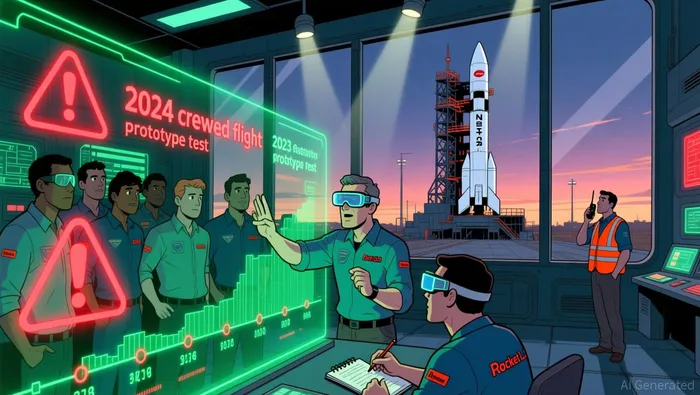 The Neutron rocket is the linchpin of Rocket Lab's growth strategy. Designed to carry 13,000 kg to low-Earth orbit, Neutron aims to capture larger payload markets currently dominated by SpaceX's Falcon 9 (17,500 kg) and Starship (150 metric tons) according to Wikipedia. Rocket LabRKLB-- has secured key contracts, including an $816 million U.S. government deal for satellite production and a $515 million agreement with the Space Development Agency as reported. These contracts, coupled with 17 dedicated Electron launch orders in Q3 2025, highlight the company's diversification.
However, Neutron's development timeline remains a critical risk. Originally slated for a 2024 debut, the rocket's first launch is now expected in mid-2026 at the earliest according to Yahoo Finance. CEO Peter Beck has emphasized a "methodical" approach to qualification testing, but delays could erode investor confidence. If the launch slips into 2027, Rocket Lab's valuation-built on assumptions of rapid growth- could face significant headwinds.
Competitive Landscape: Navigating a Crowded Market
Rocket Lab operates in a market where cost efficiency and reliability are paramount. SpaceX's dominance, with per-kilogram launch costs far below Rocket Lab's $50 million per Neutron mission, poses a formidable challenge. Blue Origin's New Glenn rocket, set for regular flights in 2026, further intensifies competition. While Rocket Lab's Electron rocket maintains a niche in small-satellite launches-21 missions completed in 2025 with a 100% success rate-the company must prove Neutron can compete on both price and performance to justify its valuation according to NASASpaceFlight.
Customer diversification offers some insulation. As of Q1 2025, 46% of Rocket Lab's backlog was tied to government contracts, up from previous quarters, reflecting growing demand for secure satellite infrastructure. The space systems segment, now accounting for 60% of revenue, also provides a recurring revenue stream through products like Star Ray Solar Arrays according to Porter's Five Forces. Yet, reliance on government contracts introduces political and budgetary risks, particularly if U.S. funding for space programs falters.
Valuation Risks and Execution Challenges
Rocket Lab's current valuation hinges on achieving 30% annual revenue growth through 2027, a target that assumes successful Neutron launches and sustained demand for its services according to Yahoo Finance. Analysts project sales could exceed $1.2 billion by 2027, but this forecast is contingent on overcoming technical hurdles and pricing pressures. The company's high burn rate-$2.7 million in Q3 2025 for Ideal Power, a peer in the space sector- underscores the importance of cash discipline.
Execution risks are further amplified by the need to balance Neutron development with maintaining Electron's launch cadence. Rocket Lab's ability to execute on both fronts will determine whether it can capitalize on its first-mover advantage in the small-satellite market while scaling into larger payloads.
Conclusion: A High-Risk, High-Reward Proposition
Rocket Lab's 2026 investment case is a double-edged sword. The company's financial performance and strategic contracts demonstrate its potential to disrupt the launch market, but its valuation demands flawless execution. Delays in Neutron, competitive pressures from SpaceX, and the need for continued capital raising all pose significant risks. For investors willing to tolerate volatility, Rocket Lab offers exposure to the next phase of space commercialization-but only if the company can deliver on its ambitious timeline.







Comentarios
Aún no hay comentarios