
Why Rocket Lab's Neutron Rocket Could Be the Key to 2026 Earnings Growth and Market Dominance
Rocket Lab's strategic pivot toward the medium-lift launch market, anchored by its Neutron rocket, positions the company to capitalize on a pivotal inflection point in the aerospace industry. As the global demand for satellite launches and national security-driven space missions accelerates, Rocket Lab's vertically integrated business model, combined with its advanced propulsion and manufacturing innovations, could redefine its competitive positioning in 2026. With a $1.1 billion backlog and a projected $170–180 million in Q4 2025 revenue, the company is poised to leverage its Neutron rocket as a catalyst for both earnings growth and market share expansion according to financial results.
Strategic Catalysts: Neutron Rocket and Launch Complex 3
Rocket Lab's Neutron rocket, a reusable vehicle capable of carrying 13,000 kg to orbit, represents a deliberate shift from its Electron rocket's small-satellite focus to the high-growth medium-lift segment as per growth strategy analysis. The rocket's development is supported by Launch Complex 3 in Virginia, a state-of-the-art facility completed in just two years. This infrastructure, featuring a 30-foot launch mount and advanced propellant storage systems, underscores Rocket Lab's commitment to rapid deployment and operational scalability according to facility reports. While the first Neutron launch was delayed to Q1 2026 due to rigorous testing protocols as per financial reports, the company's risk-averse approach has bolstered confidence in the rocket's reliability-a critical factor in securing high-value contracts.
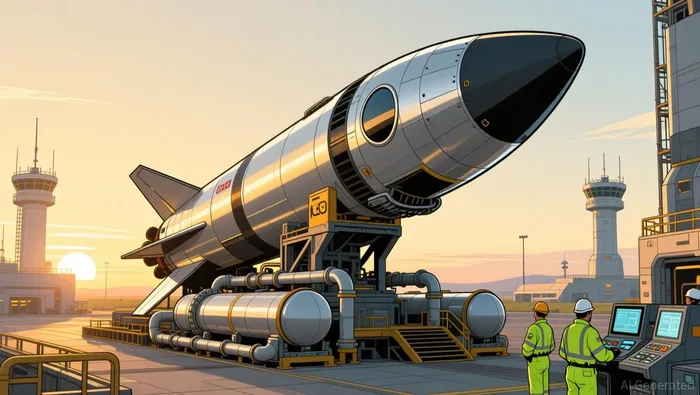 The Neutron's strategic value is further amplified by Rocket Lab's expansion into satellite manufacturing via platforms like Photon and Flatellite. By integrating launch services with end-to-end satellite solutions, Rocket LabRKLB-- differentiates itself from competitors like SpaceX, which primarily focuses on launch systems according to industry research. This full-stack approach aligns with the U.S. government's emphasis on domestic supply chain resilience, as evidenced by the company's $515 million contract with the U.S. Space Development Agency for 18 satellites as per growth strategy analysis.
Competitive Positioning: Neutron vs. Falcon 9
While SpaceX's Falcon 9 dominates the medium-lift market with its high launch cadence and reusability, Rocket Lab's Neutron rocket targets specialized niches through advanced design features. The Neutron's 3D-printed Arcturus engine and carbon fiber composites reduce manufacturing costs and enhance performance, offering a compelling value proposition for customers seeking cost-effective, high-reliability launches according to market analysis. Additionally, Rocket Lab's inclusion in the U.S. Space Force's NSSL Phase 3 Lane 1 program-a $5.6 billion contract-highlights its credibility for national security missions as per industry analysis.
The company's recent $816 million U.S. Space Force contract according to financial reports further cements its role in defense and intelligence applications, where mission assurance often outweighs marginal cost differences. Unlike SpaceX's Starship, which remains in development, the Neutron is designed to fill an immediate gap in the market for medium-lift capabilities, ensuring Rocket Lab remains a key player until Starship's cost advantages materialize as per aerospace industry outlook.
Financial Projections and Market Dynamics
Rocket Lab's Q4 2025 financial outlook, despite EBITDA losses, reflects a strategic prioritization of long-term growth over short-term profitability. With GAAP gross margins projected at 37–39% according to financial results, the company's efficiency in manufacturing and operations-bolstered by the Geost acquisition-positions it to scale profitably as Neutron enters commercial service. The $1.1 billion backlog, coupled with a $5.6 billion NSSL contract as per industry analysis, provides a stable revenue runway through 2026.
Industry projections reinforce this optimism. The aerospace and defense market, valued at $846.94 billion in 2025, is expected to grow at a 8.2% CAGR, reaching $1.47 trillion by 2032 according to market outlook. Rocket Lab's focus on defense spending-driven by U.S. modernization priorities-and the rising demand for satellite constellations positions it to capture a disproportionate share of this growth. Analysts note that Rocket Lab's agility in adapting to niche markets, such as agentic AI-driven mission planning and geospatial targeting as per market analysis, further insulates it from broader industry headwinds.
Conclusion: A 2026 Inflection Point
Rocket Lab's Neutron rocket is not merely a technological milestone but a strategic lever to unlock 2026 earnings growth and market dominance. By combining advanced engineering, a full-stack business model, and a robust contract pipeline, the company is well-positioned to challenge established players in the medium-lift segment. As the aerospace industry pivots toward defense-driven innovation and satellite proliferation, Rocket Lab's Neutron could emerge as the linchpin of its ascent-a testament to the company's vision and execution in an increasingly competitive space.





Comentarios
Aún no hay comentarios