
Rocket Lab's Neutron Launch: A Critical Inflection Point for the Space Economy
Rocket Lab's upcoming debut of its Neutron rocket in late 2025 marks a pivotal moment for the small-to-medium-lift launch market—and for investors willing to bet on a high-risk, high-reward inflection point. The company's success or failure here could redefine its trajectory from a niche player in small satellite launches to a contender in the global space economy. But with so much at stake, is this the right moment to take a position?
The Promise of Neutron
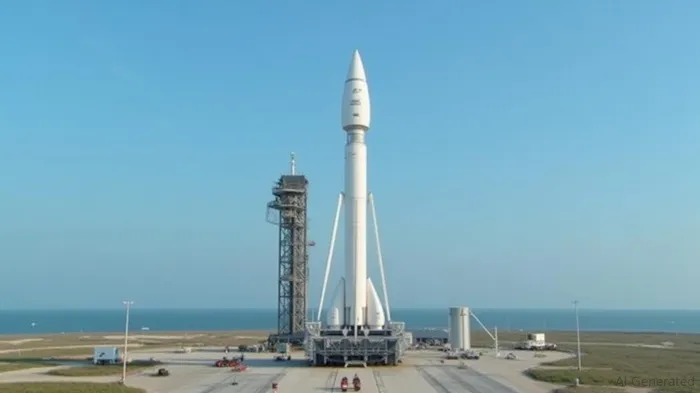
The Neutron rocket, designed as a reusable medium-class launcher, aims to fill a critical gap in the market. With a payload capacity of up to 15,000 kg to low Earth orbit (LEO) and support for lunar and interplanetary missions, Neutron positions Rocket LabRKLB-- to compete not just with SpaceX's Falcon 9 but also with emerging players like United Launch Alliance and Arianespace.
The rocket's reusable first stage, recoverable via a droneship named Return on Investment, adds to its appeal. If successful, this capability could slash launch costs over time, making Neutron a viable alternative for commercial and government customers alike.
Strategic Milestones: Progress and Pitfalls
Rocket Lab has made significant strides toward its Q2 2025 launch target:
- Hardware Qualifications: Both the first and second stages have passed structural and cryogenic testing. The second stage's avionics and guidance systems were validated under flight conditions.
- Engine Progress: The Archimedes engine, a key innovation, has completed hot-fire tests at 102% power, with 10 engines now in production for the first flight.
- Launch Site Readiness: Wallops Island's Launch Complex 3 is nearing completion, with its water deluge system operational.
However, challenges linger:
- Schedule Pressure: Delays in engine avionics integration and fairing mechanisms have pushed the launch to the second half of 2025, per recent updates.
- Infrastructure Hurdles: A shipping channel dredging project—needed to transport Neutron components—faces regulatory delays, potentially extending timelines.
- Funding Gaps: Rocket Lab's cash reserves ($504 million as of September 2024) may need to stretch further as costs could hit $300–$600 million more.
The Strategic Bet: Government Contracts and Market Share
The real prize for Rocket Lab lies in its government contracts. Being onboarded into the U.S. Space Force's National Security Space Launch (NSSL) Phase 3 program in early 2025 grants eligibility for up to $5.6 billion in national security missions. But there's a catch: Rocket Lab must demonstrate flight readiness by December 2025 to qualify. Miss this deadline, and it risks exclusion until 2027.
Meanwhile, a 2026 Air Force Research Lab contract to demonstrate point-to-point cargo delivery via Neutron's first stage underscores its potential for non-traditional missions. If successful, this could open new revenue streams beyond traditional satellite launches.
Risks and Competitor Pressures
The road is fraught with obstacles:
1. Technical Unknowns: While engines have passed tests, the Archimedes' long-duration performance and fairing recovery remain unproven in flight.
2. SpaceX's Dominance: With SpaceX capturing 86% of global launch revenue in 2024, Neutron must carve out a niche. Its $50–55 million price tag faces competition from Falcon 9's $30–$40 million price points.
3. Customer Commitments: Rocket Lab's only announced commercial customer, Japanese firm iQPS, faces its own financial challenges, raising questions about demand stability.
The Inflection Point: To Buy or Walk Away?
This is a classic inflection point scenario. Success here could:
- Unlock NSSL Phase 3 contracts, providing a steady revenue stream.
- Validate Neutron's reusability, driving down long-term costs.
- Attract commercial customers wary of SpaceX's monopoly.
Failure could:
- Trigger a liquidity crisis if funding isn't secured.
- Delay government contracts, reducing credibility in a capital-intensive industry.
- Weaken investor confidence, given Rocket Lab's $11.2 billion valuation hinges on Neutron's success.
Investment Advice: High Risk, High Reward
For investors:
- Bull Case: If Neutron launches by year-end and secures NSSL contracts, Rocket Lab's stock (RKLB) could see a 50–100% jump in 2026.
- Bear Case: A slip to 2026 or technical failures could cut the stock by 30–50%, with dilution risks from capital raises.
Recommendation:
- Aggressive Investors: Take a small position now (e.g., 1–3% of portfolio) with strict stop-loss limits. Monitor for two key milestones: 1) the launch date and 2) NSSL contract awards by early 2026.
- Conservative Investors: Wait until post-launch results and NSSL eligibility are confirmed before allocating capital.
Final Take
Rocket Lab's Neutron launch is a binary event: a triumph could cement its place in the $200 billion space economy, while a stumble might leave it fighting for scraps. For those willing to stomach volatility, this is a rare opportunity to back a potential disruptor at an inflection point. But remember: in space, there's no second chance to make a first impression.





Comentarios
Aún no hay comentarios