
Rocket Lab's Momentum and Catalysts for 2026 Growth
Rocket Lab (RKLB) has emerged as a defining growth story in the space economy, with its Q3 2025 results underscoring a trajectory of accelerating revenue, strategic innovation, and expanding market share. For high-conviction growth investors, the company's performance highlights a compelling alignment of financial strength, technological execution, and forward-looking positioning in the $500 billion global launch and satellite manufacturing sector.
Financial Performance: A Foundation for Sustained Growth
Rocket Lab's Q3 2025 financial results reflect a company in high gear. The firm reported record revenue of $155 million, , . This growth is not merely a function of volume but also of diversification: the Space Systems segment, which includes satellite manufacturing, , driven by critical contracts like the U.S. Space Development Agency (SDA) satellite program.
The company's liquidity position further strengthens its growth narrative. following an at-the-market offering, providing ample runway for R&D, M&A, and operational expansion. This financial flexibility is a critical advantage in an industry where capital intensity and long lead times often deter smaller players.
Technological Execution: Building a Launch and Space Systems Ecosystem
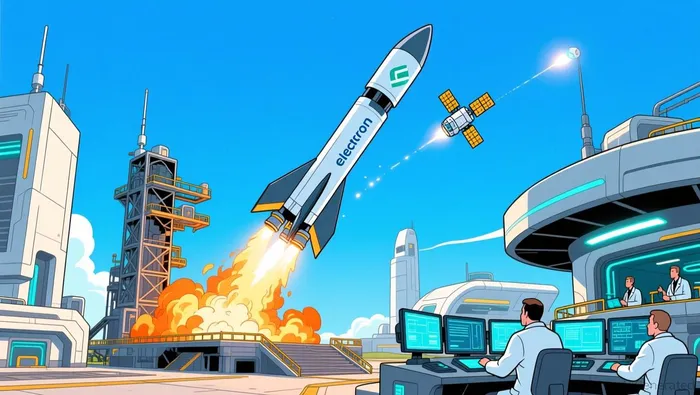
Rocket Lab's momentum is underpinned by its ability to execute on multiple technological fronts. The Electron rocket, its workhorse for small-sat launches, secured 17 dedicated contracts in Q3-a record for the platform. Meanwhile, the demonstrated progress in hypersonic and re-entry technologies, opening new revenue avenues in defense and advanced payload delivery.
The Neutron rocket, a heavy-lift vehicle designed to compete with New Glenn and Vulcan, is another key catalyst. With a revised schedule targeting arrival at Launch Complex 3 in Q1 2026, pending qualification testing, Neutron's development is now aligned with a credible timeline for first flight in late 2026. Rocket Lab's approach to Neutron backlog prioritizes schedule reliability over volume discounts, a strategic shift that signals confidence in its execution capabilities and positions the company to capture high-margin contracts in the medium-to-heavy launch segment.
Strategic Acquisitions: Expanding Capabilities and Market Reach
Rocket Lab's acquisition of , a provider of electro-optical and infrared sensors, , marks a pivotal step in vertical integration. By bringing sensor development in-house, Rocket LabRKLB-- strengthens its value proposition for government and commercial satellite programs, reducing dependency on third-party suppliers and enhancing profit margins. This move also aligns with the SDA's focus on resilient, sensor-equipped satellites for national security, a market Rocket Lab is now uniquely positioned to serve.
Backlog and Future Catalysts: A 2026 Growth Playbook
Rocket Lab has a clear runway for revenue generation. The SDA contract alone represents a multiyear, multi-billion-dollar opportunity, with Q3 results indicating strong program execution.
Looking ahead, 2026 will be defined by three key catalysts:
1. Neutron's First Flight.
2. Geost Integration: Operational synergies from the Geost acquisition could accelerate revenue growth in the space systems segment, particularly in defense-focused satellite manufacturing.
3. M&A Leverage: With $1 billion in liquidity, Rocket Lab is well-positioned to pursue strategic tuck-ins or partnerships that expand its technology stack or geographic reach.
Conclusion: A High-Conviction Bet on the Space Economy
For investors seeking exposure to the next phase of the space economy, Rocket Lab offers a rare combination of near-term revenue growth, technological differentiation, and capital-efficient scalability. Its Q3 2025 results confirm that the company is not just surviving in a competitive launch market but actively reshaping it. As Neutron approaches its first flight and Geost integration gains momentum, Rocket Lab's 2026 growth trajectory appears both robust and well-justified.





Comentarios
Aún no hay comentarios