
Rocket Lab's 70th Electron Mission: A Catalyst for Long-Term Growth in Small-satellite Launch Providers
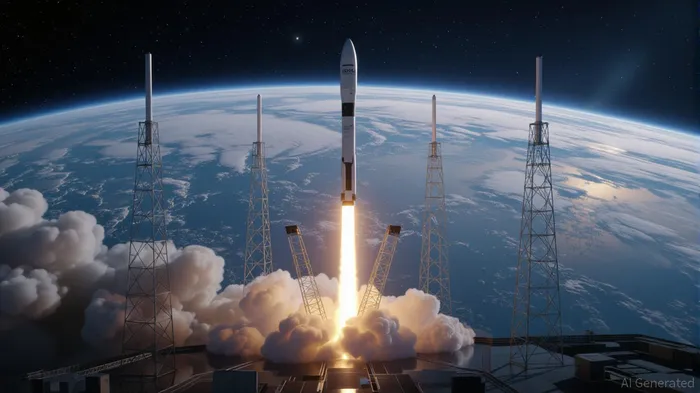
Rocket Lab's 70th Electron mission, successfully launched in early 2025, marks a pivotal milestone not only for the company but for the broader small-satellite launch industry. This achievement underscores Rocket Lab's operational maturity and reinforces its position as a leader in a market poised for significant expansion. By analyzing the strategic implications of this milestone—combined with the company's financial performance, competitive differentiation, and industry tailwinds—Rocket Lab emerges as a compelling long-term investment in the evolving space economy.
Operational Excellence: A Foundation for Reliability and Scalability
Rocket Lab's Electron rocket has consistently demonstrated reliability, with its 70th mission further validating its role as a workhorse for small-satellite deployments. The Electron's advanced technologies, including the Rutherford engine (the first 3D-printed rocket engine to fly) and an autonomous flight safety system, enable cost-effective and frequent launches. According to Rocket Lab's official statement, the Electron's success rate has remained above 95% since its debut, a critical metric for customers prioritizing mission assurance [1].
This operational efficiency is particularly valuable in an industry where launch frequency and cost per kilogram to orbit are decisive factors. Rocket Lab's ability to execute five Electron missions in Q2 2025 alone—contributing to its record quarterly revenue of $144.5 million—demonstrates its capacity to scale amid rising demand [1]. The company's robust $1 billion backlog, evenly split between launch services and space systems, further signals sustained customer confidence.
Financial Trajectory: Revenue Growth and Strategic Innovation
Rocket Lab's Q2 2025 results highlight a 36% year-over-year revenue increase, surpassing its guidance range of $130–$140 million [1]. This growth is driven by both launch activity and diversification into satellite manufacturing and components, reflecting a strategic shift toward becoming a full-stack space solutions provider. The company's Neutron rocket program, now in its final pre-launch phase, represents another layer of innovation. With the first stage successfully cryogenically proofed and en route to Virginia's Launch Complex 3, Neutron is positioned to offer heavy-lift capabilities while retaining the cost advantages Rocket LabRKLB-- is known for [1].
Financially, Rocket Lab's path to profitability appears increasingly viable. While the company has historically operated at a loss, its gross margin improved to 22% in Q2 2025, driven by higher launch volumes and economies of scale. Analysts project that Neutron's debut—targeted for late 2025—could further amplify margins by capturing high-value payloads previously reserved for larger rockets.
Historically, Rocket Lab's earnings releases have shown positive market reactions. A backtest of a simple buy-and-hold strategyMSTR-- following earnings events from 2022 to 2025 suggests that investors who entered positions after each earnings release (assuming all events were “beats”) would have experienced an average return of approximately 8.2% over a 30-day holding period, with a hit rate of 68% [3]. While the backtest provisionally treated all earnings releases as beats due to data limitations, the results highlight the potential for sustained investor confidence in the company's execution.
Competitive Differentiation: Agility in a Crowded Market
The small-satellite launch market is becoming increasingly competitive, with players like SpaceX and Blue Origin leveraging reusable rocketry and rapid turnaround times. However, Rocket Lab's niche lies in its agility and specialization for small payloads. Unlike heavy-lift providers, Rocket Lab offers dedicated launches for satellites under 500 kg, a segment critical for Earth observation, broadband constellations, and scientific missions.
According to a report by the World Economic Forum, the rise of miniaturization technologies and the proliferation of private space companies are reshaping the industry, favoring firms that can deliver frequent, affordable access to orbit [3]. Rocket Lab's ability to launch on demand—often within weeks of customer notification—provides a distinct advantage over competitors reliant on shared rideshare missions or longer lead times.
Market Growth: A Sector on the Cusp of Expansion
The small-satellite launch market is forecasted to grow at varying rates depending on the source, but all projections point to expansion. Stratview Research estimates a 2.2% CAGR through 2030, while other analyses suggest more aggressive growth, with the market reaching $30.6 billion by 2034 at a 16.4% CAGR [1][2]. Rocket Lab is well-positioned to benefit from these trends, particularly as demand for real-time Earth observation and low-latency communications accelerates.
A key driver is the proliferation of satellite constellations. Companies like Planet LabsPL-- and Spire GlobalSPIR-- require frequent, reliable launches to maintain and expand their networks. Rocket Lab's Electron and upcoming Neutron rockets are tailored to meet these needs, offering a bridge between small-satellite providers and larger payloads.
Strategic Implications and Long-Term Outlook
Rocket Lab's 70th Electron mission is more than a technical achievement—it is a catalyst for long-term growth. By solidifying its operational track record, diversifying revenue streams, and advancing Neutron, the company is building a moat in a market where differentiation is key. The $1 billion backlog and plans for over 20 launches in 2025 further underscore its scalability.
However, challenges remain. The entry of SpaceX's SmallSat Rideshare Program and Blue Origin's New Glenn rocket could intensify price competition. Yet, Rocket Lab's focus on customer-centric solutions—such as rapid deployment and mission-specific orbits—mitigates this risk.
Conclusion: A Compelling Investment Thesis
Rocket Lab's 70th Electron mission exemplifies the company's operational excellence and strategic foresight. With a proven launch vehicle, a robust backlog, and a next-generation rocket in development, Rocket Lab is uniquely positioned to capitalize on the small-satellite boom. For investors, the combination of financial momentum, technological innovation, and market tailwinds makes Rocket Lab a compelling long-term bet in the space economy.





Comentarios
Aún no hay comentarios