
Rocket Lab's 2026 Strategic Inflection Point: Neutron Launch, Defense Expansion, and Shareholder Dynamics
Rocket Lab (RKLB) stands at a pivotal juncture as it navigates the dual challenges of scaling its Neutron rocket program, capitalizing on a $816 million defense contract, and managing shareholder liquidity events. With 2026 poised to define the company's trajectory, investors must weigh the interplay of technical readiness, financial discipline, and market dynamics to assess whether Rocket LabRKLB-- can transition from a niche launch provider to a dominant player in the commercial and defense space sectors.
Neutron Rocket: A High-Stakes Bet on Reusability
Rocket Lab's Neutron rocket, a 13,000 kg payload-capable vehicle designed for reusability, has been delayed to mid-2026, pushed back from its original late-2025 window. The delay, attributed to extended ground testing of the Archimedes engine and complex integration of the fairing and flight software, underscores the company's "quality-first" approach. CEO Peter Beck has emphasized meticulous testing of subcomponents to minimize risks, particularly for national security missions. While this caution is prudent, the delay raises questions about Rocket Lab's ability to meet aggressive timelines in a competitive market. SpaceX's potential IPO in 2026 could further intensify pressure, as it may reprice the entire space sector and raise expectations for Rocket Lab's performance.
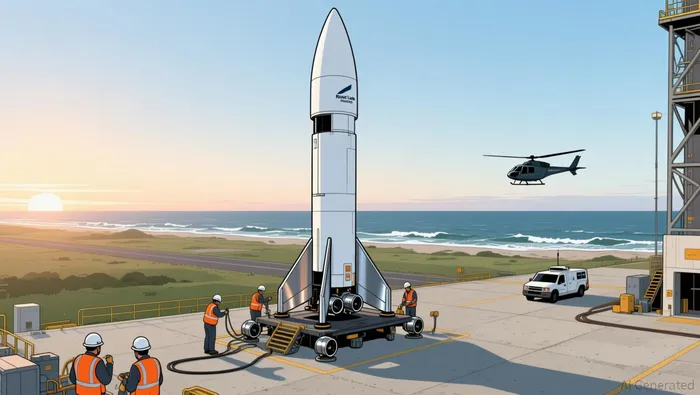 The Neutron's debut at Launch Complex 3 in Virginia, expected in Q1 2026, marks a critical milestone. Success here would validate Rocket Lab's pivot to larger missions, enabling it to compete for high-value commercial and defense contracts. However, the rocket's development cost has ballooned from $250 million to $360 million by year-end 2025, highlighting the financial strain of ambitious engineering goals.
Defense Expansion: A $816M SDA Contract and Strategic Validation
Rocket Lab's 816 million contract with the U.S. Space Development Agency to build 18 advanced missile-tracking satellites represents a transformative win. The contract, part of a 1.1 billion backlog through 2027, cements the company's role as a prime defense contractor and diversifies its revenue streams beyond launch services. This expansion into national security is particularly significant given the U.S. government's growing emphasis on space-based defense systems.
However, the absence of publicly disclosed payment schedules or milestones for the SDA contract introduces uncertainty. While Rocket Lab's Q3 2025 revenue hit $155 million-a 48% year-over-year increase-investors must scrutinize how the SDA contract's cash flow aligns with the Neutron program's capital demands. A mismatch could strain liquidity, especially if the Neutron's first flight encounters delays or technical setbacks.
Shareholder Dynamics: Insider Sales and Market Sentiment
Rocket Lab's 2025 financial performance-driven by 21 Electron launches and a booming Space Systems segment-generated 600 million in revenue. Yet this success has coincided with a wave of insider share sales. CEO Peter Beck sold 5.02 million shares, CFO Adam Spice offloaded 1.01 million, and COO Frank Klein filed to sell up to 100,000 shares. Non-executive directors, including Nina M. Armagno and Merline Saintil, executed multimillion-dollar transactions in late 2025.
While insider selling is not uncommon in high-growth companies, the scale and timing of these transactions have sparked investor skepticism. Social media chatter and analyst commentary suggest some view the sales as a lack of confidence in Rocket Lab's short-term prospects. Yet others argue that executives are monetizing gains from a stock that surged 182% in 2025, reflecting broader optimism about the company's inflection point.
Balancing Risks and Rewards in 2026
Rocket Lab's 2026 success hinges on three interdependent factors:
1. Neutron's Operational Readiness: A successful first flight would validate the company's reusable rocket ambitions and open doors to larger missions. However, any failure could erode investor trust and delay revenue recognition.
2. Defense Contract Execution: Delivering on the SDA contract will require disciplined project management and alignment with the Neutron's launch schedule. The lack of detailed payment terms remains a risk, though the contract's size alone strengthens Rocket Lab's balance sheet.
3. Shareholder Confidence: Insider sales must be contextualized within Rocket Lab's broader financial health. With a robust backlog and rising defense demand, the company's long-term fundamentals remain strong-even if short-term jitters persist.
Conclusion: A Calculated Gamble
Rocket Lab's 2026 inflection point is a high-stakes gamble. The Neutron rocket represents a leap into the next generation of launch vehicles, while the SDA contract signals its growing relevance in defense. Yet the company's ability to scale profitably will depend on its execution against these milestones and its management of shareholder dynamics. For investors, the key question is whether Rocket Lab's meticulous approach to risk-both technical and financial-can translate into sustained growth in a sector where patience is often rewarded.







Comentarios
Aún no hay comentarios