
Robotics' Inflection Point: The S-Curve from CES 2026 to Commercial Deployment
For years, humanoid robots at CES felt like carefully controlled previews of a distant future. Impressive, but safely confined to prototypes and concept demos. CES 2026 marked a clear break from that pattern. This year, humanoid robots didn't just pose for cameras or repeat scripted movements. They actually worked. From factory floors and hospital environments to home kitchens and service desks, companies showcased robots that are already shipping, already deployed, or scheduled for real-world rollout in 2026. What made this shift notable wasn't just better hardware, but clearer intent. Defined jobs, commercial customers, and production timelines. Here are the nine humanoid robots at CES 2026 that signaled the transition from experimental machines to practical, deployable co-workers.
The market is projected to grow from an estimated $38-66 billion within the next decade, fueled by a projected global workforce shortage of 85-100 million workers by 2030. This isn't just a tech story; it's an infrastructure play responding to a fundamental economic gap. The need is urgent, and the timing is right for robotics to step into the breach.
Key metrics for this adoption phase are now defined. We're moving past vague promises to concrete plans. For instance, Boston Dynamics confirmed that its new Electric Atlas will be deployed in 2026 at Hyundai's Metaplant in Georgia. Unitree Robotics is shifting toward a Robot-as-a-Service model, indicating readiness for global commercial deployment. Meanwhile, 1X has opened preorders for its NEO robot, with first customer deliveries planned for 2026. The focus is on multimodal reasoning capabilities that enable robots to operate in unstructured environments. Boston Dynamics' partnership with Google DeepMind to integrate Gemini Robotics AI is a prime example, aiming to enable Atlas to reason through complex instructions and work alongside humans without factory redesign.
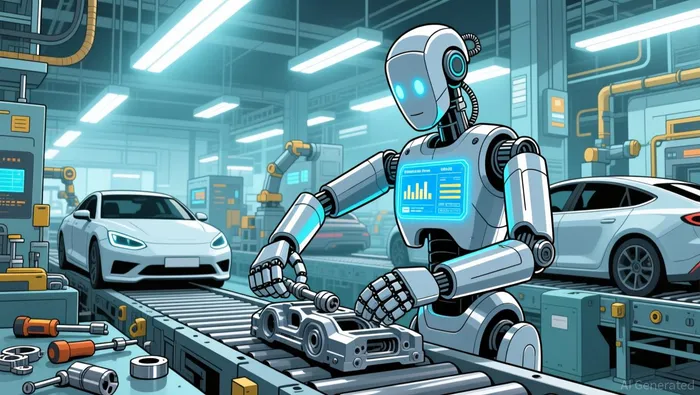 This is the inflection point. The exponential growth curve for humanoid robotics is beginning its steep climb. The early, slow phase of research and proof-of-concept is over. The next phase is about scaling production, proving reliability in real-world jobs, and building the commercial use cases that will drive the next decade of adoption. The rails are being laid.
The Infrastructure Layer: Chips, AI, and the Compute Stack
The robotics boom isn't happening in a vacuum. It's being powered by the same fundamental infrastructure that drove the AI revolution: a massive, ongoing buildout of compute power and data center capacity. This is the essential stack that enables the multimodal reasoning and real-time learning required for robots to move beyond demos into production.
The rally in chipmaking stocks at the start of 2026 is a direct signal of this infrastructure demand. Companies like ASML, Intel, and Micron Technology saw their shares surge as investors piled into the AI-fueled sector. This wasn't just a tech story; it was a bet on the physical rails needed for the next paradigm. The data center market is poised for another year of significant growth, with AI hyperscalers and data center operators racing to build the computing capacity required for the AI boom. This capacity is the necessary precursor to the massive training and inference workloads that advanced robotics will demand.
At CES 2026, this stack was on full display. Nvidia's keynote unveiled its new Vera Rubin platform, promising a 10x improvement in throughput and a 10x reduction in token costs. This isn't just for chatbots; it's the kind of raw performance that will be needed to train the complex models for physical AI. Similarly, AMD and Intel showcased their latest AI chips, explicitly targeting the robotics market. The message is clear: the underlying AI engines are now mature enough to support the next wave of applications.
The strategic partnerships emerging highlight the need for integrated value chains. Hyundai's plan to mass-produce Boston Dynamics robots is a prime example. This isn't just about selling a robot; it's about building a complete production and deployment ecosystem. It requires deep integration between the robot's hardware, its AI software stack, and the manufacturing infrastructure. This integrated approach is the hallmark of a technology that has moved past the prototype phase and is now scaling for the commercial S-curve.
The bottom line is that the robotics inflection point is a function of the compute stack's readiness. The chips are here, the data center capacity is being built, and the partnerships are forming. This foundational layer is what will determine the speed and scale of the adoption curve. Without this infrastructure, the promise of humanoid robots remains just that-a promise. With it, the exponential growth phase is fully enabled.
Catalysts, Scenarios, and What to Watch
The shift from CES prototypes to commercial deployments is the primary catalyst accelerating the robotics adoption curve. The next phase is about proving unit economics at scale. We are moving from pilot programs in logistics, manufacturing, and healthcare to actual production lines and service desks. This transition will be the true test of whether these robots can deliver a return on investment that justifies their cost. The first major deployments, like Boston Dynamics' Atlas at Hyundai's Metaplant in 2026, are the initial signals. Success here will validate the business model and open the floodgates for broader adoption. The key metric to watch is the pace of these commercial rollouts-how many units are deployed, in which sectors, and at what cost per unit.
Yet a persistent gap remains between advanced prototypes and cost-effective, reliable commercial products. This is the central risk that could decelerate the adoption rate. The hardware and AI are improving rapidly, but achieving the necessary combination of affordability, durability, and safety for unstructured environments is a formidable engineering challenge. As industry leaders noted, practical deployment and cost challenges persist alongside the optimism. If the first wave of commercial robots faces reliability issues or fails to meet promised performance benchmarks, it could create a credibility gap and slow investor and customer enthusiasm. The evolution of robot capabilities-specifically dexterity, autonomy, and task learning speed-will be the next set of adoption signals. A robot that can handle a wider variety of objects and adapt to new tasks without constant reprogramming is exponentially more valuable.
For investors, the near-term watchlist is clear. Monitor production milestones and customer contracts as concrete proof of scaling. Look for announcements of new deployment sites and volume commitments. Simultaneously, track the technical evolution: improvements in battery life, manipulation accuracy, and the transition from teleoperation to true autonomy. These are the metrics that will determine if the robotics S-curve is climbing steadily or hitting a plateau. The year 2026 is the inflection point; the next twelve months will show whether the foundation laid by CES is strong enough to support the exponential growth ahead.







Comentarios
Aún no hay comentarios