
The Robotaxi Revolution: Tesla's Disruptive Play vs. Waymo and Chinese Contenders
The autonomous vehicle (AV) market is entering a pivotal phase as TeslaTSLA--, Waymo, and Chinese competitors like Baidu and PonyPONY--.ai race to dominate the robotaxi sector. With global AV revenue projected to surge into the trillions by 2035, the stakes for investors are immense. This analysis evaluates Tesla's long-term investment thesis in the context of intensifying competition, regulatory hurdles, and divergent technological strategies.
Tesla's High-Risk, High-Reward Strategy
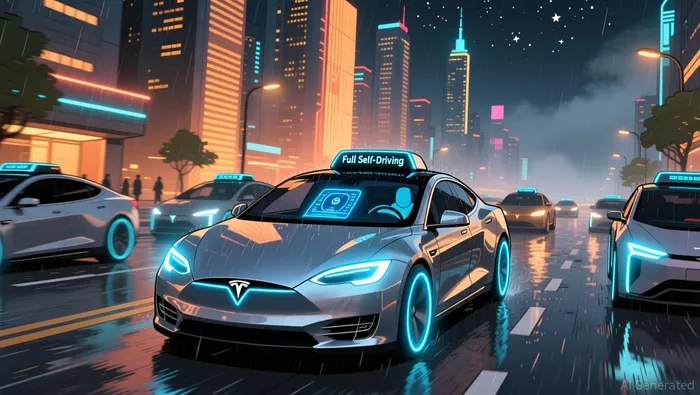
Tesla's approach to robotaxis is emblematic of Elon Musk's disruptive ethos. The company aims to launch a fleet of 1 million robotaxis by 2035, leveraging its Full Self-Driving (FSD) technology and a 10-billion-mile dataset. Internal testing in Austin has already surpassed 1,500 trips and 15,000 miles, but safety concerns persist. A crash rate of one incident per 40,000 miles in Austin-far higher than the human average of one per 500,000 miles-has drawn regulatory scrutiny. Legal challenges over overstated FSD capabilities further complicate Tesla's path.
Despite these risks, Tesla's vertically integrated AI-hardware-software system enables rapid iteration. Its Cybercab, slated for 2026 mass production, could disrupt the market if safety metrics improve. However, the company's valuation-trading at over 326x earnings as of late 2025 reflects speculative bets on future profitability rather than current operational metrics.
Waymo's Proven Operational Metrics
Alphabet's Waymo has adopted a disciplined, safety-first strategy. By late 2025, it delivered 450,000 weekly paid rides across five U.S. markets, with a crash rate 90% lower than human drivers. Its 2,500-vehicle fleet generates a $420 million revenue run-rate, establishing it as the current market leader. Waymo's pivot to generalizable AI systems-potentially reducing reliance on high-definition mapping-could close the technological gap with Tesla.
Yet, Waymo's profitability remains elusive. Alphabet's "Other Bets" segment, which includes Waymo, reported $344 million in Q3 2025 revenue but $1.43 billion in losses. Regulatory challenges, such as liability disputes in Texas, and inconsistent state laws, pose ongoing risks.
Chinese Contenders: Scalability and Cost Efficiency
Chinese firms are leveraging regulatory support and 5G infrastructure to accelerate AV adoption. Baidu's Apollo Go operates over 1,000 fully driverless vehicles, with a cost per mile of 35 cents-far below the U.S. average of $2. Its sixth-generation robotaxi model reduced BOM costs by 60% compared to prior versions, enabling breakeven unit economics in Wuhan. Apollo Go's expansion into Europe and the Middle East underscores its global ambitions.
Pony.ai, meanwhile, achieved city-wide unit economics breakeven in Guangzhou with its Gen-7 platform. The company's Q3 2025 revenue surged 72% year-over-year to $25.4 million, driven by a 200% increase in fare-charging revenues. Pony.ai's asset-light model and 70% cost reduction in autonomous driving kits highlight its operational efficiency.
Regulatory and Financial Challenges
Regulatory landscapes vary widely. Tesla faces legal hurdles in the U.S., including investor lawsuits over FSD disclosures, while Waymo grapples with liability ambiguities in Texas. In China, regulatory delays and public concerns over safety and data privacy have slowed progress, despite government backing.
Financially, Tesla's high-growth model contrasts with the more conservative approaches of Waymo and Chinese firms. While Tesla's potential scale is unmatched, its profitability hinges on resolving safety and regulatory issues. Chinese competitors, with their lower cost structures, and rapid deployment, are already capturing early market value.
Investment Implications
For investors, the key differentiators are safety records, cost per mile, and regulatory adaptability. Tesla's long-term thesis rests on its ability to iterate FSD rapidly and achieve mass production of Cybercabs. However, its current valuation reflects high expectations that may not materialize if safety incidents delay deployments or utilisation rates fall short.
Waymo's proven operational metrics and Alphabet's financial backing provide a safer bet, albeit with slower growth. Chinese firms like Baidu and Pony.ai offer compelling unit economics and scalability, particularly in markets with favorable regulations.
Conclusion
The robotaxi race is a global contest between innovation and execution. Tesla's disruptive vision could redefine mobility, but its success depends on overcoming safety, regulatory, and financial hurdles. Investors must weigh Tesla's technological edge against the proven operational metrics of Waymo and the cost efficiency of Chinese contenders. As the market evolves, a diversified portfolio that balances high-risk bets with established players may offer the best path to long-term value.







Comentarios
Aún no hay comentarios